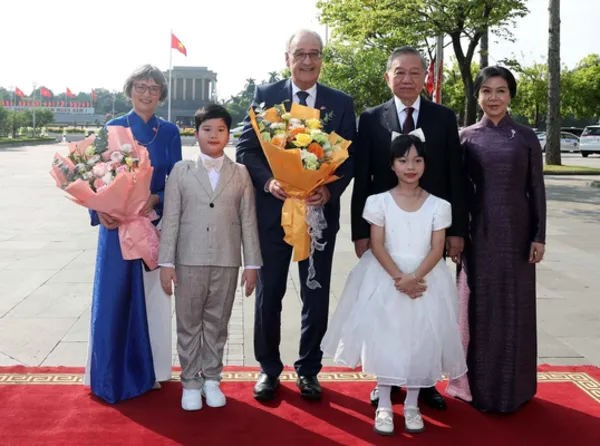
Top Vietnamese leader hosts welcome ceremony for Swiss President
1.
|
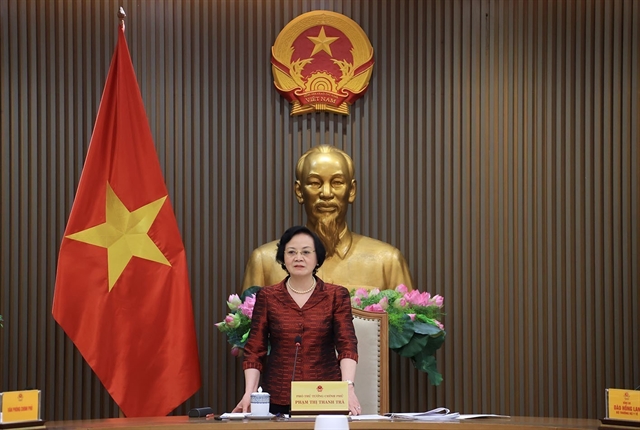
| Deputy Prime Minister Phạm Thị Thanh Trà chairs a conference reviewing the National Committee on the Elderly's work in Hà Nội on Monday. — VNA/VNS Photo Tuấn Anh |
HÀ NỘI — Deputy Prime Minister Phạm Thị Thanh Trà has ordered the Ministry of Health to urgently complete a review report on the implementation of the Law on the Elderly and propose an appropriate roadmap for its revision.
Trà, who chairs the National Committee on the Elderly, made the request on Monday morning at the Government Office while chairing a conference reviewing the committee’s work during the first seven months of 2026 and outlining key tasks for the months ahead.
Emphasising the importance of healthcare and the material, cultural and spiritual wellbeing of older people, Trà also required the health ministry to coordinate with relevant ministries and agencies to focus on medical examinations and treatment, health records and management for older persons, and the development of a geriatric healthcare ecosystem.
The ministry should also improve the quality of geriatric hospitals and rehabilitation facilities, she said.
Trà also asked the Ministry of Justice, the Ministry of Home Affairs and other relevant ministries and agencies to review policy documents and legal regulations concerning older persons, stressing that gender equality among older people must be taken into account in the law-making process.
To achieve breakthroughs in work concerning older persons, she called for greater awareness and responsibility across the political system and society as a whole in the new context.
A fundamental shift in the mindset of the political system and society is needed, from simply providing care to offering broader support, to affirm that older people are a national development resource and one of the driving forces for rapid and sustainable development, she said.
She also urged greater efforts to develop a sustainable 'silver economy' ecosystem, contributing to national economic development.
Relevant ministries and agencies were asked to coordinate with the Central Policy and Strategy Commission to develop a system of schemes and projects for the development of the 'silver economy', creating a foundation for institutionalising and promoting the ecosystem.
She also called on the Ministry of Foreign Affairs to participate in negotiations on an international convention on the rights of older persons and proactively prepare initiatives for an APEC 2027 side event focusing on the 'silver economy'.
The ministry should also strengthen research and assessment of global trends to provide timely advice and recommendations to competent authorities on policies concerning older persons, she said.
The Ministry of Finance was assigned to coordinate with relevant agencies to promote the socialisation of healthcare and nursing services for older people and develop policies to mobilise resources from older persons for socio-economic development.
Regarding information technology applications and data digitalisation, Trà told the Ministry of Public Security to work with the Vietnam Association of the Elderly and relevant agencies to accelerate digital transformation and complete the national database on older persons.
The database must be interconnected and synchronised with all relevant digital platforms and sector-specific databases, particularly those in the health sector, she said.
Sharing views raised at the conference on ensuring the security and safety of older people, particularly in cyberspace and telecommunications, she asked the Ministry of Public Security to take the lead in studying and developing a scheme that would both protect older persons and promote their role in cybersecurity and the country’s digital transformation.
|
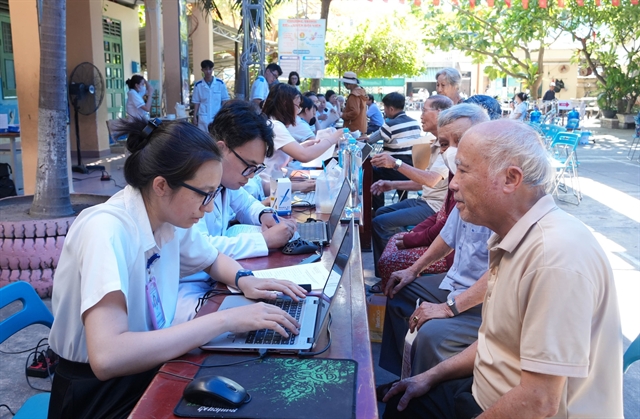
| Health sector staff give free check-ups for the elderly in the coastal central province of Khánh Hòa. — VNA/VNS Photo Phan Sáu |
16.5 million elderly people
Reporting at the conference, Deputy Minister of Health Nguyễn Thị Liên Hương said Việt Nam currently has nearly 16.5 million older people, including more than 7 million men, accounting for 42.78 per cent, and more than 9.4 million women, or 57.22 per cent.
During the first seven months of 2026, the scale and coverage of the social security system for older persons continued to expand and provide more comprehensive protection.
More than 3.53 million older people are currently receiving monthly social insurance benefits, including around 2.35 million pensioners and 530,000 people aged 60 and above receiving monthly social insurance allowances.
In addition, more than 1.2 million people are receiving preferential allowances for people with meritorious services to the revolution, while nearly 2.5 million are receiving social retirement pensions.
Healthcare for older persons has also recorded significant progress, with nearly 15.7 million older people holding health insurance cards.
The geriatric healthcare network has continued to expand, with seven specialised geriatric hospitals and around 155 central- and provincial-level hospitals having geriatric departments.
Nearly 80,000 cultural, arts, sports and physical activity clubs are operating nationwide, attracting more than three million older participants.
Reporting on the activities of the Vietnam Association of the Elderly, its Chairman Nguyễn Thanh Bình said older people have continued to affirm their role as a core and exemplary force in observing the law, preserving traditional cultural identities, and educating younger generations about morality and patriotism.
However, delegates also highlighted a number of difficulties and challenges. Việt Nam is ageing rapidly, placing significant pressure on the social security system, while infrastructure and services for older persons remain insufficient and fragmented.
Mechanisms to attract private-sector investment in nursing homes and rehabilitation facilities remain insufficiently attractive, while inter-sectoral coordination is, in some cases and localities, still largely formal rather than substantive. — VNS
 Society
 Society
 Society
 Society
 Society
 Society
 Society
 Society
 Society
 Society
 Society
 Society
 Society
 Society