 Society

Sơn La holds second coffee festival, targeting stronger businesses in future
1.
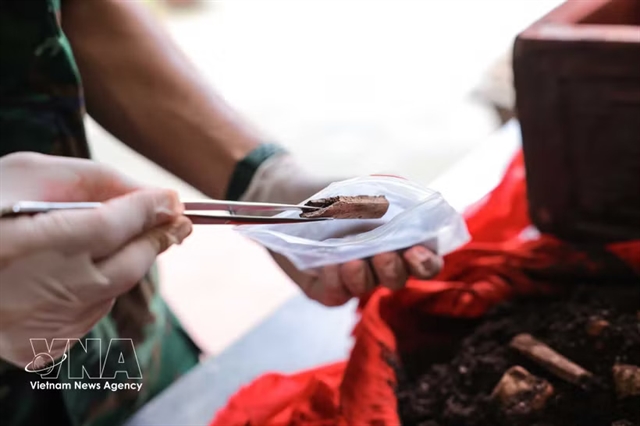 |
| Checking a DNA sample. VNA/VNS Photo |
TUYÊN QUANG — Police in the northern province of Tuyên Quang are about to launch a sweeping DNA collection effort, asking relatives of more than 3,900 unidentified martyrs to give samples between July 22 and 26, as part of a nationwide push to put names to the fallen.
Three main collection hubs will cover 18 spots across the province. This is a key mission within a 500-day national campaign to search for, recover and identify the remains of fallen soldiers, in the lead-up to the 80th anniversary of War Invalids and Martyrs’ Day (July 27, 1947 - 2027).
Mobile teams are rotating through communes and wards to handle the mass sampling, from Minh Xuân, Sơn Dương, Hà Giang 2, Vị Xuyên, Mèo Vạc, Đồng Văn, Hàm Yên, Chiêm Hóa, Yên Hoa, Yên Minh, An Tường, Bắc Quang, Quang Bình, Pà Vầy Sủ, Hoàng Su Phì, Quản Bạ.
The provincial police told specialised units and commune-level officers to work closely with the Department of Home Affairs and local authorities to verify data on the fallen and their families, update the National Population Database, and ready personnel, equipment, and logistics for the DNA collection.
So far, search teams have combed more than 935 ha, dug up almost 10,000 cu.m of soil and rock, and brought home 42 sets of remains. Mine and unexploded ordnance clearance teams have swept close to 3,000 ha, or 66 per cent of the target, while DNA samples have been collected from 84 unnamed graves at 10 martyrs' cemeteries.
The search for and recovery of martyrs' remains is moving deeper into vast, mountainous terrain. More than 73,000 ha of land still littered with unexploded ordnance left over from the war need to be cleared, and in many cases, the details of where soldiers were killed or first laid to rest are patchy at best.
In response, the provincial Party Committee has issued a decree urging all levels of the political system to fully support the search, recovery, and identification efforts to help the province meet national targets.
It’s also pushing for a bigger role for science and technology, including a dedicated database to guide search missions and make DNA testing standard for every newly found set of remains. The Việt Nam Fatherland Front, along with socio-political organisations, businesses, and ordinary citizens, is being asked to pitch in with technical know-how, equipment, and any scrap of information about missing soldiers and burial sites.
Local authorities have also been asked to spruce up martyrs' cemeteries and memorials, turning them into “red addresses” that keep revolutionary history alive and teach younger generations about patriotism.
Tuyên Quang has 24 martyrs' cemeteries holding 4,265 graves. DNA testing is required for 162 to confirm their identities. Of those, 84 graves have zero identifying details, and 78 others hold only partial clues. Sampling has to date wrapped up at 10 local martyrs' cemeteries. — VNA/VNS
Society
 Society
 Society
 Society
 Society
 Society
.jpg) Society
Society
 Society
 Society
 Society
.jpeg) Society
Society
 Society
 Society
 Society
 Society