 Society

LANDMARK Launches ‘Destination CENTRAL’: A District-Wide Invitation to Explore the Dynamism, Luxury, and Soul of Central
1.
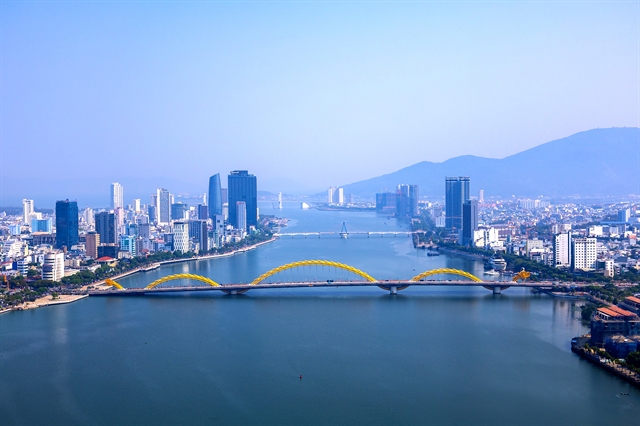 |
| Bridges spanning the Hàn River in the central city of Đà Nẵng. — VNA/VNS Photo Xuân Quý |
HÀ NỘI — After four decades of Đổi mới (Renewal), Việt Nam has undergone a fundamental shift in its development philosophy, moving away from a model centred on exploiting natural resources for economic growth towards one founded on sustainable development.
Trần Văn Miều, vice chairman of the Việt Nam Association for Conservation of Nature and Environment under the Việt Nam Union of Science and Technology Associations made the statement as the country gears up to celebrate 40 years of Đổi mới in December.
Miều said environmental protection and climate change response have become central national priorities, with the green transition serving as a key driver of development.
Việt Nam's strongest political commitment has incorporated international standards into its national development strategy, most notably its pledge to achieve net zero emissions by 2050 and its shift towards nature conservation coupled with equitable benefit sharing.
He also added that Việt Nam has successfully transformed itself into a socialist-oriented market economy, broken through years of international embargoes and steadily emerged as one of the region's fastest-growing and most deeply integrated economies.
These achievements have laid a solid foundation for the country's next stage of development, according to Miều.
Việt Nam's economy is now valued at more than US$514 billion, while annual GDP per capita has surpassed $5,026.
Alongside robust economic growth, the country has made significant progress in international integration, infrastructure development, poverty reduction and improvements in human development indicators.
Associate Professor Vũ Văn Phúc, chairman of the Scientific Council of the Institute of International Economics and Law under the Việt Nam Union of Science and Technology Associations and former Editor-in-Chief of the Tạp chí Cộng sản (Communist Review), agreed with Miều's assessment.
He said the country's strength, potential, international standing and global reputation have reached unprecedented levels after nearly half a century of reform.
From a poor and underdeveloped nation subjected to international isolation, Việt Nam has recorded remarkable achievements in economic growth and export expansion.
Phúc said the country’s social progress has been equally striking.
The multidimensional poverty rate has fallen to just 1.93 per cent, while the country's happiness index has improved significantly.
Việt Nam has signed or joined 17 free trade agreements, established diplomatic relations with 194 countries and developed comprehensive partnerships or higher-level ties with 42 nations, including 17 G20 members thus far.
“It has also forged Comprehensive Strategic Partnerships with all five permanent members of the United Nations Security Council,” Phúc added.
These results have strengthened both the country's capabilities and strategic position, providing a firm platform for Việt Nam to enter a new era of national development with confidence.
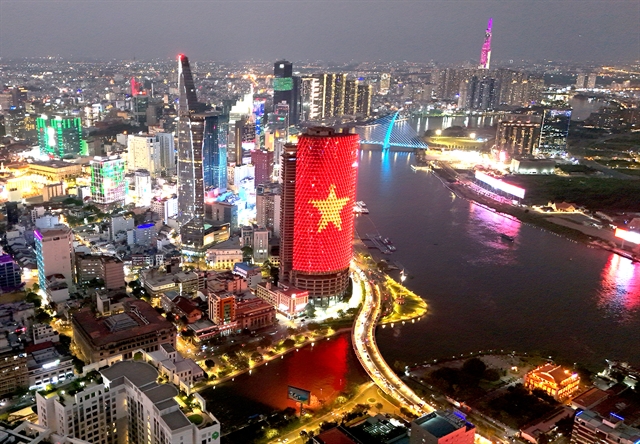 |
| A panoramic view of downtown HCM City from above. — VNA/VNS Photo Hồng Đạt |
Key lessons
Despite the country's accomplishments, rapid industrialisation has also brought considerable environmental challenges.
Miều identified five key lessons for balancing economic development with nature conservation.
The first is the need to strengthen the institutional and policy framework by clearly defining the responsibilities of Government agencies, businesses and citizens, while making greater use of economic instruments to promote green and circular economic models.
He also called for more effective public communication to raise awareness and encourage businesses and consumers to adopt more sustainable production and consumption practices.
Enterprises should be encouraged to prioritise environmentally friendly products and establish systems for collecting and recycling products at the end of their life cycle, Miều said.
Planning should also be based on the carrying capacity of ecosystems.
All development projects should undergo transparent environmental impact assessments that take account of ecosystem resilience and climate change scenarios.
At the same time, Việt Nam should accelerate the application of science, technology and digital transformation in environmental governance and biodiversity conservation.
Looking ahead, Miều said that fulfilling the country's strong environmental commitments would require a fundamental transition towards a circular economy, green infrastructure and digital transformation, with ecosystems placed at the centre of development.
Priority should be given to developing a low-carbon economy by mandating eco-design to reduce plastic waste while accelerating the shift to renewable energy.
Biodiversity conservation should adopt an ecosystem-based approach, with particular emphasis on restoring mangrove forests to enhance carbon absorption while strengthening natural defences against disasters.
Miều also highlighted the importance of digital transformation through the development of big data systems for environmental monitoring and early risk forecasting.
He further proposed launching green finance mechanisms to attract green foreign direct investment, expand green bond issuance and accelerate the development of the carbon credit market.
"People must remain at the heart of Việt Nam's sustainable development journey,” he said.
Only by closely linking the rights and responsibilities of every individual, community, school, religious organisation and business to the green transition can environmental protection deliver lasting results, he added.
For his part, Phúc proposed a package of comprehensive reforms to help realise Việt Nam's ambition of becoming a high-income developed nation with a modern economy, a civilised society, high living standards and international standing commensurate with its aspirations by 2045, marking the centenary of the country's founding.
He said that economic breakthroughs will lie in accelerating the transition to a new growth model driven by the digital, data and green economies, with science, technology and innovation serving as the primary engines of development.
Việt Nam should seize the opportunities presented by the Fourth Industrial Revolution, particularly in artificial intelligence and semiconductor technologies, to gain a competitive advantage and significantly increase the contribution of total factor productivity to economic growth.
At the same time, the country should continue refining its socialist-oriented market economy to unlock all available resources, foster the growth of domestic enterprises and safeguard national interests in an increasingly complex international environment.
In terms of institutions and governance, Phúc said the priority should be to further modernise the Party's leadership methods while building a streamlined, effective and efficient socialist rule-of-law State.
“Every law and policy adopted by the National Assembly should ultimately be judged against the core standards of people's safety, satisfaction and well-being,” Phúc said.
Mechanisms for direct public participation should be strengthened, combining the Party's vision with the aspirations of the people to create the collective strength needed for Việt Nam to stand shoulder to shoulder the world's leading nations. — VNS
Society
 Society
 Society
 Society
 Society
 Society
 Society
 Society
 Society
 Society
 Society
 Society
 Society
 Society
 Society