 Economy



Vietnamese Prime Minister meets Cambodian National Assembly President
1.
|
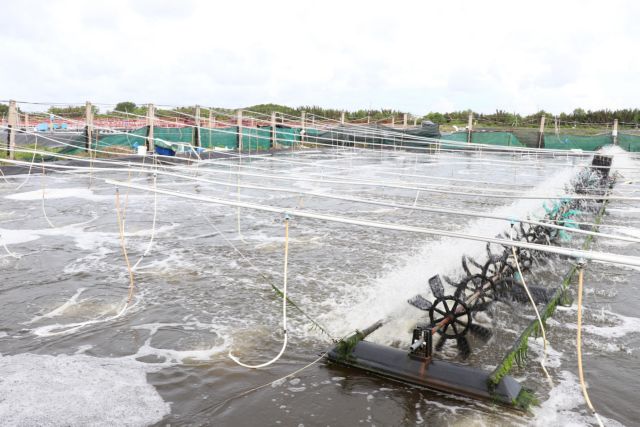
| A high-tech whiteleg shrimp farming model operated by Nguyễn Minh Vương in Vĩnh Long Province. —VNA/VNS Photo |
VĨNH LONG — High-tech shrimp farming is emerging as a key driver of agricultural growth as Vĩnh Long Province seeks to expand modern aquaculture across its coastal areas.
With a coastline stretching 130km, Vĩnh Long has significant potential for aquaculture development.
In recent years, high-tech shrimp farming has delivered higher productivity and stronger economic returns, prompting the province to accelerate investment in modern farming zones supported by infrastructure and advanced technologies.
Aquaculture remained one of the brightest performers in the province's agricultural sector during the first half of 2026.
Total aquatic output reached 477,110 tonnes, including 352,770 tonnes from aquaculture, accounting for nearly 74 per cent of total production, while capture fisheries contributed 124,340 tonnes.
Brackish-water shrimp remained the province's flagship aquaculture product, with farming covering 65,185 hectares, equal to 91.42 per cent of the annual target.
Output reached 162,900 tonnes, achieving 51.66 per cent of the year's goal.
High-tech whiteleg shrimp farming expanded to 6,325 hectares, producing more than 88,000 tonnes and further demonstrating the effectiveness of intensive, technology-based production systems.
Farmers invest in modern production
Trường Long Hòa Ward has become one of the province's leading aquaculture areas, with 4,418 hectares devoted to aquatic farming.
Many households have shifted to industrial-scale shrimp farming using advanced technologies, creating a more efficient and sustainable production model.
The ward currently has 265 intensive whiteleg shrimp farms covering more than 560 hectares.
Among the pioneers is Nguyễn Minh Vương, who has invested in nine ponds covering eight hectares.
His farming system operates through a closed production process, from water treatment and environmental management to disease prevention.
According to Vương, although high-tech shrimp farming requires substantial initial investment, it enables farmers to better control production conditions, reduce environmental risks, improve survival rates and significantly increase yields and revenue.
He described the model as particularly suitable amid increasingly unpredictable weather and disease outbreaks linked to climate change.
Another successful farmer, Lê Thanh Truyền, has operated a two-stage industrial whiteleg shrimp farming system since 2020. On his 12ha farm, around five hectares are used for five intensive ponds.
Each pond produces between seven and 10 tonnes of shrimp per crop. Under favourable conditions, each pond can generate profits of approximately VNĐ400 million (US$15,300) after a four-month production cycle.
Alongside intensive farming, Truyền maintains seven hectares of improved extensive black tiger shrimp farming, generating an additional annual income of around VNĐ100 million ($3,800).
These successful models illustrate how scientific and technological applications not only improve productivity and product quality but also encourage farmers to adopt more professional and commercially oriented production methods.
|
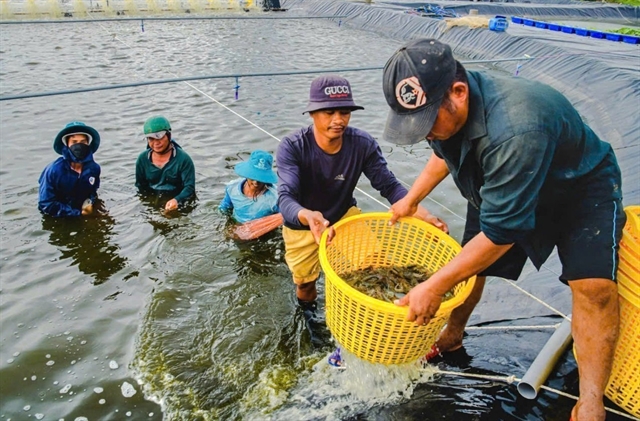
| Farmers harvest shrimp at a high-tech aquaculture farm in Vĩnh Long Province. —VNA/VNS Photo |
Expansion potential
The success achieved in Trường Long Hòa is encouraging neighbouring coastal localities to pursue similar development.
Long Thành Commune is considered one of the province's most promising areas for expanding intensive and high-tech shrimp farming.
According to Đào Văn Năng, Chairman of the Long Thành Commune People's Committee, fisheries generated approximately VNĐ461.45 billion ($17.7 million) during the first six months of 2026, accounting for more than 41 per cent of the commune's total production value and over 96 per cent of its agriculture, forestry and fisheries sector.
By the end of May, aquatic production reached 5,563.8 tonnes, equivalent to 58.77 per cent of the annual target.
Whiteleg shrimp remained the commune's main aquaculture product, with production reaching 2,889 tonnes, or 62.4 per cent of the annual plan.
High-density intensive shrimp farming has become the main growth engine. The commune currently has 166 farming households operating 467 ponds over approximately 416 hectares.
While the actual water surface used for intensive production covers just over 58 hectares, it generates around 4,630 tonnes, accounting for more than 83 per cent of the commune's total aquatic output.
Infrastructure remains key
Despite its strong performance, the province's aquaculture sector continues to face major challenges, including climate change, increasingly unpredictable weather, rising input costs, unstable market prices and persistent disease risks.
During the first half of 2026, more than 580 hectares of aquaculture were damaged, equivalent to about 2.78 per cent of the total farming area.
Most shrimp losses occurred between 20 and 50 days after stocking due to diseases such as white spot syndrome, red body disease, hepatopancreatic disorders and intestinal infections.
Long Thành still has around 1,500 hectares of improved extensive shrimp farming, of which roughly 750 hectares could be converted into high-density intensive farming if supporting infrastructure were upgraded.
According to Năng, converting those 750 hectares could increase annual shrimp production by around 8,300 tonnes, raising the commune's total output to approximately 13,000 tonnes a year and creating substantial additional income and employment for coastal communities.
However, inadequate infrastructure remains the biggest constraint.
Poor transport links continue to increase the cost of moving seedstock, feed and farming materials while limiting market access for harvested shrimp.
The commune has proposed provincial investment in the D3 and D4 roads, stretching about 15.36 kilometres to connect Long Thành, Đông Hải and Long Vĩnh, together with Road No. 6, approximately four kilometres long.
Local authorities believe these transport projects would not only support high-tech shrimp farming but also strengthen regional connectivity, eco-tourism, renewable energy development and the broader coastal economy.
Planning for sustainable growth
During a recent field inspection of coastal aquaculture projects, Vice Chairman of the Vĩnh Long People's Committee Châu Văn Hòa stressed that aquaculture development must be integrated into long-term regional planning, with synchronised investment in transport, irrigation and water supply systems.
He called on the agriculture sector and local authorities to prepare a comprehensive development plan identifying existing farming areas, high-tech production zones, traditional aquaculture and land available for future expansion.
According to Hòa, aquaculture has become one of the province's most important agricultural growth drivers.
He urged localities to shift from traditional agricultural production towards an agricultural economy focused on efficiency, value creation and stronger market linkages.
He also encouraged farmers to embrace digital technologies, scientific innovation and closer cooperation with businesses to improve competitiveness.
"Planning must come first. A comprehensive master plan will enable localities to attract investment, organise production more effectively and develop a modern, efficient and sustainable agricultural economy," Hòa said.
With successful high-tech shrimp farming models already delivering tangible results and considerable room for further expansion along its coastline, Vĩnh Long is well positioned to develop large-scale, modern shrimp farming zones.
As infrastructure bottlenecks are gradually addressed, aquaculture is expected to strengthen its role as one of the province's key agricultural growth pillars while supporting higher incomes and sustainable coastal development. —VNS
Economy
 Economy
 Economy
 Economy
 Economy
 Economy
 Economy
 Economy
 Economy
 Economy
 Economy
 Economy
 Economy
.jfif) Economy
Economy
 Economy