 Economy



Vietnamese Prime Minister meets Cambodian National Assembly President
1.
|
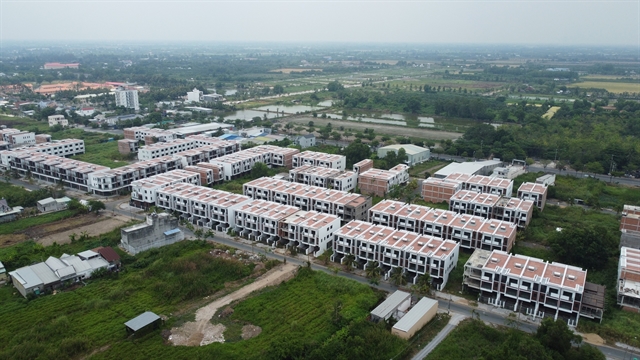
| A housing project under slow progress in Đồng Tháp Province. The Party Central Committee’s Resolution No. 21-NQ/TW dated July 28, is paving the way for the State to buy commercial housing projects that developers can no longer complete or transfer. — VNA/VNS Photo Nhựt An |
Compiled by Mai Linh
HÀ NỘI — Việt Nam is weighing an unprecedented pilot mechanism to unlock hundreds of trillions of đồng capital trapped in stalled property projects, a move that could reshape the real estate market by bringing frozen land, investment and unfinished developments back into use.
The mechanism, set out in the Party Central Committee’s Resolution No. 21-NQ/TW dated July 28 on orientations to amend the Law on Land and related laws, is paving the way for the State to buy commercial housing projects that developers can no longer complete or transfer, and create a publicly owned housing fund.
The purchase price will be based on the developers’ reasonable and properly accounted input costs while excluding speculative land-value gains.
The Politburo’s implementation plan has tasked the Government's Party Committee with preparing a resolution for submission to the National Assembly on piloting the mechanism before 2027.
“This is not a bailout for property developers, but a mechanism for the State to acquire assets for public purposes,” said property law expert Nguyễn Văn Đỉnh.
The mechanism allows the State to create public housing without starting the entire investment process from scratch, which can save years of land clearance, infrastructure preparation and construction, he said.
The banking system could also benefit if acquisitions help unlock collateral tied up in non-performing property loans.
Nguyễn Chí Thanh, permanent vice chairman of the Vietnam Association of Realtors, said converting suitable commercial sites into social or rental housing could help expand supply more quickly.
As commercial land is often in relatively good locations, converting such land to social or rental housing could be particularly valuable in major cities, Thanh said.
The practical challenge, however, could be more complicated because many stalled projects are not simply the result of developers running out of money.
According to Trần Việt Anh, vice rector of Hùng Vương University, converting those assets into public housing will require the Government to solve a much harder problem, that is determining how much the State should pay and ensuring that public funds are not misplaced.
Việt Nam’s property market has accumulated a large stock of unfinished or legally stalled projects after years of tighter credit for the sector, financial difficulties among developers and legal bottlenecks, creating a chain of economic costs, Việt Anh said.
It is critical to design a policy that can allow the State to acquire the real value already created in a project rather than compensate developers for speculative gains, he stressed.
By excluding such gains, the mechanism will make clear that developers remain responsible for their investment decisions, while the State would acquire only the underlying value that has actually been created and can be put to public use, he said.
For Việt Nam, the crucial safeguard will be how projects are selected and valued, Việt Anh stressed.
The mechanism should apply only to projects with clear legal status, adequate construction quality and compliance with approved planning. Valuations should be independent and transparent, based on properly documented and reasonable input costs while excluding differential land rent, to minimise the risk of losses to public assets.
In addition, acquired housing should be used for public-interest purposes, with priority given to social housing, rental housing and homes for workers, low-income households and public-sector employees rather than being returned to the commercial market.
The mechanism should remain exceptional and subject to strict eligibility criteria to prevent developers from assuming the State will absorb losses from unsuccessful investments.
The mechanism marks a potentially significant shift in the State’s role in Việt Nam’s property market. Rather than relying solely on planning, licensing and regulation to resolve stalled projects, the State could become a direct buyer of selected property assets when private capital has become trapped and the projects can serve a public housing purpose.
Việt Anh said: “The approach can address several problems at once, including idle land, unfinished projects and housing shortages, while helping stabilise the property market.
"But its success would depend on transparent valuations, strict project selection and safeguards against distorting market incentives.”
From land valuation to market discipline
|
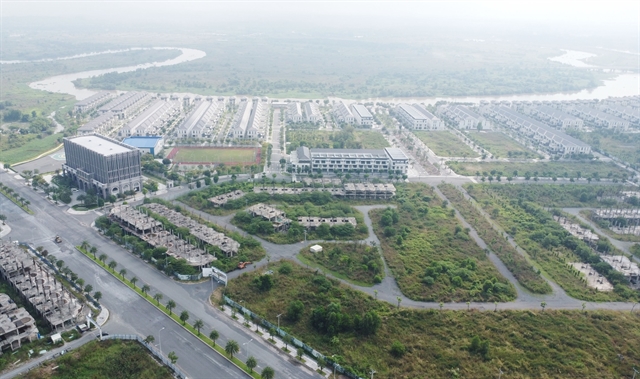
| An urban area in Đồng Nai City. The Government needs a valuation framework that can distinguish between actual investment costs, legitimate development expenditure and gains generated primarily by land-price speculation — VNA/VNS Photo Công Phong |
The policy's greatest long-term test may be behavioural rather than financial.
If developers believe the State will eventually purchase failed projects, the mechanism could weaken market discipline.
Đỉnh warned that companies could deliberately take excessive risks, speculate on land or pursue projects without adequate financial capacity if they expected the State to intervene later. That would turn a mechanism designed to clear existing blockages into a source of future distortions.
The pilot therefore needs to be narrow and selective.
Projects should not qualify simply because they are financially distressed. They should have demonstrable public value, viable legal status and a realistic path to being converted into public assets.
The State also needs to distinguish between a developer that has become unable to complete an otherwise viable project and one whose project is fundamentally flawed.
Valuation is also where the policy faces its biggest risk.
Resolution 21 requires the State to calculate reasonable and properly accounted input costs while excluding differential land rent. But determining what constitutes a reasonable cost can be difficult when projects have been delayed for years, construction costs have changed and financial structures involve multiple creditors and investors.
Trần Xuân Lượng, a real estate specialist at the National Economics University, said the lack of sufficiently detailed and standardised data could make the valuation process vulnerable to manipulation. The difference between paying too little and paying too much is substantial.
The Government therefore needs a valuation framework that can distinguish between actual investment costs, legitimate development expenditure and gains generated primarily by land-price speculation, he said.
Cao Thi Thanh Nga, chairwoman of Reatimes Holding, said projects should first pass a transparent set of eligibility tests, including clean legal status, conformity with approved planning and adequate transport and technical infrastructure.
She also called for independent valuation rather than relying on original investment costs or inflated prices.
Phan Viết Nuôi, chairman of NHQ Investment and Consulting JSC, said many projects have become unviable because of legal problems, while others are mortgaged to banks and have accumulated substantial interest costs.
Developers may also have raised funds through different channels, creating competing rights and obligations among banks, investors and homebuyers.
The Government will need to reassess the value of each project and determine how much of its existing debt and other financial obligations could be recognised in an acquisition.
Nuôi proposed establishing a national or local housing fund to finance purchases of eligible projects, which can potentially be financed through taxes on idle land, unused housing or second homes.
A critical thinking shift in land valuation

|
| Land plots in Đà Nẵng City. The State is moving to set land prices based on the development priorities of each period. — VNA/VNS Photo Quốc Dũng |
Under Resolution 21, the State will set land prices based on the development priorities of each period, while ensuring reasonable input costs for production and business, improving the economy's competitiveness and supporting socio-economic development.
This signals a fundamental shift in how land prices are determined, moving beyond the question of how to reflect market values towards using land costs as a tool to enhance competitiveness, support economic development and housing affordability.
Accordingly, the State will issue land price tables, adjustment coefficients (K coefficients), rates for land-use fees and land rents, and compensation rates tailored to different land types and market conditions. The aim is to ensure fairness, transparency and a balance of interests among the State, land users and investors.
The change comes just four years after Resolution No. 18-NQ/TW of 2022, which sought to strengthen market mechanisms in land management.
If Resolution 18 focused on bringing land closer to market-based principles, Resolution 21 raises a harder question: how can land markets serve development without allowing speculation, excessive costs and inefficient allocation of resources to undermine the economy’s competitiveness?
Experts said that a reasonable land price should not only reflect the value of land, but also allow people to access housing, businesses to invest in production and the State to mobilise resources for infrastructure development.
If implemented effectively, the framework could help stabilise the overall land-price level, curb speculative price surges and return land to its role as an input for production rather than primarily an asset for wealth accumulation.
But the new framework will require more than changes to pricing rules. Comprehensive land databases, transparent valuation methods, sufficiently independent valuation organisations, public scrutiny and effective accountability mechanisms will be essential to prevent greater State discretion from creating new opportunities for abuse.
Tax policy will also need to play a stronger role in curbing speculation, particularly by targeting idle land and inefficient land use, rather than placing most of the regulatory burden on land prices themselves.
Lê Hoàng Châu, chairman of the HCM City Real Estate Association, said the land-pricing system had for years tended to chase market prices rather than anticipate or properly reflect them.
Resolution 21 changes that approach by making clear that State-determined land prices should be based on data, scientific methods and stronger oversight, he said.
“If the State sets reasonable land price tables, K coefficients and land-use fee rates, it can better control input costs across the economy,” Châu said, adding that land-use fees were already too high.
The new policy direction suggests that the State is moving away from an objective of maximising land-use fees and rents and towards reducing input costs, creating more room for developers to build commercial housing affordable to middle- and lower-income households, Châu said.
He also stressed that the principles of Resolution 21 need to be fully incorporated into the amended Land Law and implementing regulations to avoid inconsistencies between laws, decrees and local rules. — VNS
Economy
 Economy
 Economy
 Economy
 Economy
 Economy
 Economy
 Economy
 Economy
 Economy
.jfif) Economy
Economy
 Economy
 Economy
 Economy
 Economy