 Politics & Law

Rural tourism needs to cash quantities over goods sold
1.

|
| National Assembly deputy Đỗ Đức Hiển of HCM City talks with reporters on the sidelines of the first extraordinary session of the 16th National Assembly in Hà Nội on Friday morning. — VNA/VNS Photo Hài Ngọc |
HÀ NỘI — The draft Law on Urban Development is expected to establish a stable, long-term institutional framework commensurate with the scale of HCM City as a mega-city, while removing bottlenecks related to decentralisation, resource mobilisation and the investment environment.
The assessment was made by National Assembly (NA) deputy Đỗ Đức Hiển from HCM City while speaking to reporters on the sidelines of the first extraordinary session of the 16th National Assembly in Hà Nội on Friday morning.
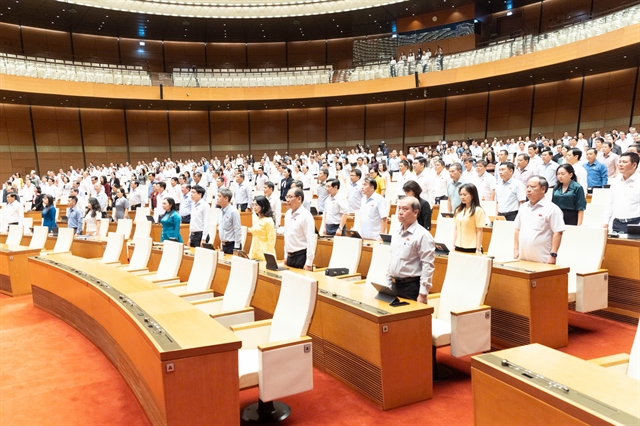
The NA heard proposals and reports on the draft Law on Urban Development; a draft law amending and supplementing several provisions of the Law on Radio Frequencies, the Law on Telecommunications, the Law on Electronic Transactions and the Law on Technology Transfer; and another draft law revising provisions in 10 laws governing administrative procedures and business conditions in the agriculture and environment sectors.
Hiển said the draft Law on Urban Development is designed to comprehensively decentralise powers to the HCM City administration.
With the exception of four key areas remaining under central government authority of national defence, security, religion and foreign affairs, the city would be empowered to decide on most implementation mechanisms and policies.
“The draft Law on Urban Development is designed to grant Hồ Chí Minh City greater autonomy in issuing legal documents to detail and implement the powers delegated to it,” Hiển said.
The legal instruments may prescribe procedures or regulations that differ from those issued by central ministries and agencies in order to better reflect local realities.
However, the final decision-making authority will rest with HCM City, strengthening the principle of local authorities making decisions, implementing policies and taking responsibility for the outcomes, he added.
Addressing urban development orientations, NA deputy Nguyễn Thanh Phương of the Mekong Delta city of Cần Thơ proposed studying legal mechanisms for the model of a 'city within a city', tailored to specialised urban areas such as science cities or education cities.
He said preserving the designation and status of a city would play an important role in enhancing connectivity, attracting investment and fostering the development of major science and technology hubs.
Regarding policies to attract talent and businesses, Phương stressed the need for a balanced approach, warning against concentrating overly generous incentives in a single region at the expense of neighbouring localities.
He said preferential policies should be calibrated appropriately and accompanied by synchronised infrastructure investment to ensure sustainable regional development.
Expressing strong support for the proposed amendments to the Law on Electronic Transactions, NA deputy Lê Thành Đông of the central province of Hà Tĩnh backed the removal of procedures for extending or modifying licences for trust service providers, replacing them with a streamlined licence reissuance process.
Đông added that the proposal would allow authorities to reassess business conditions at each licensing cycle while reducing overlapping administrative procedures for businesses, in line with the Government’s agenda on administrative reform and digital transformation.
He also called on the Government to issue detailed regulations requiring all licence reissuance procedures for trust service providers to be conducted electronically and to strengthen data sharing among relevant agencies to eliminate repeated requests for the same documentation.
Commenting on the draft amendments to the Law on Telecommunications, Đông proposed requiring telecommunications enterprises to share technical infrastructure data with local authorities in accordance with regulations issued by the relevant ministry.
He noted that the absence of a clear legal framework for infrastructure data sharing had hindered local authorities in carrying out regulatory duties and responding effectively to emergencies such as natural disasters, disease outbreaks and severe storms.
Regarding the proposed amendments to the Law on Technology Transfer, Đông welcomed the revisions, saying they were aligned with the Law on Science and Technology and reflected the Party's and Government's policy on decentralisation.
To further improve the draft, he recommended that the drafting agency continue reviewing the mechanism for establishing appraisal councils to ensure rigorous technology impact assessments while maintaining consistency with related legislation, including the Law on Intellectual Property and the Law on the State Budget. — VNS
Politics & Law
 Politics & Law
 Politics & Law
 Politics & Law
 Politics & Law
 Politics & Law
 Politics & Law
 Politics & Law
 Politics & Law
 Politics & Law
 Politics & Law
 Politics & Law
 Politics & Law