 Economy


HIIVE by fusion brings business and golf closer in Bình Dương
1.
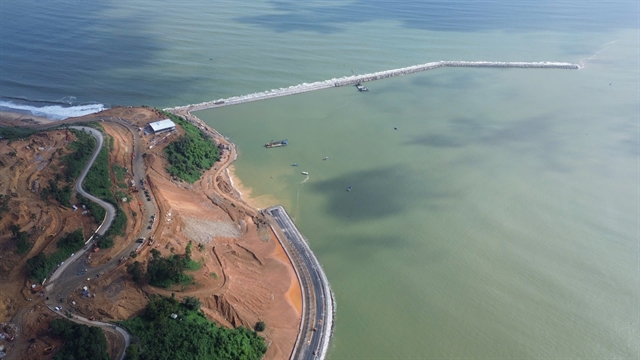 |
| A section of breakwater completed for the deep-sea Liên Chiểu Port project in Đà Nẵng City. Photo courtesy of Giao Liên |
ĐÀ NẴNG – The Đà Nẵng People’s Council has approved a VNĐ6.2 trillion (US$237 million) investment proposal for shared infrastructure items for the second phase of the Liên Chiểu Port project from 2026 to 2030, one of the area's key projects for driving breakthrough growth.
The decision, announced at the council’s session on August 6, provided that the second phase of investment will cover a 920m-long breakwater, a 5.73km-long internal transport system, two liquid bulk terminals, and three piers for oil and gas tankers.
According to the central city's Management Board for Priority Infrastructure Investment Projects, the first phase of the project has completed 1.17km of sea dike and the dredging of a 7.3km-long shipping channel, as well as a 2.96km-long six-lane internal road system and a series of power and water supply systems, which cost VNĐ3.4 trillion ($130 million).
The Đà Nẵng People’s Council also asked relevant agencies to review relevant regulations and safety requirements relating to environmental protection, mineral exploitation and fire prevention and fighting on the Làng Vân Project, or Vinhomes Hải Vân Bay, as well as the Nam Ô Urban Project and the first functional zone of the Free Trade Zone (FTZ).
It also urged land clearance for an internal railway system connecting the planned Kim Liên cargo station and the under-construction Liên Chiểu Port, along with promoting investment in the FTZ's first functional site.
In April, a joint venture between Hateco Group and APM Terminals B.V. of the Netherlands began construction of the Liên Chiểu Container Port with an estimated total investment of VNĐ45.3 trillion ($1.7 billion).
The port, which is designed to handle vessels of up to 18,000 TEUs, is seen as one of the most important projects in the city's master plan, linked to the newly established FTZ.
Liên Chiểu port has been designed as a major commercial port in the region and one of the key gateways to the East Sea (known internationally as the South China Sea) from the sub-Mekong region. It is also expected to serve as an international entrance port and a major international-standard logistics centre for Việt Nam, ASEAN and the Asia Pacific region. VNS
Economy
 Economy
 Economy
 Economy
 Economy
 Economy
 Economy
 Economy
 Economy
 Economy
 Economy
 Economy
 Economy
.jpg) Economy
Economy
 Economy