 Society

LANDMARK Launches ‘Destination CENTRAL’: A District-Wide Invitation to Explore the Dynamism, Luxury, and Soul of Central
1.
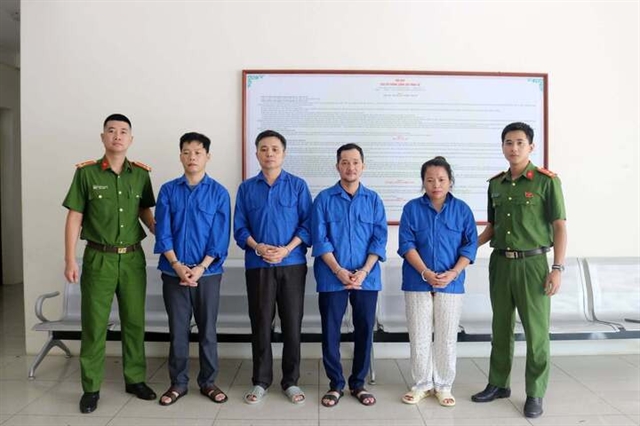 |
| The suspects are detained by the police. — Photo courtesy by the Thái Nguyên Police |
THÁI NGUYÊN — Police in the northern province of Thái Nguyên smashed an illegal digital currency ring, which is alleged to have appropriate funds totalling VNĐ100 billion (US$3.8 million) from more than 3,000 unsuspecting victims nationwide.
Lê Trung Hiếu, 42, from Hoà Khánh Ward, the central city of Đà Nẵng City is accused of being the ringleader and is being prosecuted for 'using computer networks, telecommunications networks and electronic means to appropriate property'.
Hiếu, along with three other people, are also facing clams of 'violating regulations on business activities under the multi-level marketing model'.
Thái Nguyên Police coordinated with other forces to launch operations to dismantle multiple facilities belonging to the virtual currency network across the country, including the command and control centre of the criminal ring.
To date, more than 3,000 victims nationwide have invested in Hiếu’s ecosystem, with a total amount of VNĐ100 billion (US$3.8 million).
From late last year, through monitoring the situation in localities and in cyberspace, investigators discovered suspicious signs relating to the promotion and sale of digital shares in the Canvanex ecosystem in the form of investment in the 'CVX digital currency', allegedly based on Blockchain technology, which attracted many people across the country to participate and contribute investment capital.
In Thái Nguyên Province, the suspects established multiple branch companies and frequently organised meetings, conferences and seminars, including events where more than 700 people were persuaded to attend.
Under the philosophy 'Wholehearted service today for lasting happiness of future generations', the suspects sold investment packages in digital shares to mobilise public participation, promising that, after 365 days, the profits could reach several dozen, even several hundred times the original value, with sustainable benefits extending to their children and grandchildren.
During further verification, the police obtained information and documents indicating that the Idea & Start-up technology ecosystem showed signs of appropriating assets of an exceptionally large value through investment in digital shares of the Canvanex ecosystem (CVX digital currency) via the website http://id.canvanex.com.
The Criminal Police Division of the Thái Nguyên Police established special case 326C in order to pursue the investigation.
This type of crime involves the use of high technology; most of the suspects are well-educated, and their activities are extremely sophisticated and cunning, hiding behind the façade of businesses and operating in a highly organised manner, causing considerable difficulties for investigators and detectives.
From multiple sources of information, Hiếu was identified by the police as the ringleader.
Hiếu set up four companies in An Khánh Commune, Hà Nội, where he served as chairman of the board of directors, general director, founder and legal representative, thereby creating a lawful cover to mobilise capital illegally in the form of investment in the 'CVX digital currency' on the Canvanex 'exchange'.
The main operational base of the suspects was located in Hoà Khánh Ward, Đà Nẵng City.
On May 28, the Thái Nguyên Police, in coordination with units from the Ministry of Public Security and police in provinces and cities nationwide, simultaneously deployed working groups to arrest Hiếu and other suspects, and to search all headquarters of the criminal network across the country.
In Hoà Khánh Ward,police discovered 31 individuals working as staff in the system and seized 66 computer sets, including server systems running the Canvanex electronic 'exchange'and computers operating the network; two cars; five land use right certificates belonging to Hiếu; and numerous relevant documents.
According to his statements, Hiếu was the head of the ecosystem. Beneath him were senior leaders selected by Hiếu from among knowledgeable individuals to direct and manage regions and areas.
In localities, PGC companies were established (with more than 30 PGC companies nationwide), which signed contracts with Hiếu’s companies to develop markets.
At the lowest level were group heads who continued to expand subordinate branches, receiving commissions, performance bonuses and other benefits based on the number of investors they brought in.
To attract investors, Hiếu instructed senior leaders to establish lawful enterprises, develop digital products, apply technology and regularly organise conferences, seminars, promotional events, live-streamed sessions and grand launches of projects in many provinces and cities nationwide.
They also held ceremonies to honour prominent leaders and entrepreneurs within the ecosystem, thereby creating credibility to mobilise capital.
Local PGC companies promoted products and developed markets under a multi-level marketing business model and enjoyed percentage-based commissions.
Further investigation is underway.
The Thái Nguyên Police calls on organisations and individuals involved, victims, persons with related rights and obligations, and those with knowledge of the case to proactively provide information or come directly to work with the provincial Criminal Police Division to clarifying the case. — VNS
Society
 Society
 Society
 Society
 Society
 Society
 Society
 Society
 Society
 Society
 Society
 Society
 Society
 Society
 Society