 Society
Vietnamese Prime Minister meets Cambodian National Assembly President
1.
|
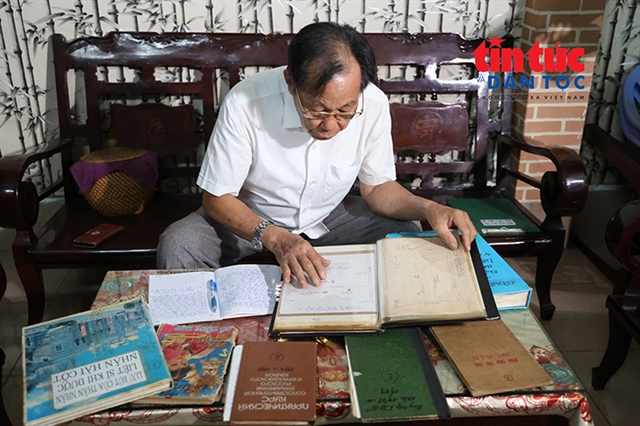
| Dr Trần Văn Bản with his collection of yellowing notebooks. — VNA/VNS Photos Mạnh Linh |
Mạnh Linh
HÀ NỘI — More than 50 years after reunification, Dr Trần Văn Bản still returns to former battlefields to search for comrades who never came home.
For the past 47 years, the 82-year-old former military doctor has devoted his life to honouring a wartime promise to bring the fallen back to their families.
Age has slowed him. Shrapnel remains embedded in his body, and changing weather leaves him in constant pain. But whenever word reaches him of a newly discovered mass grave, traces of an old battlefield or the possible resting place of fallen soldiers, he sets off once again.
"It is not a journey," he told Vietnam News Agency. "It is my return."
For him, returning means revisiting the forests of Củ Chi, Dầu Tiếng, Bến Cát and Tây Ninh – landscapes once scarred by war. It means returning to memories of comrades whose names, faces and final battles remain etched in his mind.
Dr Bản enlisted in 1967, leaving his hometown of Vĩnh Bảo Commune in Hải Phòng City. After training in the Yên Tử mountains of Quảng Ninh Province, he was deployed to the southern battlefield.
His unit eventually numbered nearly 1,000 officers and soldiers. By the time the war ended in 1975, only about one in 10 had survived.
The figures have haunted him ever since.
Before each battle, the young soldiers would joke grimly among themselves: "If you survive, take my body home to my mother."
None imagined those words would become a lifelong vow.
He still remembers fellow soldiers from Hải Phòng who had barely reached adulthood. Some had not yet married. Others carried letters to their families that were never posted. They entered battle expecting to return after victory, but many were left in forests, beside canals, in bomb craters or makeshift field hospitals.
|
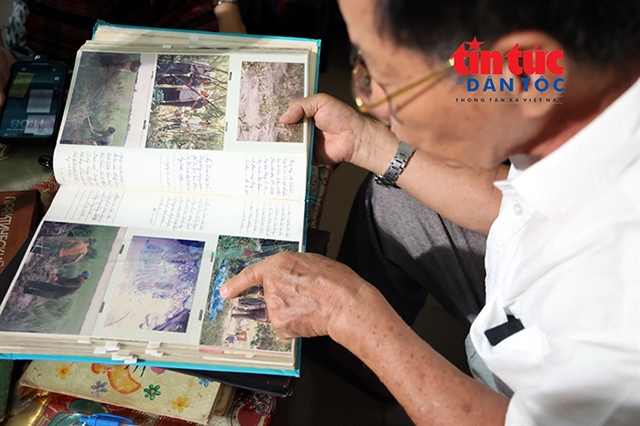
| Early photos and diary pages from Dr Bản’s first forest searches for comrades are carefully preserved. |
After he was seriously wounded in 1970, Dr Bản was assigned to the Military Medical Department of the Sài Gòn-Gia Định Military Region, where he compiled records of wounded soldiers and those killed in action.
Whenever he learned where soldiers had been buried, he carefully recorded the location, sketched maps and noted landmarks. He believed that one day, when the war was over, those records would guide someone back.
When peace arrived, others rebuilt their lives. Dr Bản began a different mission.
In March 1979, armed with an ageing bicycle and a small bag of boiled coix seeds, he set out on his first search, cycling up to 80 kilometres to former battlefields. Where canals blocked his path, he fashioned makeshift floats from tree branches and plastic bags, swimming across while pulling his bicycle behind him.
They led him to the graves of two close friends from his hometown – one killed in 1969 and another during the 1968 Tết Offensive.
When their remains were finally returned home, he knew he had kept one promise, but he also realised there were thousands more waiting.
More than four decades later, Bản's greatest possession is neither his worn backpack nor his military maps, but a collection of yellowing notebooks.
He calls them "the greatest asset of my life".
In his modest home in HCM City, the notebooks chronicle nearly every search since 1979. Their pages record dates, locations, witness testimonies, excavation plans, sketches of burial sites, artefacts recovered and the outcome of each mission. Every set of remains is numbered and cross-referenced for future verification.
Bản believes that while human memory fades with time, the written record cannot afford to be wrong.
That is why he never rushes to excavate after receiving new information. Instead, he searches first for witnesses – veterans who fought in the battle, villagers who saw soldiers buried or elderly residents who still remember an old tree, a canal or a long-forgotten well after more than 50 years.
Each recalls only fragments.
"My job is to put those fragments together," he said.
While assisting the family of a fallen soldier in Long An Province, he interviewed eight veterans who had buried their comrade decades earlier.
"I prepared 18 questions and interviewed each person separately about the location, terrain, landmarks and direction of the burial," he said. "Twelve answers matched. That was enough to pinpoint the site."
|
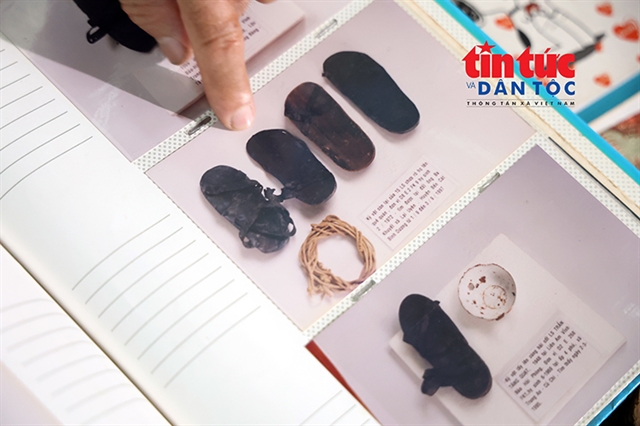
| Every recovered artefact stands as an invaluable witness to history. |
Once a likely location has been identified, his team digs narrow trenches rather than excavating large areas, allowing them to search methodically without disturbing unnecessary ground.
"Every time we find another comrade, I feel I have honoured another promise," he said.
During one survey of abandoned village wells, many of which had become mass burial sites after fierce fighting, search teams recovered more than 400 sets of remains in just two months.
Another excavation in 1994 uncovered the remains of 43 soldiers from 13 wells in what was then Tân Bình District. They had died during the 1968 Tết Offensive.
Each time remains emerge from the earth, he knows that beneath every layer of soil lie not only bones, but the unfulfilled dreams of young men whose lives ended before they had truly begun.
Yet the most moving moment comes not at the excavation site. It comes when the soldiers finally return home.
Some sons and daughters are already in their sixties before they can embrace the remains of the fathers they never knew. Some wives, their hair now white, have waited decades to welcome their husbands home at last.
Many families no longer have a single photograph of the relative they lost in the war. So when they receive a comb, a pen, a canteen, a pair of rubber sandals or a fragment of a hammock recovered alongside the remains, they hold them as priceless keepsakes.
For Dr Bản, the tears that accompany such reunions after decades of waiting are the greatest reward.
According to his own records, he has personally verified more than 2,300 burial sites, helping authorities recover thousands of fallen soldiers. Of these, he has directly assisted in returning the remains of 134 soldiers to their hometowns and families.
He dismisses any claim that the credit is his alone, adding that it belongs to the veterans, local residents, the military and all who never lost hope of bringing the fallen home.
The doctor has also helped more than 200 families identify relatives buried in military cemeteries. Every case is carefully documented, from witness statements and excavation records to the signatures of family members after the remains are handed over.
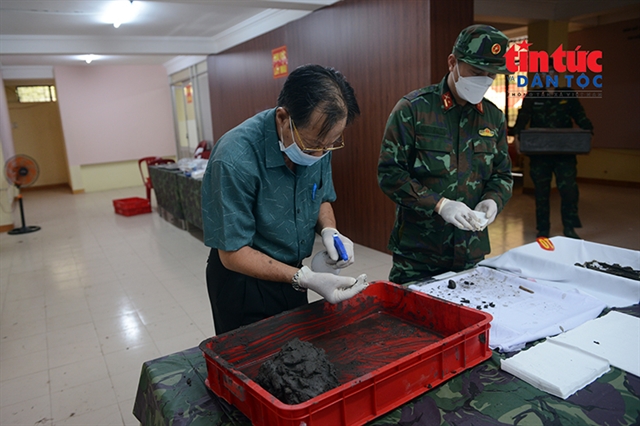
|
| Dr Bản taking part in the search for fallen soldiers’ remains at Lê Thị Riêng Park, HCM City. |
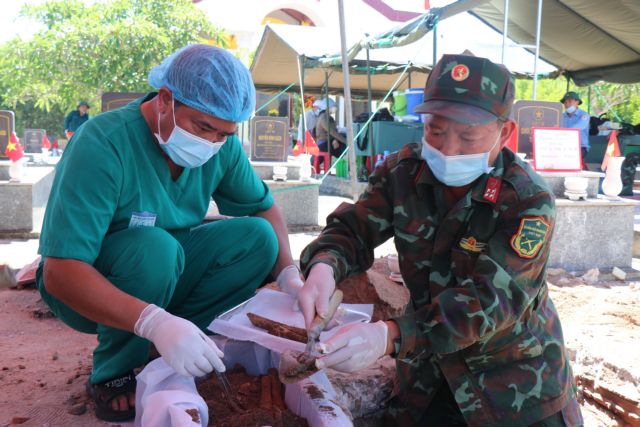
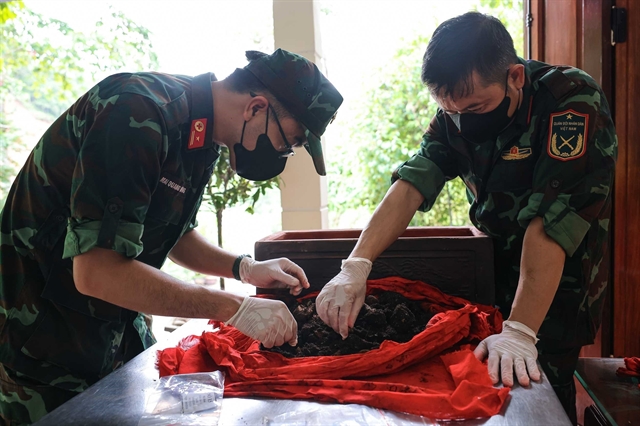
In early July, Dr Bản was again at work, this time at the excavation of a wartime mass grave in Lê Thị Riêng Park in HCM City.
He no longer digs as he did in his youth; instead, the veteran quietly watched as each layer of earth was removed.
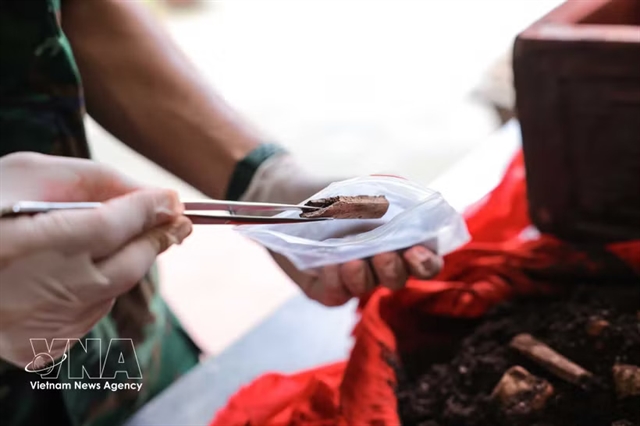
Dr Bản studied every fragment of bone brought from the excavation, gently examining it before passing it to forensic experts for sampling and identification.
More than four decades in the field have taught him to recognise even the smallest traces left behind.
"Other people see old bones," he said softly. "We see our comrades."
"When they went to war, they were strong young men. Now they return like this. No one can look at them without sorrow."
That sense of loss has driven his long campaign for wider DNA testing of mass graves and unidentified remains.
Recovering the dead, he said, would be only half the mission. What families would want most is to know exactly where their loved ones are, so they can bring them home or at least restore their names after decades of being unknown.
He believes advances in DNA technology, combined with wartime records, burial maps and historical archives, could identify many soldiers still resting in anonymous graves, including those buried near Tân Sơn Nhất Airport and the former Tân Bình Martyrs' Cemetery.
At 82, his greatest worry is time. His comrades are in their late seventies, eighties and nineties. Each year eyewitnesses pass away, taking unrecorded memories with them.
The landscape has shifted too, as forest tracks became highways, canals vanished and trees and landmarks that once guided soldiers back to burials disappeared. Unless those who remember speak now, many graves may never be found.
That is why he writes everything down. His notebooks list burial sites, excavation notes and every soldier from his hometown of Vĩnh Bảo, Hải Phòng, with careful entries: killed in action, wounded, missing, recovered or still unaccounted for.
He recalls nearly every story and has escorted comrades’ remains home after decades.
Meanwhile, others survived with lasting injuries.
One veteran, severely brain‑injured, spent years in rehabilitation. Dr Bản fought to bring him home and helped rebuild his life.
“Remembering comrades isn’t only about those who died,” he said. “It’s also about caring for those who survived.”
After more than 40 years, his greatest reward is not medals, but the sight of families reunited after long uncertainty. With satellite imagery, remote sensing, AI and DNA analysis now aiding the search, he believes the next generation can finish what ageing veterans began.
“They’re still waiting for us,” he said.
His promise endures: that no soldier will be left nameless and no sacrifice forgotten. — VNS
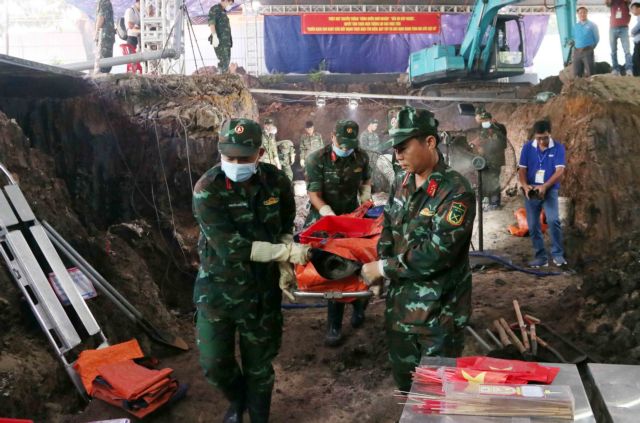
|
| The Martyrs’ Remains Recovery Team of the HCM City Command has recovered 93 sets of remains, two collective sets and several sets of artefacts at Lê Thị Riêng Park as of July 15. — VNA/VNS Photo Xuân Khu |
Society
 Society
 Society
 Society
 Society
 Society
 Society
 Society
 Society
 Society
 Society
 Society
.jpg) Society
Society
 Society
 Society