 Society

Việt Nam seeks to help businesses adopt greener production
1.
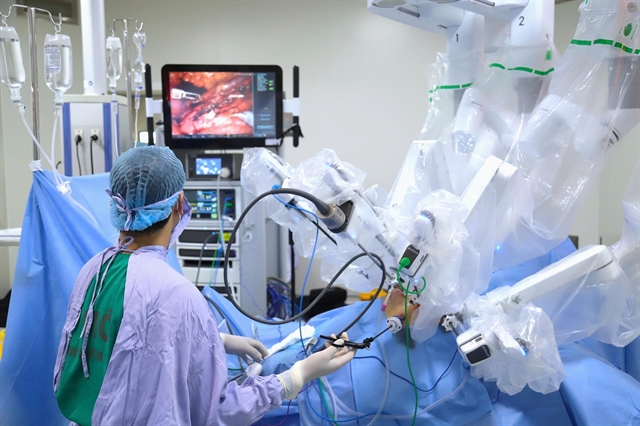 |
| A doctor performs a colorectal cancer surgery with the assistance of a robot. — Photo courtesy of K Hospital |
HÀ NỘI — With its ability to perform precise manoeuvres within narrow anatomical spaces, minimise invasiveness and maximise organ function preservation, robot-assisted laparoscopic surgery is marking a new milestone in cancer treatment in Việt Nam.
Doctors at Việt Nam's National Cancer Hospital (K Hospital) have successfully treated a series of complex cancer cases – including cancer in the oesophagus, rectum, kidney, cervix and prostate – using this technology, demonstrating the potential to expand the application of robotics in oncological surgery in Việt Nam.
To standardise and expand the application of this technique, K Hospital organised its first 30-day basic robot-assisted laparoscopic surgery training course, attended by surgeons from K Hospital and Việt Tiệp Friendship Hospital (in Hà Nội), and Chợ Rẫy Hospital and Hồ Chí Minh City Oncology Hospital (in HCM City).
Prof. Dr. Lê Văn Quảng, K Hospital Director, said that robot-assisted surgery is considered the pinnacle of modern surgical technique, offering numerous superior advantages over traditional laparoscopic surgery.
According to Dr Quảng, the training course is crucial to update and enhance the professional capabilities of the surgical team, while also promoting the effective application of advanced techniques in cancer treatment.
"As a tertiary specialised oncology hospital, K Hospital consistently prioritises the development of highly skilled personnel with intense training and technology transfer, enabling surgeons to gradually master modern technologies and deliver superior treatment outcomes for patients," added Dr Quảng.
The training programme is guided by leading domestic and international experts and incorporates live surgeries, allowing participants to observe firsthand and engage in professional discussions.
During the very first weeks of the training course, six complex cancer surgeries were successfully performed using the robot-assisted system.
One case involved a 62-year-old male patient with locally advanced squamous cell carcinoma of the lower third of the oesophagus. The tumour was large and extensively invasive, with multiple metastases present in the mediastinal and paracardial lymph nodes.
Following neoadjuvant chemoradiotherapy, the tumour showed a favourable response and significant shrinkage, enabling surgeons to perform a robot-assisted oesophagectomy with radical lymph node dissection.
According to Dr Đoàn Trọng Tú, head of the Department of Digestive Surgery 2 at K Hospital, immediate surgery for cases involving large tumours and metastases at multiple sites carries a high risk of complications and recurrence.
“Integrating a multimodal treatment approach with robotic technology helps enhance the safety and efficacy of the surgery,” Dr Tú said.
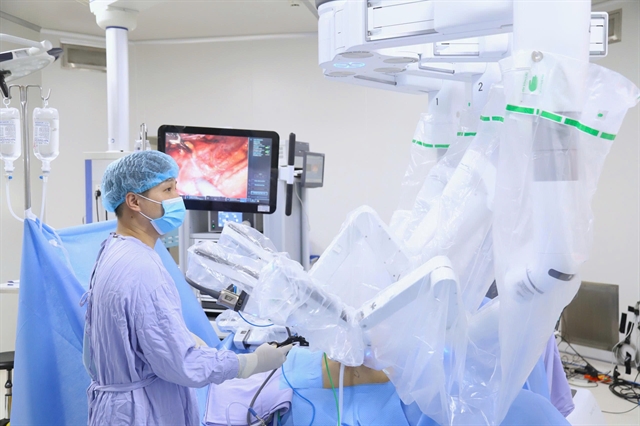 |
| A doctor performs a robot-assisted surgery to treat cervical cancer.— Photo courtesy of K Hospital |
In another case, a 69-year-old male patient presented with right kidney cancer against a backdrop of complex cardiovascular disease, having previously undergone coronary stenting and requiring long-term anticoagulant therapy.
The tumour was located deep within the renal parenchyma, making it particularly challenging to preserve maximal kidney function. Leveraging the robot's image magnification capabilities and precise suturing, the surgical team successfully excised the tumour in its entirety while minimising the duration of warm ischemia.
As for colorectal cancer, doctors have successfully managed numerous complex cases following neoadjuvant chemoradiotherapy.
Notably, a 48-year-old patient with advanced rectal cancer showed significant tumour shrinkage after treatment, with pelvic lymph nodes no longer detectable on MRI scans. Thanks to robot assistance enabling precise dissection of the entire mesorectum, the surgical team was able to preserve critical nerve and vascular structures within the narrow pelvic space.
In gynaecology, doctors successfully treated a 34-year-old female patient with FIGO stage IA2 cervical cancer who had previously undergone a hysterectomy at another medical facility. This was a complex secondary surgery, as the pelvic anatomy had been altered by the prior procedure. A robotic system was used to perform a wide resection of the perivaginal tissue and pelvic lymph node dissection while preserving the nerves.
According to experts, this successful series of cases demonstrates that robot-assisted laparoscopic surgery not only enhances precision in cancer surgeries, but also reduces blood loss and postoperative pain, shortens hospital stays and accelerates recovery.
When combined with preoperative chemotherapy and radiotherapy within a multimodal treatment strategy, this technique also expands the potential for curative treatment for many patients with advanced-stage cancer.
The implementation of comprehensive training in robot-assisted laparoscopic surgery is expected to help standardise techniques at major surgical oncology centres, gradually establishing robotic technology as a standard treatment method and enabling domestic patients to access advanced procedures in Việt Nam. — VNS
Society
 Society
 Society
 Society
 Society
 Society
 Society
 Society
 Society
 Society
 Society
 Society
 Society
 Society
 Society