 Society

Hà Nội sets example in digitising public services
1.
|
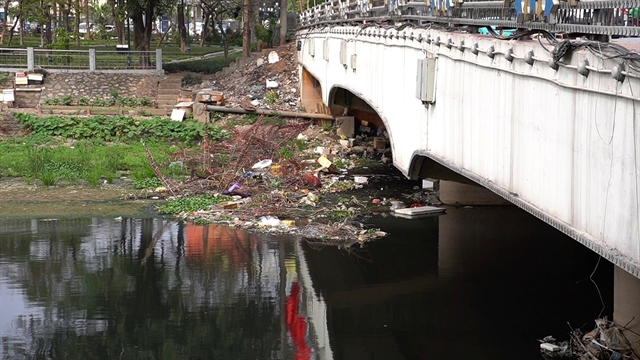
| Household waste trapped beneath a bridge in the Nhuệ River. — VNA/VNS Photo |
HÀ NỘI — The Hà Nội People's Committee has proposed a five-year US$2.9-billion project to dredge and depollute the Nhuệ River, one of the capital's most degraded waterways, submitting the plan this week to city People's Council for approval.
Nhuệ River runs 61.5km through 19 wards and communes, serving as a key drainage and water-supply channel and a major urban corridor. For years, it has run dry in places and suffered severe pollution, with water quality rated 'very poor' and no longer usable as a surface-water source.
The project, covering about 855ha, would run from 2026 to 2030 in two phases: a 30.5-kilometre stretch to Ring Road 4 completed by 2028, followed by the remaining 31km by 2030. The work includes land clearance, dredging and bank reinforcement, new roads and utilities along both banks and wastewater treatment plants.
|
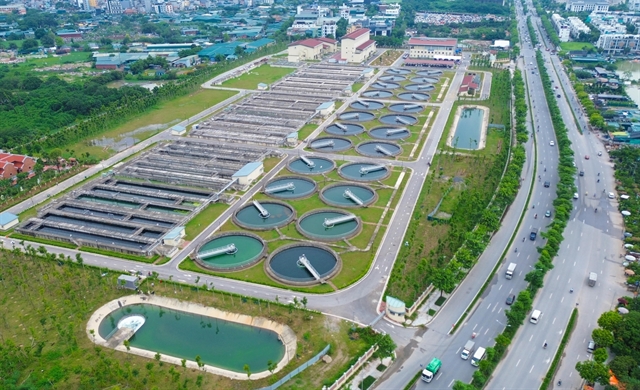
| The Yên Xá wastewater treatment plant, built to treat wastewater from central urban areas in the Tô Lịch River basin, the left bank of the Nhuệ River and the Lừ River basin. — VNA/VNS Photo |
It would be built under a BT (build-transfer) contract, in which private investors construct the infrastructure and are repaid in land, which they can then develop commercially. In this case, the investors would receive roughly $2.6 billion worth of land along the riverbanks and elsewhere, with no State budget funds involved.
The city council's Urban Affairs Committee, which reviews the plan, said the proposal still rests on preliminary figures: the $2.9 billion total cost is only a rough estimate, and neither the value of the BT construction work nor the roughly $2.6 billion in land earmarked for payment has been fully substantiated.
The committee also flagged an unexplained $229 million shortfall – about 8 percent – between the vetted project cost and the value of land earmarked to cover it, with no plan yet in place to close the gap.
The committee said the land parcels intended as payment have been identified only in general terms, without confirmed boundaries, legal status or zoning compliance, and that the investor's ability to raise financing has not been assessed.
Given the scale of land to be cleared, the committee said the proposal fails to specify how many residents would need to be resettled or where they would be rehoused
It also asked the city to justify the feasibility of its timeline: completing land clearance by the end of 2026 and finishing the entire project by 2030. — VNS
Society
 Society
 Society
 Society
 Society
 Society
 Society
 Society
 Society
 Society
 Society
 Society
 Society
 Society
 Society