 Economy

Lotte, Phát Đạt combine strengths in Thu Thiem project
1.
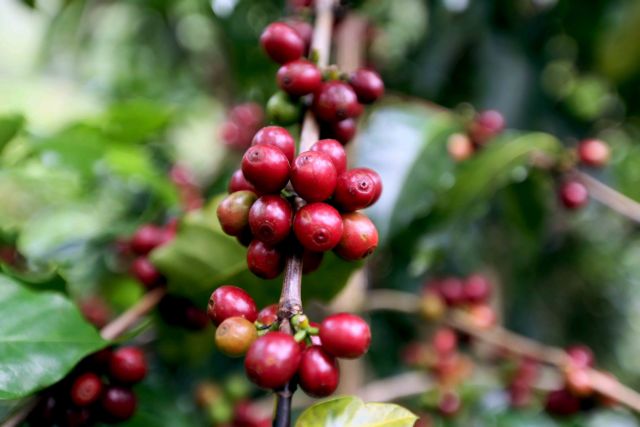 |
| A coffee farm in Sơn La Province. Coffee exporters must proactively invest in building their own production-area databases retain access to the EU market. — VNA/VNS Photo Quang Quyết |
HÀ NỘI — Coffee exporters are gearing up preparations to strengthen traceability systems as the European Union's anti-deforestation regulation (EUDR) enters full implementation in less than six months, making transparent production data critical to maintaining access to the bloc.
Thái Như Hiệp, chairman of Vĩnh Hiệp Company and vice president of the Việt Nam Coffee-Cocoa Association (Vicofa), said the industry's biggest challenge was whether businesses were prepared to shift towards greener and more transparent production.
"Green production and sustainable consumption have become irreversible trends," Hiệp said, adding that the goal is not simply to export more coffee but to build the Vietnamese coffee brand on transparent, traceable and sustainably managed growing areas.
The EUDR, which requires companies to prove that products placed on the EU market are not linked to deforestation, will make comprehensive farm-level traceability a prerequisite for exports.
Hiệp said businesses must proactively invest in building their own production-area databases retain access to the EU market. He noted that reliable traceability data also strengthens exporters' credibility with international buyers.
One of the biggest problems is overlapping production-area data among different companies, Hiệp pointed out.
In the past, farmers could participate in multiple certification schemes. Under the EUDR, however, duplicate records could create compliance risks if the same farm or production volume is reported by several exporters, potentially resulting in declared export volumes exceeding actual output.
Hiệp said there were still no clear regulations on liability for duplication or inconsistency in declarations from the same production area.
To minimise risks, it is important for exporters to review all of its production-area data to identify overlapping records and verify information independently rather than relying entirely on certification organisations, Hiệp said.
He also called for the establishment of coordinated mechanisms for managing production-area databases by comparing and reconciling data submitted by companies operating in the same region before the EUDR takes full effect.
If local authorities publicly identify which enterprises manage which production areas, the risk of inconsistencies will be significantly reduced while creating a transparent database for both businesses and regulators, Hiệp said.
Tô Xuân Phúc, managing director for forest policy, trade and finance at Forest Trends, said production-area databases would not only support corporate traceability requirements but also improve government management.
He said coffee was among the sectors where farm-level information remained incomplete, with certified production areas accounting for only about 30 per cent of the country's total coffee-growing area.
It is necessary to combining data supplied by businesses and farmers with official government databases to verify whether coffee-growing areas overlap with forest land and standardise data, which would help identify potential non-compliance with anti-deforestation requirements, Phúc said.
Phạm Tuấn Anh, former director of the Department of Agriculture and Rural Development of former Đắk Nông Province, said Việt Nam did not lack agricultural data but rather a system capable of standardising, integrating and sharing information among businesses, farmers and regulators.
Farm-level production databases should be considered as essential agricultural infrastructure, with regular updates to support both state management and export traceability, he said.
The Ministry of Agriculture and Environment’s statistics showed that Việt Nam exported around 1.1 million tonnes of coffee worth US$4.78 billion in the first six months of 2026.
Export volume rose 9.7 per cent year-on-year, while export value fell 14.4 per cent as average export prices declined to about $4,435 per tonne.
Việt Nam is the world's second-largest coffee exporter after Brazil, accounting for about 8.3 per cent of global market share.
The EU accounts more than 40 per cent of Việt Nam’s coffee exports, which benefit from zero tariffs under the EU-Việt Nam Free Trade Agreement (EVFTA). — VNS
Economy
 Economy
 Economy
 Economy
 Economy
 Economy
 Economy
 Economy
 Economy
 Economy
 Economy
 Economy
 Economy
 Economy
 Economy