 Politics & Law

HCM City plans Tết support for 370,000 disadvantaged workers
1.
|
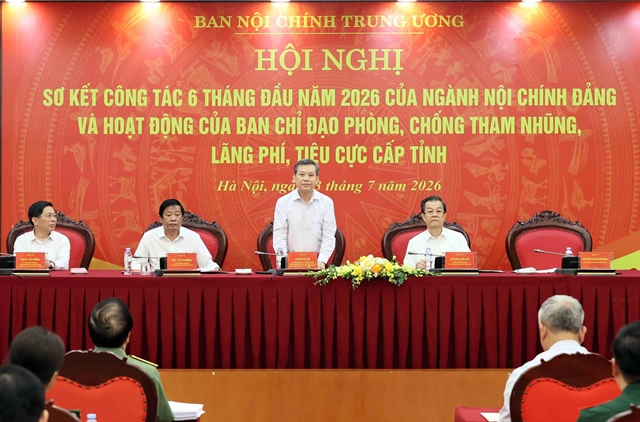
| Politburo member, Secretary of the Party Central Committee and head of the Party Central Committee's Commission for Internal Affairs Lê Minh Trí speaks at the conference reviewing the Party's internal affairs sector and the activities of provincial steering committees on anti-corruption, waste prevention and the fight against other negative phenomena during the first six months of 2026. VNA/VNS Photo |
HÀ NỘI — Politburo member, Secretary of the Party Central Committee and head of the Party Central Committee's Commission for Internal Affairs Lê Minh Trí on Monday stressed that efforts to combat waste must extend beyond money and public assets to include wasted time and missed development opportunities.
He called on provinces and cities' steering committees for anti-corruption, waste prevention and the fight against other negative phenomena to identify a number of typical waste-related cases for focused handling. Local authorities were also urged to promptly compile inventories and develop plans to deal with redundant, delayed and long-stalled projects and public works that have caused waste.
Trí was speaking at a conference reviewing the Party's internal affairs sector and the activities of steering committees on anti-corruption, waste prevention and the fight against other negative phenomena during the first six months of 2026. The event was held in person and connected online with all 34 provinces and centrally governed cities.
He commended the achievements made in combating corruption, waste and other negative practices during the first half of the year.
Looking ahead, Trí instructed local authorities to swiftly translate the Party Central Committee's resolutions and conclusions into concrete action.
He also directed provincial and municipal commissions for internal affairs to comprehensively review their work programmes, conclusions and newly issued directives from the central authorities to promptly update priorities and effectively implement the 65 tasks assigned by the Central Steering Committee.
The official also called for stronger inspection and supervision, improved citizen reception and more effective settlement of complaints and denunciations.
From now until the end of the year, localities should further refine operational mechanisms, strengthen coordination among agencies and tighten power control at the grassroots level, he said.
Under the new two-tier local government model, provincial and municipal steering committees on anti-corruption, waste prevention and the fight against other negative phenomena were instructed to promptly finalise regulations governing their functions, responsibilities, powers and working procedures, with particular attention given to strengthening power oversight and preventing corruption, waste and misconduct at the commune level.
According to a report presented at the conference, the Party's internal affairs sector and provincial and municipal steering committees successfully fulfilled their assigned tasks during the first half of 2026.
The Party Central Committee's Commission for Internal Affairs developed and implemented an action programme to carry out the Resolution of the 14th National Party Congress while advising on the issuance of a series of new policies, mechanisms and measures on anti-corruption, waste prevention and the fight against other negative phenomena. These initiatives were designed both to remove institutional bottlenecks and unlock development resources.
Among them were seven major policy proposals covering internal affairs, anti-corruption, waste prevention, the fight against other negative phenomena and judicial reform.
Notably, the commission advised the Politburo to issue Resolution No. 04-NQ/TW and Plan No. 03-KH/TW, which set out 114 specific tasks.
At the local level, provincial and municipal steering committees issued more than 5,000 directives and guidance documents on anti-corruption, waste prevention and the fight against other negative practices. So far, 29 of the country's 34 provinces and cities have adopted action programmes to implement Resolution No 04-NQ/TW and Plan No 03-KH/TW.
Provincial and municipal commissions for internal affairs also advised Party committees to issue 1,163 documents, while helping standing boards of provincial and municipal Party committees issue 263 directives governing the organisation and operation of internal affairs, judicial and related agencies in line with the two-tier local government model.
The central commission strengthened monitoring, supervision and inspections, while advising competent authorities on handling emerging complex issues, public complaints, petitions and denunciations, contributing to safeguarding political security and maintaining social order and safety.
It also continued reviewing and providing opinions on draft laws, policy proposals and other important legal documents concerning internal affairs, anti-corruption, waste prevention and judicial reform.
Meanwhile, provincial and municipal steering committees carried out 57 inspections and supervisory missions focusing on power control and the prevention of corruption, waste and other negative practices in connection with the operation of the new two-tier local government system.
During the first six months of the year, the Party Central Committee's Commission for Internal Affairs also assisted the standing boards of provincial and municipal Party committees in conducting 34 inspections and supervisory missions involving local internal affairs agencies. It advised authorities on handling 240 criminal cases and incidents, including the resolution of 80 cases, while directly organising 173 monitoring, inspection and supervision missions and coordinating the handling of 110 major and complex cases related to security and public order. — VNS
Politics & Law
 Politics & Law
 Politics & Law
 Politics & Law
 Politics & Law
 Politics & Law
 Politics & Law
 Politics & Law
 Politics & Law
 Politics & Law
 Politics & Law
 Politics & Law
 Politics & Law
 Politics & Law
 Politics & Law