 Society
Việt Nam, Switzerland to turn education, sci-tech, innovation into cooperation focus
1.
|
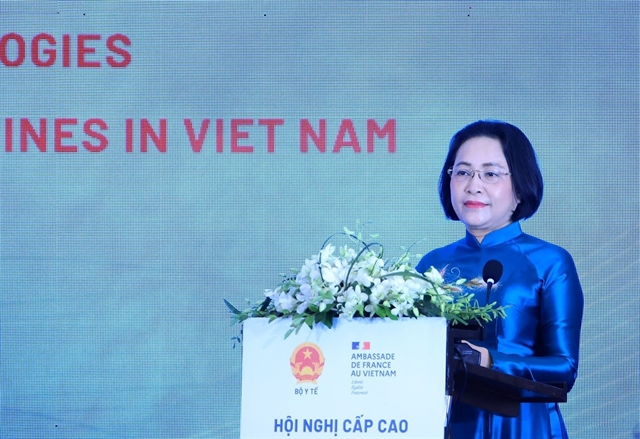
| National Assembly Vice Chairwoman Nguyễn Thị Thanh delivers a speech at the conference in Hà Nội on Thursday. — VNA/VNS Photo Tuấn Anh |
HÀ NỘI — Cooperation between Việt Nam and France to develop next-generation vaccine manufacturing should pursue a long-term vision of enhancing the self-reliance of Vietnamese healthcare and establishing the nation as a regional hub for research and development, clinical trials and production and distribution of vaccinations.
This statement was made by National Assembly Vice Chairwoman Nguyễn Thị Thanh at the Việt Nam–France High-Level Conference, which focused on strengthening cooperation in strategic technologies and related products to develop next-generation vaccines in Việt Nam, and was held in Hà Nội on Thursday morning.
The conference was jointly organised by the Ministry of Health and the French Embassy in Việt Nam.
To ensure the partnership with French counterparts delivers tangible outcomes, Thanh outlined some key priorities.
The first is establishing a clear roadmap for joint research and development of next-generation vaccines, backed by concrete commitments to deliver products that benefit the public.
Another priority is creating a favourable, flexible and coherent legal framework to accelerate public access to advanced vaccines while maintaining the highest standards of quality and safety.
The next is strengthening the role of the private sector, with the State supporting sustainable market development through a facilitating regulatory framework, public procurement policies and domestic technological capacity-building.
Carrying out a long-term strategy to develop a highly skilled workforce capable of mastering advanced technologies and supporting the sustainable growth of Việt Nam's biotechnology industry is also a priority.
Thanh said the conference is particularly significant, as the Party and State continue to pursue breakthrough measures to improve public healthcare, reflecting the growing strategic partnership between the two countries in healthcare, science and technology.
Reflecting on the COVID-19 pandemic, Thanh said an important lesson had emerged that technological self-reliance in vaccine development is not merely a healthcare issue, but one of health security and socio-economic stability.
“With the increasing uncertainty posed by emerging diseases and climate change, a country's ability to research, manufacture, stockpile and ensure equitable access to vaccines has become a key indicator of national governance within global value chains,” she said.
At the conference, Health Minister Đào Hồng Lan also stressed the importance of achieving technological self-reliance in vaccine development and production in the current global context.
Lan said mastering the entire vaccine value chain, from research and manufacturing to the supply of high-quality vaccinations, requires a comprehensive approach that goes well beyond technology transfer.
It calls for coordinated investment in research and development, quality testing, regulatory approval and effective public-private partnerships capable of building resilient supply chains.
The ministry is actively identifying strategic technologies for priority development, she said, expressing the hope that the gathering of policymakers, businesses and international organisations would foster a multi-disciplinary approach to advancing Việt Nam's vaccine manufacturing industry.
|
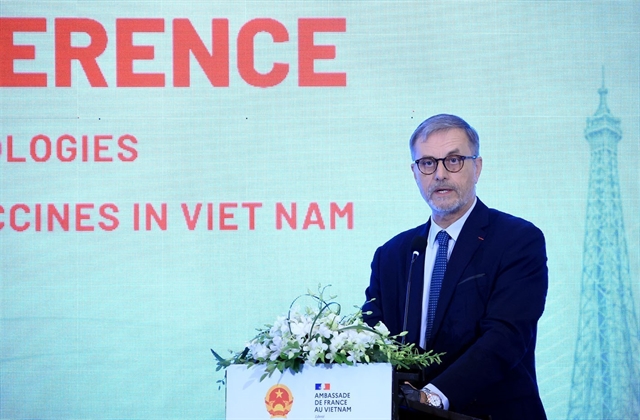
| French Ambassador to Việt Nam Olivier Brochet delivers a speech at the conference on Thursday. — VNA/VNS Photo Tuấn Anh |
Most successful pillar
Meanwhile, French Ambassador to Việt Nam Olivier Brochet said healthcare has consistently been one of the strongest and most successful pillars of bilateral cooperation between the two countries.
He noted that Việt Nam imported substantial volumes of pharmaceuticals from France in 2025, with vaccines accounting for a significant share.
However, he emphasised that the true value of the partnership extends far beyond trade figures, resting instead on mutual trust, a shared commitment to quality and safety, and efforts to ensure equitable access to medical advances.
One notable example Brochet cited is the landmark cooperation agreement between Vietnam Vaccine JSC and France's Sanofi Group.
Exchanged during French President Emmanuel Macron's visit to Việt Nam in May 2025, the agreement establishes a framework for the gradual development of vaccine manufacturing technologies while strengthening the domestic workforce, quality management systems and the capacity to meet the highest international standards in research, production and safety.
To provide a comprehensive framework for future collaboration in training, research, innovation and the development of the medical industry, he expressed hope that the two countries would soon sign a new inter-governmental healthcare cooperation agreement.
He also said that vaccine manufacturing is among the world's most demanding industries in terms of regulatory and technical standards.
Việt Nam should thus develop a fully integrated ecosystem encompassing research and development, disease surveillance, clinical trials, quality assurance, cold-chain infrastructure, logistics, distribution networks and safe immunisation services, he said.
Such an ecosystem would provide the foundation for strengthening the country's vaccine self-reliance, improving preparedness for future disease outbreaks and enhancing national health security. — VNS
Society
 Society
 Society
 Society
 Society
 Society
 Society
 Society
 Society
 Society
 Society
 Society
 Society
 Society
 Society