 Society
Việt Nam, Switzerland to turn education, sci-tech, innovation into cooperation focus
1.
|
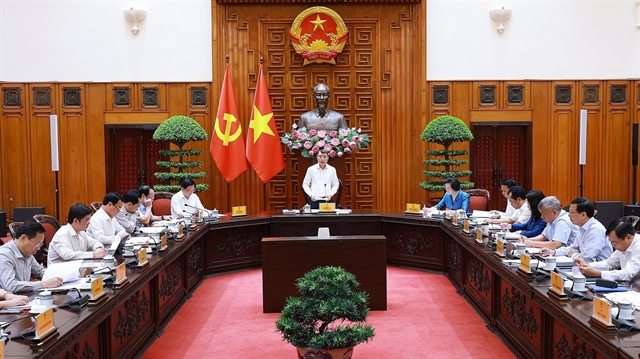
| Prime Minister Lê Minh Hưng, head of the Central Steering Committee for the realisation of national target programmes, chairs the committee’s first meeting. — VNA/VNS Photo Dương Giang |
HÀ NỘI — Prime Minister Lê Minh Hưng has said that despite many achievements, the national target programmes are proceeding much more slowly than required, as many tasks risk not being completed and funds for 2026 may not be disbursed.
The PM made the statement in his capacity as head of the Central Steering Committee for the realisation of the national target programmes, while he chaired the committee’s first meeting on Thursday.
The Prime Minister has recently issued a decision establishing the Central Steering Committee for the implementation of four national target programmes. The four programmes comprise the National Target Programme on New Rural Development, Sustainable Poverty Reduction, and Socio-Economic Development in Ethnic Minority and Mountainous Areas; the National Target Programme on Cultural Development; the National Target Programme on Healthcare, Population and Development; and the National Target Programme on Modernising and Improving the Quality of Education and Training.
He noted that despite constrained budgets, the National Assembly and the Government have allocated a relatively large amount of funding for the programmes, so ministries and localities should focus on carrying them out effectively, on schedule and in line with their objectives.
Yet according to Hưng, guidance documents and capital allocation plans for some programmes remain unfinished. A substantial amount of funding from three programmes for the 2021-25 period has been carried over into this year, while disbursement rates as of the end of last month remain low.
Moreover, an excessive number of guidance papers is complicating delivery at the local level. Programmes on new rural development, sustainable poverty reduction and socio-economic development in ethnic groups and mountainous areas alone have as many as 54 guidance documents. There is currently no mechanism for coordination between these programmes.
In some localities, particularly among senior leaders, the importance of the national target programmes has not been clearly recognised, so concrete action on them has been lacking.
While there are a few concrete reasons for the delay – for example, 2026 is the first year of the new era and some initiatives have been merged into joint programmes – the PM confirmed that certain agencies have not shown sufficient initiative or determination, while preparation of documentation, coordination and provision of information have been slow and uneven.
In some cases, the responsibilities of lead and coordinating agencies have not been fully discharged, while coordination between ministries, sectors and localities has been poor, and staffing remains limited.
A crucial task
PM Hưng assigned the Government Office to issue a notice of the meeting’s conclusions and allocate specific tasks and timelines to various agencies. He emphasised several key points.
First, the PM stressed the need for more substantive and effective measures to ensure both disbursement and investment efficiency.
At the same time, there must be coordination between all three national target programmes to create development momentum, especially in rural and mountainous areas. Allocation and use of resources must be prioritised and targeted, aimed at the right beneficiaries.
Implementation must also clarify personnel, tasks, responsibilities, deadlines and results. Performance evaluation of leaders should be based on delivery, disbursement progress and the programmes’ impact on local residents.
As for specific tasks, Hưng directed the Ministry of Agriculture and Environment to regularly remind ministries, sectors and localities to conduct the programmes, strengthen supervision, provide timely guidance and remove obstacles so that all of the funds for this year are disbursed.
The Ministry of Culture, Sports and Tourism must promptly finalise the capital allocation plan for the central Government-funded mid-term public investment for 2026–2030, submit it to the Ministry of Finance for review and consolidation, and present it to relevant authorities for a decision before July 25. It should also prepare an implementation handbook for the programme within this month.
Both the Ministry of Health and the Ministry of Education and Training must work with the Government Office to submit regulations on principles, criteria and norms for central budget allocation and the required rates of counterpart funding from local budgets by the middle of this month.
They must also finalise the mid‑term public investment allocation plan for 2026–2030 and the central budget allocation for this year, submitting these to the Ministry of Finance for consolidation and onward submission to relevant authorities later this month.
The Ministry of Ethnic Affairs and Religion must provide guidance and resolve difficulties in carrying out its assignments, as well as ensure policies are carried out in the correct localities, for the correct beneficiaries and in response to genuine needs.
It should also focus on addressing urgent needs for land for housing and production, electricity, water supply and livelihoods for people in ethnic groups and mountainous areas.
Meanwhile, the Ministry of Finance must consolidate its mid‑term public investment allocation plan and the 2026 capital plan for each programme and submit them to relevant authorities to allocate funds as soon as conditions are met.
It must also work with other ministries to finalise and issue regulations on management and use of routine programme funding, publish progress data publicly and propose immediate reallocation of funds where necessary.
Lead ministries and agencies responsible for specific content and component projects must urgently complete guidance documents, project dossiers and budget estimates within their remit, and address difficulties within their functions.
Alongside these tasks, the PM emphasised another duty: to study better coordination between the programmes in a substantive way, not mechanically or by simple aggregation. The approach should be to propose adjustments where something proves inefficient, he said.
He added that strong decentralisation and evaluation based on final outcomes is needed. Ministries should conduct inspections and provide detailed guidance where issues remain unclear, ensuring alignment with the objectives set by the Party and the State. — VNS
Society
 Society
 Society
 Society
 Society
 Society
 Society
 Society
 Society
 Society
 Society
 Society
 Society
 Society
 Society