 Society
Việt Nam, Switzerland seek to deepen parliamentary cooperation
1.
|
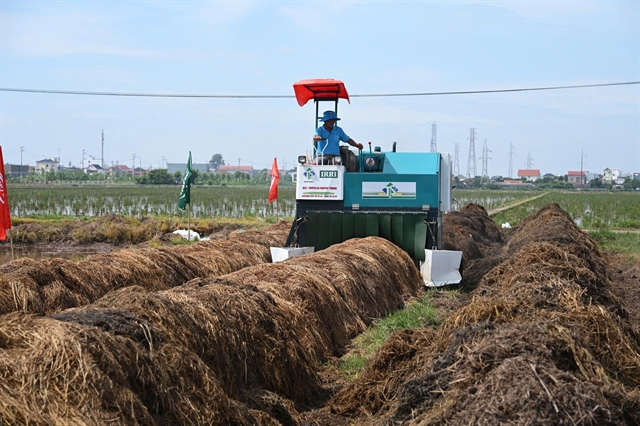
| A farmer uses a machine to process rice straw after harvest, replacing the traditional practice of burning it. — VNS Photo Trần Như |
Trần Như
NINH BÌNH — Farmers in the northern province of Ninh Bình are cutting production costs by more than a quarter and boosting profits by turning rice straw, long burned off as waste after harvest, into organic fertiliser, under a new low-emission rice programme launched on Wednesday.
The initiative, unveiled on July 8, links the International Rice Research Institute (IRRI), Vietnamese agribusiness VAG Group, and Ninh Bình's Department of Agriculture and Environment in an effort to build a 'green, sustainable, low-emission' rice supply chain paired with a circular-economy model for straw disposal.
It builds on pilot projects already under way in Ninh Bình, Hưng Yên and Hải Phòng, and officials say it is part of a broader push to green the rice sector and cut its greenhouse gas footprint.
Precision seeding replaces manual transplanting
At the centre of the model is a technique known in Vietnamese as '4 Đúng-4 Tăng' ('4 Rights, 4 Gains') – a fertiliser application method built around applying the right type, the right dose, at the right time, and in the right place, to deliver four gains: higher yield, better quality, higher income and healthier soil.
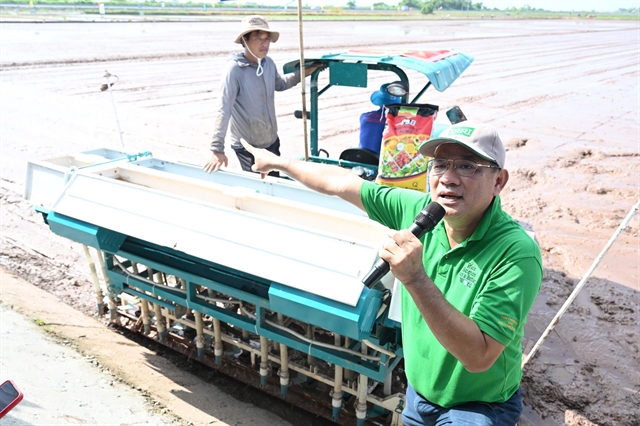
It is paired with a mechanised technology called mDSR-FDP (mechanised direct seeding with fertiliser deep placement), in which machines sow seed in precise rows while simultaneously burying fertiliser beneath the soil early in the season.
Organisers say the method helps rice plants absorb nutrients more efficiently, grow more evenly, resist pests and disease better and stand up straighter in wind and rain than crops grown through the traditional labour-intensive transplanting method.
The results from the three-province pilots, organisers said, have been striking. Sowing costs fell to roughly VNĐ60,000 (about US$2.3) per sào – a traditional land unit used in northern Việt Nam equal to 360 square metres, or roughly one-28th of a hectare – about six times cheaper than conventional transplanting.
Seed and nitrogen fertiliser use both dropped by more than 30 per cent, total production costs fell over 25 per cent and average profit rose by about VNĐ21 million (roughly $800) per hectare.
|
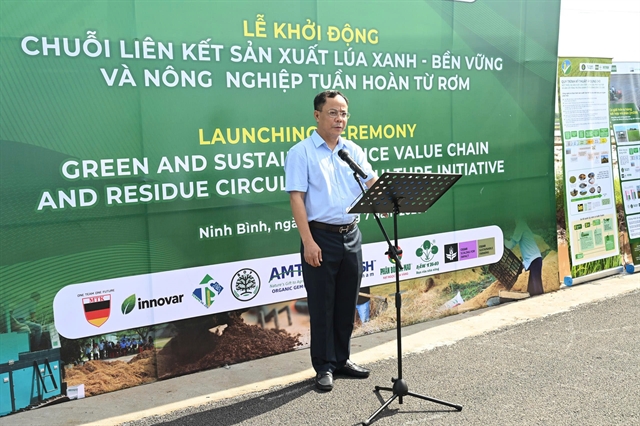
| Nguyễn Sinh Tiến, deputy director of Ninh Binh's Department of Agriculture and Environment, speaks at the ceremony launching the initiatitve on Wednesday. — VNS Photo Trần Như |
Organisers say better water and nutrient management under the model also lowers greenhouse gas emissions, aligning with Việt Nam's climate goals.
Straw, once burned, now becomes fertiliser
The programme's second pillar tackles a practice common across rice-growing regions: burning leftover straw in the field after harvest, which pollutes the air and wastes organic material.
Under the new model, straw is instead collected and treated with a biological agent that breaks it down into organic fertiliser, replenishing soil health, adding organic matter and reducing farmers' reliance on chemical fertiliser.
IRRI has transferred a biotechnology process that shortens the decomposition period to about 30 days, producing compost rich in beneficial microorganisms that can be used on multiple crops, not just rice.
Project partners are also field-testing a rice variety called LP5 under different fertiliser regimens to refine the technique before wider rollout.
Nguyễn Quang Trường, VAG Group's chief executive, said the company's goal goes beyond supplying a single technical fix.
"We're building an integrated chain of solutions, from mechanised sowing and nutrient and water management to straw collection and organic fertiliser production, turning agricultural byproducts into a resource and raising the value of the whole rice industry," he said.
Nguyễn Sinh Tiến, deputy director of Ninh Bình's Department of Agriculture and Environment, called the launch a concrete step toward the province's low-emission rice production scheme, adding that local authorities plan to work with IRRI and VAG Group to refine the technique before expanding it across Ninh Bình and the wider Red River Delta.
Nguyễn Văn Hùng, a senior IRRI specialist, said early results from the 2026 spring rice crop show the mDSR-FDP technology delivers clear economic and environmental gains, though he cautioned it still needs testing across a wider range of growing conditions.
|
| Nguyễn Văn Hùng (in green shirt), a senior IRRI specialist, explains the benefits of the mDSR-FDP method. — VNS Photo Trần Như |
He said private companies have a particularly important role to play in transferring the technology to farmers, linking production to markets and building a brand for Vietnamese 'green,' low-emission rice – positioning the country's rice sector to meet international sustainability standards and eventually tap into carbon credit markets.
Farmers see savings, want more machinery
Trần Quốc Toản, a farmer in Ninh Bình's Nghĩa Sơn Commune, said using straw-based organic fertiliser has cut his fertiliser costs by about VNĐ100,000 (roughly $3.8) per sào while improving soil quality and reducing pest problems.
He said he and other farmers would expand the practice further if given access to more composting machinery, since it saves money and curbs straw-burning after harvest.
According to Nguyễn Văn Hiếu, an IRRI Vietnam consultant, a tonne of treated straw yields about 700 kilogrammes of organic fertiliser, which can cut chemical fertiliser use by a further 30 per cent and reduce the need for pesticides as field ecosystems recover.
Hồ Xuân Hùng, chairman of the Vietnam General Association of Agriculture and Rural Development, said the Nghĩa Sơn model addresses long-standing bottlenecks in the rice sector: small, fragmented landholdings, a disconnect between scientific advances and mechanisation and a fractured value chain.
Mechanising the sowing process, he said, saves about VNĐ8 million (roughly $304) per hectare in labour costs and makes larger-scale production more viable.
VAG Group said combining mechanised sowing with fertiliser deep placement cuts labour by up to 30 per cent, fertiliser costs by about 30 per cent and seed costs by 20 per cent, while lifting yields by roughly 20 per cent.
The company said it is also working with buyers to build a green, low-emission rice brand that could raise the value of the final product by up to 15 per cent.
Delegates at the launch said scaling the model nationwide will require Việt Nam to finalise green-agriculture standards and certification systems, expand farmers' and businesses' access to preferential credit and build out local mechanisation services – with cooperatives and private companies playing a bigger role in coordinating production, collecting straw and connecting farmers to markets.
Organisers said the early results in Ninh Bình point to a broader lesson: cutting emissions from rice farming is not just a technical challenge but a matter of reorganising the entire value chain, with government agencies, scientists, businesses and farmers working in close coordination.
If that coordination holds, they said, the goals of raising farmer incomes, cutting greenhouse gas emissions and building a Vietnamese green rice brand are within reach on a much larger scale. — VNS
Society
 Society
 Society
 Society
 Society
 Society
 Society
 Society
 Society
 Society
 Society
 Society
 Society
 Society
 Society