 Society
Việt Nam, Switzerland to turn education, sci-tech, innovation into cooperation focus
1.
|
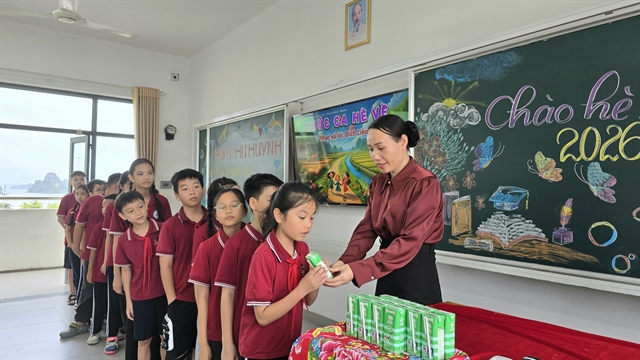
| The distribution of school milk and instructions for pupils on its use in the classroom are carried out in a systematic and conscientious manner at Lê Thánh Tông Primary, Junior Secondary and High School during the first term of the policy’s application. — VNA/VNS Photo Thanh Vân |
QUẢNG NINH — The northeastern province of Quảng Ninh has completed the first semester implementing Resolution No. 86/2025/NQ-HĐND of the provincial People’s Council on providing milk at school for preschool and primary pupils.
The policy, issued on November 14 last year, reflects the province’s strategic, priority investment in the care, protection and physical development of children from the earliest years.
Aimed at ensuring that differences in economic conditions or place of residence do not affect children’s opportunities for physical development, the programme has produced clear results, narrowing the nutritional gap between urban areas and mountainous, border and island regions.
It has regulated that children in nurseries receive 110ml of milk per child per day, while kindergarten and primary-school children receive 180ml per child per day.
Joy of going to school
Located on Quảng Ninh’s eastern border, Hải Sơn border-commune kindergarten is a notable example of the changes brought by the province’s milk provision under the Resolution.
Deputy principal Nguyễn Thị Dung said the school milk programme is highly meaningful, contributing to children’s growth and helping to maintain attendance rates.
“The children enjoy school more and their physical development has improved, because previously they did not have the means to drink milk every day,” she said.
To ensure rigour, milk is always distributed correctly and in full for children to drink in the classroom. If a child is absent, the milk is strictly stored for the following day and must never be taken home.
Before the programme, teachers had to call for community support to obtain extra milk, but that provision was uncertain and irregular.
The Resolution 86 has definitively solved a long-standing problem for teachers in highland areas, turning the dream of daily milk for ethnic pupils into reality and thereby strengthening the border communities’ firm trust in Party organisations at different levels.
Residents Phùn Thị Hồng and Phùn Thị Vương, who live in Lục Phủ Hamlet, said the programme substantially reduced childcare costs for people in the highlands, where large families and difficult economic circumstances remain common.
“Our children both attend school and receive adequate nutritional milk,” Hồng said.
Vương added that with her three school-age children receiving milk at school, her household saves a significant monthly expense. This support not only encourages children to attend school but also eases the financial burden on many families.
Narrowing regional nutritional gaps
The milk provided under Resolution 86 reaches beyond urban and border areas to children on distant islands.
At the Trần island school in the Cô Tô special zone – often described as a frontline island of the nation – education welfare has been prioritised by Party committees from the provincial level downwards as part of a strategy to secure land and sea as well as safeguard social welfare.
Teacher Mai Thị Loan, who works on Trần island, said that as on the mainland, pupils on the island receive milk in accordance with the provincial People’s Council’s Resolution.
Staff follow strict procedures for receipt and storage, hoping the children will gain full nutritional support, stronger motivation to learn and improved stature.
Parents also feel reassured to go to sea for extended periods, knowing their children are well cared for at school with proper meals, rest and standard milk provided in class.
After one semester, Đinh Ngọc Sơn, deputy director of the Quảng Ninh Department of Education and Training, affirmed that the policy has so far yielded positive results and enjoys broad social consensus.
The programme carries out major central and provincial directives on comprehensive human development. It sets out measures to strengthen protection, care and improvement of public health, with the goal of raising the physical standards and stature of Vietnamese people.
Sơn said that Quảng Ninh’s fragmented terrain means some mountainous and island localities still face transport difficulties and limited facilities for milk storage at remote school sites.
Implementation has also created additional tasks for school managers and teachers in receiving and monitoring supplies.
Under the strong leadership and close direction of the provincial People’s Committee and through inter-agency coordination, these initial obstacles are being resolved in collaboration with localities and suppliers.
Vi Ngọc Đạo, waiting for his grandson at the Quang Trung Primary School in Hạ Long Ward, welcomed the Resolution as a humane policy of Quảng Ninh province.
He noted that children from disadvantaged areas and pupils in urban settings alike benefit from the scheme.
The equality is most evident in non-state education. At Lê Thánh Tông Primary, Junior Secondary and High School in Hạ Long Ward, parents and pupils expressed delight.
Fourth-grade pupil Trần Hà An said: “Drinking milk at school helps my parents save money on monthly milk purchases. The milk also carries a distinctive programme logo, so we feel assured about its origin and enjoy holding the carton.”
Strict standards
|
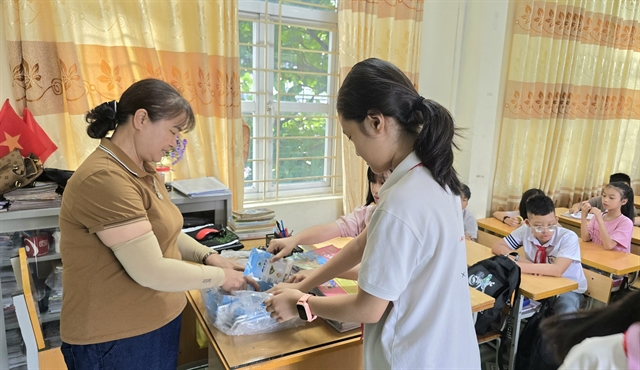
| After consumption, milk cartons are carefully collected and segregated as recyclable waste. — VNA/VNS Photo Thanh Vân |
The programme’s success rests on rigorous standards and transparent supervision, reflecting the accountability of Party and state agencies to the public.
Explaining why schools use different milk brands, deputy director Sơn said procurement is decentralized. Purchases are not made centrally by the province but are devolved to commune, ward and special-zone authorities, which allow schools to hold procurements under the Law on Bidding.
Because procurement is decentralised, bidding enterprises offer different branded products; schools use the products won by their local tenders. The prerequisite is that all tendered milks must meet the same stringent mandatory quality standards.
Milk provided to schools must be fresh, pasteurised liquid milk and comply strictly with the Ministry of Health’s national technical regulations for liquid products. Packaging must prominently display the Quảng Ninh school-milk programme logo.
Trần Thị Thu Trà, deputy principal of the Quang Trung Primary School in Hạ Long Ward, said the school has set up a daily milk supervision team. Incoming milk must bear the programme logo, and receiving teachers check that packaging is intact and that the remaining shelf life is at least 90 days.
After one semester of implementation, Resolution No. 86/2025/NQ-HĐND of the Quảng Ninh Provincial People’s Council has demonstrated outstanding value and long-term vision.
By combining deep humanism with scientific management, Quảng Ninh is not only providing standard milk to nearly 200,000 children each day but is advancing the goal of improving the stature and physical strength of future generations in the region.
The humane policy demonstrates effective leadership and a “words matched by actions” approach by the provincial Party committee, winning praise from multiple ministries and widespread public approval. — VNS
Society
 Society
 Society
 Society
 Society
 Society
 Society
 Society
 Society
 Society
 Society
 Society
 Society
 Society
 Society