 Society

Top Vietnamese leader hosts banquet in honour of Swiss President
1.
|
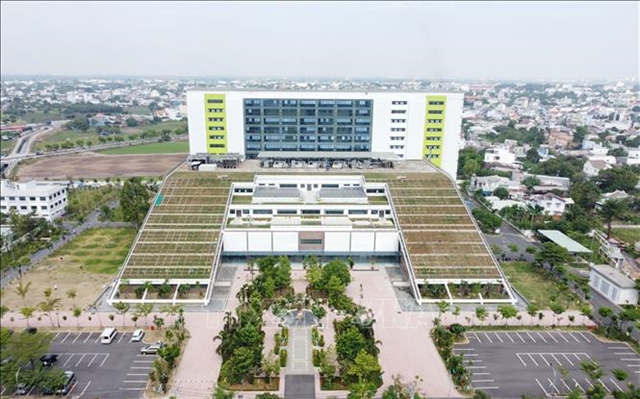
| Hóc Môn Regional General Hospital with a capacity of 1,000 beds. —VNA/VNS Photo |
HCM CITY — HCM City will implement drastic public investment policies for hospitals in gateway areas to alleviate overcrowding in major hospitals in central areas, officials said.
Over the past two years, the city has allocated public investment into the healthcare sector, particularly focusing on three regional general gateway hospitals: Củ Chi, Hóc Môn, and Thủ Đức, said Deputy Secretary of the HCM City Party Committee, Nguyễn Phước Lộc, at a meeting with the municipal Department of Health on July 4.
These are all large-scale projects featuring synchronised infrastructure and modern equipment, Lộc said.
The Thủ Đức and Hóc Môn regional general hospitals are each equipped with 18 modern operating rooms, while the Củ Chi Regional General Hospital boasts 22 operation rooms, surpassing many current first-tier, tertiary hospitals.
Thủ Đức and Hóc Môn have been equipped with robotic surgery systems.
Robotic surgery experts from Bình Dân Hospital stand ready to transfer technologies and train the medical staff at these gateway facilities.
The city’s orientation is to build these three gateway hospitals into highly specialised medical hubs in the future, he said.
He requested the health sector focus on building a network of gateway hospitals and specialised medical hubs to enhance healthcare capacity following the expansion of the city’s administrative boundaries.
The city will research support policies for medical personnel and boost the training of high-quality human resources under the “Hospital-University” model.
This includes investment policies for training resident doctors, a vital source of high-quality human resources necessary for upgrading the gateway hospital and grassroots medical systems.
Regarding the ratio of hospital beds per 10,000 residents, HCM City is striving to reach 35 beds, with a target of 42 beds per 10,000 residents by 2030, according to the city’s Department of Health.
However, given the current population size, all gateway hospitals are facing shortages of hospital beds, and this gap will widen significantly without expansion investments.
In Củ Chi, with a population of around 588,000, there is a current need for 2,030 beds, which will rise to 2,436 by 2030.
Despite the presence of Củ Chi Regional General Hospital (1,000 beds), Củ Chi Hospital (300 beds), and Xuyên Á Hospital (800 beds), the area will still face a shortage of more than 300 beds by 2030.
Similarly, Hóc Môn has a population of 774,000 but currently only possesses one 1,000-bed hospital while the actual demand is 2,695 beds this year and 3,234 beds by 2030.
In Thủ Đức, the current population of 1.2 million requires 4,900 beds, a figure expected to reach 5,880 by 2030.
This area still lacks between 250 and 750 beds. —VNS
Society
 Society
 Society
 Society
 Society
 Society
 Society
 Society
 Society
 Society
 Society
 Society
 Society
 Society
 Society