 Society

Viên dives again to popularise swimming passion
1.
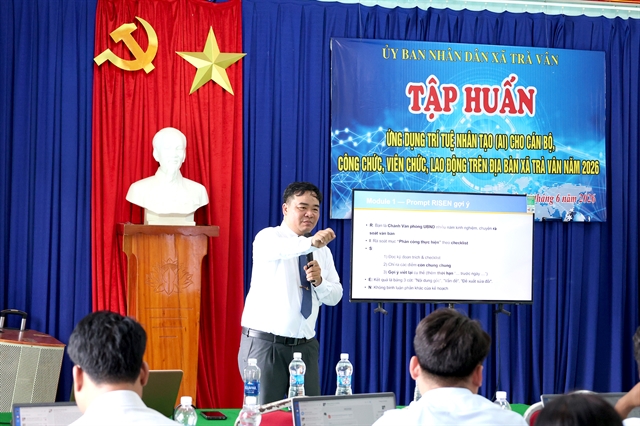 |
| An instructor guiding trainees in the use of artificial intelligence platforms to assist with text processing, information retrieval and lesson preparation directly on their personal computers in Trà Vân Commune, Đà Nẵng City. — VNA/VNS Photo Xuân Quý |
HÀ NỘI — Development policies for science, technology and digital transformation set out in a resolution from December 2024 have already started seeing results across the country.
The Party Central Committee's Resolution 57‑NQ/TW dated December 22, 2024 focuses on developing science, technology, innovation and digital transformation nationwide to spur socio-economic growth.
However, some difficulties in implementing the resolution remain. Following last year's administrative unit mergers, the workload at the local level has increased significantly, while the number of staff has not risen accordingly.
In remote communes, physical infrastructure still falls short in terms of working conditions and the operation of digital infrastructure platforms.
To overcome these issues, a number of effective and locally appropriate digital transformation initiatives have been scaled up.
Several communes in the mountainous western area of Đà Nẵng have held training courses on artificial intelligence (AI) for officials, civil servants and teachers to improve digital skills and gradually introduce technology into everyday tasks.
Universities in the central city have partnered with local authorities on this journey.
The demand for access to technology in mountainous localities is currently very high, according to Lê Vũ, director of the Information Technology Centre at the University of Technical Education, University of Đà Nẵng.
In Trà Leng and Trà Vân communes, many teachers travel tens of kilometres along forest tracks, wade across streams and then ride motorbikes on steep roads to attend AI classes. Meanwhile, despite inadequate working conditions, commune officials are concentrating on practising each application of technology for everyday tasks.
Secretary of the Trà Vân Commune Party Committee Nguyễn Văn Cẩn said AI could help staff summarise documents, consolidate information, search data and prepare reports more quickly.
“This is not only a measure to increase work efficiency, but also contributes to administrative reform and better public service,” he said.
Hòa An Commune in Cao Bằng Province covers a large area, in which several highland hamlets are inhabited exclusively by Mông and Dao ethnic groups.
To ensure timely communication, commune leaders asked hamlets to check households to ensure that each one has at least one person who knows how to use a smartphone.
Everyone is responsible for keeping their families informed about commune and hamlet notices.
Đàm Thu Hằng, secretary of the Hòa An Commune Party Committee, said it was a very effective approach that increased responsibility and encouraged hamlet heads and households to use technology in spreading the State’s policies, laws and directives.
To extend communications network coverage and other technologies to highland residents, Cao Bằng Province has called on various forces, including the Cốc Pàng Border Guard Station.
Lũng Mần Hamlet, in the border commune of Cốc Pàng, is home to more than 100 Mông households, most of whom do not yet know how to use smartphones for mandatory administrative procedures.
Officers and soldiers of the Cốc Pàng Border Guard Station have helped residents use these applications, while also educating them about safety and cybersecurity in the digital environment, including recognising and avoiding online scams.
The border force has also provided guidance on using smartphones to scan QR codes, access legal information channels, look up legal documents and report or denounce acts affecting public order.
Proactive research
Many countries now regard aerospace and unmanned aerial vehicles (UAVs) as strategic technology sectors. Alongside the development of these technologies, the low‑altitude economy has emerged as a new global trend.
In Việt Nam, UAVs have emerged as a useful tool in agricultural production, terrain surveying and resource monitoring.
On June 23, the Điện Biên Province People's Committee issued Decision 1291/QĐ‑UBND permitting the controlled testing of products and services that apply digital technology to develop the province's low‑altitude economy using UAVs.
With around 6,000 flights projected during the trial period, this is the first experiment aimed at finding solutions for managing a field that is still very new in Việt Nam.
Điện Biên is one of the first localities to register for a controlled trial in the low‑altitude economy.
This is not only a model for new economic development, but also an important policy test that will help complete the institutional framework for science and technology, innovation and national digital transformation.
Under Decision 1291, the trial programme runs from the date the decision takes effect until the end of May 2027. Trial activities will focus on four areas: agriculture, logistics, healthcare and digital mapping.
In the initial phase, flight permits will be issued monthly.
After each phase, authorities will evaluate implementation results, safety levels and any issues that arise before considering next steps.
If the target of about 6,000 flights with a safety rate above 99 per cent is achieved as planned, Điện Biên will establish a database to support flight operation management, flight monitoring and the construction of digital maps and digital terrain models within the trial area.
Officially launched on June 26, the National Centre for Supporting Pilot Production of Semiconductor Chips under the Ministry of Science and Technology's Department of Information Technology Industry is Việt Nam’s first national centre to support pilot chip production.
The centre acts as a bridge between domestic research and chip design needs and the global semiconductor manufacturing ecosystem.
Through the Multi‑Project Wafer model – a mechanism that aggregates multiple chip designs on a single fabrication run to reduce costs – the centre will help shorten product development time, reduce prototyping costs and promote chips made in Việt Nam.
Establishing the national chip production centre demonstrates the determination of the Ministry of Science and Technology as well as Việt Nam’s semiconductor community, in the spirit of Resolution 57‑NQ/TW, to gradually master strategic technologies, remove difficulties and build a substantive, sustainable and competitive Vietnamese semiconductor industrial ecosystem. — VNS
Society
 Society
 Society
 Society
 Society
 Society
 Society
 Society
 Society
 Society
 Society
 Society
.jpg) Society
Society
 Society
 Society