 Society

Viên dives again to popularise swimming passion
1.
 |
| French digital law specialist Manon Lafitte. — VNS Photo Khánh Dương |
Việt Nam News speaks to French digital law specialist Manon Lafitte* about AI's ethical issues and her experience with AI legislation in the European Union (EU), which is applicable to Việt Nam.
What are the main challenges related to the ethical use of AI in Việt Nam?
First and foremost, AI is an opportunity. We need to keep that in mind before talking about the risks and the challenges associated with AI; we should begin by discussing the opportunities.
There are opportunities for the media, and there are also opportunities for public officials to better serve citizens by making government decisions more transparent and easier for people to understand.
This is a real opportunity because Việt Nam's regulatory framework, particularly Resolution 57, promotes transparency and helps ensure that public decisions incorporating AI can be made more transparent. This is therefore an important issue both in Việt Nam and in Europe.
Of course, there are also risks associated with the use of AI. To manage these risks effectively, we first need to be aware of them whenever we use AI, whether in education or in public administration.
We must remember that AI systems can hallucinate. They are only tools. Critical thinking remains a uniquely human capability whether Vietnamese, French or European.
That critical thinking is the real added value in the use of AI. It is what we must preserve, regardless of the technological advances that will come in the years ahead.
What should we prepare in the AI era to use these technologies effectively and responsibly?
I truly believe that training is essential.
Training students, public officials and professionals whose jobs will not disappear but will certainly be transformed is both necessary and indispensable.
Today, we are speaking with students of communications and journalism. They will play an enormous role in the years ahead because they will need to identify what we call deepfakes — AI-generated fake images and false information.
Before such content is circulated through the media, they must be able to determine whether the information is genuine or false.
Developing that ability to distinguish fact from fiction is fundamental to the future of AI and its responsible use. It is therefore the most important priority.
The EU was early in adopting AI legislation through the EU AI Act. Việt Nam also has the Law on AI. How do you assess this legal framework? How should it be implemented to reduce risks without slowing AI development?
Many people have spoken about the possibility that regulation could slow innovation. That concern was also central during the European negotiations, when we began discussing AI regulation about five years ago.
There were fears that regulation might hinder innovation. As a result, we designed legislation based on risk and intended use, rather than regulating the technology itself.
That is where innovation lies. Việt Nam is also adopting this risk-based approach.
I believe this approach will enable both Europeans and Vietnamese to move forward with technological development because we regulate uses, not the technology itself.
In practice, we recognise different levels of risk: high-risk applications, lower-risk applications, minimal-risk applications and prohibited uses.
High-risk applications require stronger safeguards than lower-risk ones.
Examples include AI used in the justice system, healthcare and public security. These applications are inherently high risk and therefore require greater transparency, more documentation and stronger oversight.
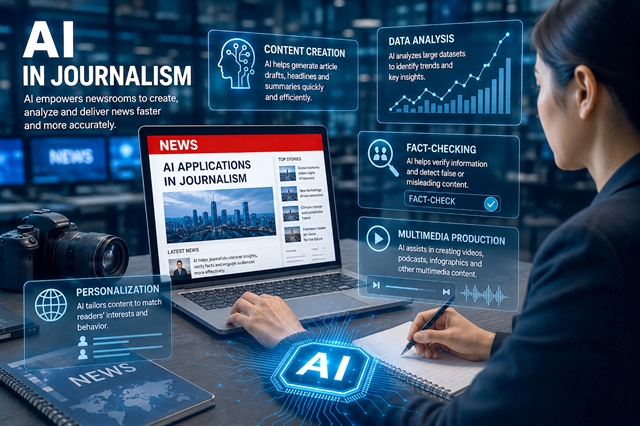 |
| Critical thinking is the real added value in the use of AI. AI generated photo |
How can we protect personal data when using AI?
Personal data protection applies throughout the entire AI life cycle.
Both Vietnamese legislation and European regulations divide AI into different stages, because responsibilities vary throughout the life cycle.
For example, the developer who builds an AI system bears responsibility for the algorithms and datasets used to train it.
When preparing the training data, developers must pay particular attention to personal data. Such data should either be anonymised or removed entirely before being used.
Responsibility continues after deployment, because AI systems may process personal data during operation.
For example, if an AI system is used within a government agency, responsibility depends on the specific actor using it.
Ideally, AI models should be developed without personal data whenever possible. If personal data must later be incorporated for training or operational purposes, those responsible assume greater obligations during that stage.
Attention must therefore be paid throughout every phase of the AI life cycle to ensure that no personal data appears in the final model unlawfully.
Việt Nam’s Personal Data Protection Law, adopted several years ago, already provides a solid foundation because it applies throughout this entire life cycle. It works alongside AI legislation rather than requiring major changes.
In that respect, both Europe and Việt Nam are well positioned.
The EU adopted the AI Act to promote both innovation and the protection of fundamental rights. What is the most important lesson that countries like Việt Nam can learn when building their own AI ecosystem?
We have now been implementing AI regulation for about a year and a half, and we are already seeing its effects, particularly regarding deepfakes.
One important provision requires transparency from AI systems. When an image or any other content has been created using AI, that fact must be disclosed.
This is especially important for journalism and the media, because people need to know whether content has been generated by AI.
As we apply the law, we are discovering new types of AI uses that were not originally anticipated.
Because the law regulates uses rather than technologies, we can classify deepfakes as high-risk applications.
For example, deepfakes used in child sexual abuse material represent either a high-risk or even prohibited use, and the law allows us to prevent such practices.
Looking ahead, I believe Vietnamese legislation should continue focusing on classifying AI according to its intended use.
According to the United Nations Development Programme (UNDP), Việt Nam ranks among the countries in the region with the highest share of workers concerned about losing their jobs to AI, at 61 per cent. At the same time, the labour market is facing a severe shortage of core AI talent. Data from LinkedIn shows that AI-related job postings in Việt Nam have surged by 60 per cent, while the supply of qualified candidates meets less than 3 per cent of demand. What skills should the Vietnamese labour force be equipped with to adapt to AI-related job requirements?
AI requires us to develop expertise in a wide range of applications rather than continue focusing on repetitive tasks. Those repetitive tasks will indeed tend to be automated or replaced.
However, the real question we should be asking today is: how can we, as human beings — with our critical thinking, imagination and creativity — go beyond repetitive work? Such repetitive tasks are neither desirable in today's society nor particularly rewarding.
That is why we all have an interest in understanding AI, at least in broad terms, and in understanding both its opportunities and its challenges. Doing so will allow us to find our place alongside this evolving technology, which will always require the critical judgment that is uniquely human.
How will the French project to help modernise Việt Nam’s public administration through digital transformation contribute to improving the Vietnamese workforce's ability to adapt to AI and strengthen public services?
The project is designed to help build expertise in advanced technologies.
This is something Việt Nam has been working toward for nearly a decade. The country has made significant progress in developing its digital capabilities, particularly in strengthening the protection of citizens' personal data.
Việt Nam has also moved very quickly in developing its AI legislation, which shows that the country is well prepared. I do not see any major obstacles in that regard.
I believe this project will support the Vietnamese Government in centralising data management, making better use of data within the public sector and improving transparency by helping authorities better explain to citizens decisions that involve the use of AI. — VNS
*Manon Lafitte is also a member of the consulting team for a French project titled 'Modernising Việt Nam’s Public Administration through Digital Transformation', supported by the French Ministry for Europe and Foreign Affairs through the French Embassy in Việt Nam. She, along with other senior French experts, is on a working visit to Việt Nam this week.
Society
 Society
 Society
 Society
 Society
 Society
 Society
 Society
 Society
.jpg) Society
Society
 Society
 Society
 Society
 Society
.jpg) Society
Society