 Society

Việt Nam fosters comprehensive cooperation with Uruguay
1.
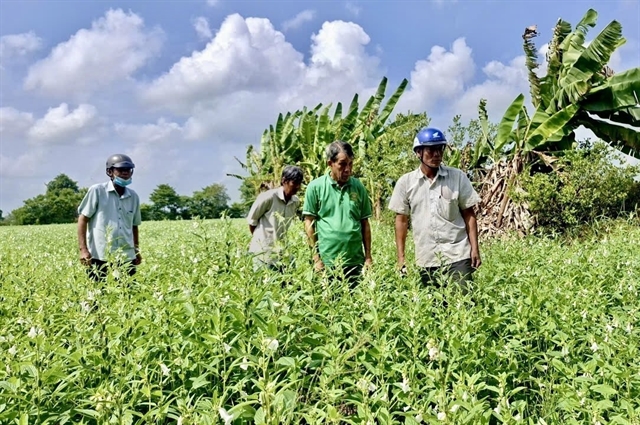 |
| Farmer Mai Tấn Phước inspects sesame plants grown on rotational farmland following the rice harvest in Mỹ Thới Ward, An Giang Province. — VNA/VNS Photo |
AN GIANG — Farmers in the Mekong Delta province of An Giang are gradually moving away from traditional production methods by diversifying crops and livestock, which helps improve incomes while adapting to changing market conditions, rising production costs and increasingly unpredictable weather.
Instead of relying solely on rice cultivation, many households are adopting more flexible farming models that place greater emphasis on economic efficiency, sustainability and market demand.
In Mỹ Thới Ward, where rice has long been the dominant crop, many farmers have replaced the third annual rice crop with sesame under a "two rice crops, one upland crop" rotation model.
The shift comes as fertiliser, pesticide and labour costs continue to rise while profits from rice cultivation have narrowed.
Mai Tấn Phước, one of the first farmers in Thới An A Hamlet to introduce sesame cultivation, said he began experimenting with the crop after attending agricultural training courses organised by local authorities.
He found sesame easier to cultivate than rice, requiring less irrigation, fewer inputs and lower production costs while generating higher returns.
"The crop is relatively easy to grow and does not require much water or labour. After seeing good results, I expanded the cultivation area and encouraged other farmers to adopt the model," he said.
Besides improving incomes, sesame also benefits the farming system by improving soil quality after years of continuous rice cultivation.
According to Phước, rotating sesame with rice helps reduce pests and diseases, improves soil structure and creates better conditions for the following rice crop.
Farmer Nguyễn Văn Tâm has also embraced the model, planting more than 1.2 hectares of sesame after harvesting his winter-spring rice crop.
He said sesame matures within 70 to 75 days and uses significantly less water than rice, making it increasingly suitable under changing climate conditions.
By applying proper cultivation techniques, his fields consistently produce between 1.4 and 1.6 tonnes per hectare.
With market prices currently ranging from VNĐ60,000 to VNĐ70,000 (US$2.30–2.68) per kilogramme, sesame provides attractive profits after production costs are deducted.
"More importantly, sesame reduces irrigation costs, eases pressure on water resources and improves soil fertility for the next rice season," Tâm said.
The success of the crop rotation model has encouraged more households to participate.
Mỹ Thới Ward now has around 15 households cultivating more than 40 hectares of sesame, increasing the value generated from existing farmland while reducing dependence on a single crop.
Livestock provides an additional source of income
Agricultural diversification is also taking place in Bình Đức Ward, where many households have developed commercial beef cattle farming alongside rice production.
For farmer Trần Thanh Vũ, who has raised cattle for more than two decades, livestock has become an important source of income.
Starting with only a few local cattle, he has gradually expanded to a herd of nearly 20 crossbred beef cattle.
Although cattle prices have fluctuated and disease outbreaks have occasionally affected production, improved husbandry techniques and better feed management have made the business more stable.
Feed costs have also remained manageable because farmers make use of rice straw, maize stalks and locally grown grasses instead of relying entirely on commercial feed.
Nearby farmer Trần Hữu Nghĩa follows a similar integrated farming model by combining rice cultivation with a herd of more than 10 beef cattle.
Maintaining clean cattle sheds, ensuring timely vaccinations and closely monitoring animal health are essential to reducing disease risks and improving productivity, according to Nghĩa.
In recent years, many livestock farmers in Bình Đức have invested in semi-permanent barns, planted dedicated grass fields and adopted biological products to treat livestock waste and prevent disease.
These improvements have helped make cattle farming more efficient while reducing environmental impacts.
According to Lý Công Trình, head of the Farmers' Association chapter in Bình Khánh 4 Hamlet, the ward currently has more than 10 commercial cattle farms with a combined herd exceeding 90 head.
Many households have expanded production by applying modern husbandry techniques and making better use of locally available resources.
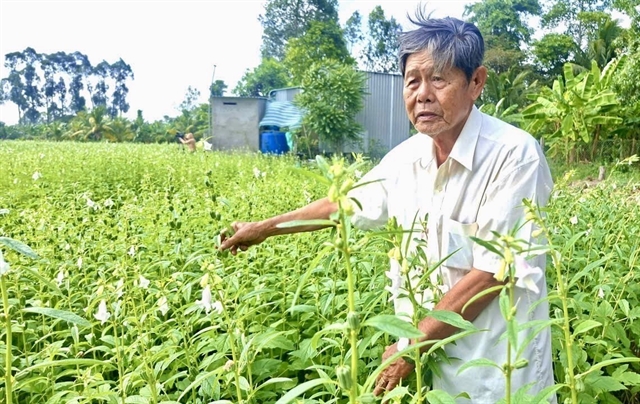 |
| Farmers in Mỹ Thới Ward, An Giang Province, tend sesame fields converted from rice paddies under the "two rice crops, one upland crop" rotation model. — VNA/VNS Photo |
A changing mindset
Local authorities say the most significant change is not simply the introduction of new crops or livestock but the transformation in farmers' thinking.
Vương Mai Trinh, chairwoman of the People's Committee of Mỹ Thới Ward, said more farmers were restructuring production based on local conditions instead of following long-established cultivation habits.
The "two rice crops, one upland crop" model has demonstrated clear economic and environmental benefits by increasing incomes, reducing production costs and improving soil quality.
"Previously, farmers mainly focused on achieving higher yields. Today, they are paying greater attention to profitability, market demand and sustainable production," she said.
Nguyễn Văn Đẹp, chairman of the Farmers' Association of Bình Đức Ward, said local authorities would continue helping farmers access preferential loans, technical training and stronger production linkages.
"The encouraging change is that farmers are no longer simply producing agricultural products," he said.
"They are making business decisions based on market demand, applying new technologies and selecting production models that maximise economic value."
Authorities in both wards plan to continue to expand technical training programmes, strengthen value chain linkages and replicate successful production models to improve farmers' livelihoods.
From sesame fields in Mỹ Thới to commercial cattle farms in Bình Đức, agriculture in An Giang is undergoing a gradual transformation.
Rather than relying solely on traditional experience, farmers are increasingly adopting scientific techniques, diversifying production and focusing on long-term economic efficiency.
The shift reflects a broader move towards a more resilient and sustainable agricultural sector capable of adapting to market fluctuations and climate change while creating more stable incomes for rural communities. — VNS
Society
 Society
 Society
 Society
 Society
 Society
 Society
 Society
.jpg) Society
Society
 Society
 Society
 Society
 Society
 Society
 Society