 Society
Việt Nam fosters comprehensive cooperation with Uruguay
1.
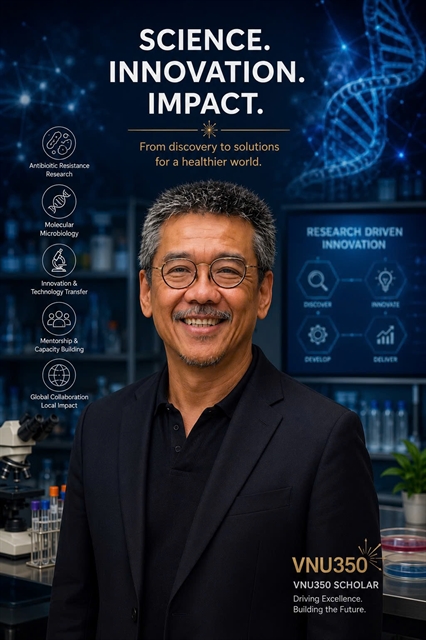 |
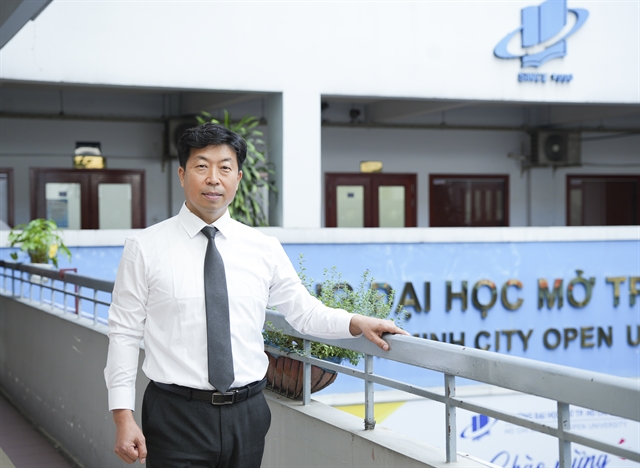
| Assoc. Prof. Nguyễn Duy Liêm, who has returned from the US to work at the Việt Nam National University's HCM City Innovation Centre as part of the university's VNU350 Programme to attract 350 outstanding domestic and international young scientists and leading scholars to the university by 2030. — Photo courtesy of the scientist |
Nguyễn Diệp
HCM CITY — Fostering independent thinking and cultivating an open, globally connected academic environment are far more critical to building a world-class research institution than merely financial investment or state-of-the-art infrastructure, newly returned overseas Vietnamese academics have said.
The recruitment of top-tier scholars like them marks a big step forward for the Việt Nam National University-HCM City (VNU-HCM), which is welcoming the first cohort of its VNU350 Programme.
The initiative aims to attract 350 outstanding domestic and international young scientists and leading scholars to spearhead the university’s international integration by 2030.
Among the prominent returnees are molecular microbiologist Associate Professor Nguyễn Duy Liêm and applied mathematician Dr Văn Phụng Trường Sơn.
Both bring extensive overseas experience to Việt Nam, united by a shared vision of redefining the nation’s scientific landscape.
Liêm is set to join the VNU-HCM Innovation Centre, arriving with a distinguished academic background.
He previously served as an Associate Professor at the Case Western Reserve University School of Medicine in Ohio, the US, and directed the Elizabeth A. Rich Biosafety Level 3 (BSL-3) Laboratory at University Hospitals Cleveland Medical Centre.
His academic portfolio includes more than 40 international peer-reviewed publications in molecular microbiology, bacterial genetics, and antimicrobial resistance.
He described the VNU350 Programme as a masterstroke of long-term vision amid an increasingly fierce global competition for talent.
"The true value of this programme lies not just in its incentives, but in its clear message: a determination to build an academic environment that meets international standards."
He said contemporary research hubs must distinguish themselves through vibrant innovation ecosystems and academic culture rather than bricks and mortar alone.
"Innovation does not start with modern equipment or large budgets; it begins with people and attitude. When we cultivate a generation of young scientists who dare to ask big questions, dare to be different, and know how to collaborate, the future of Việt Nam’s science and technology will be immensely promising."
Working at the VNU-HCM Innovation Centre, he aims to break down traditional academic silos by championing interdisciplinary groups where biology, data science, artificial intelligence, and medicine intersect, he said.
He is equally committed to bridging the gap between laboratory and market, streamlining technology transfer to deliver practical benefits to society, he added.
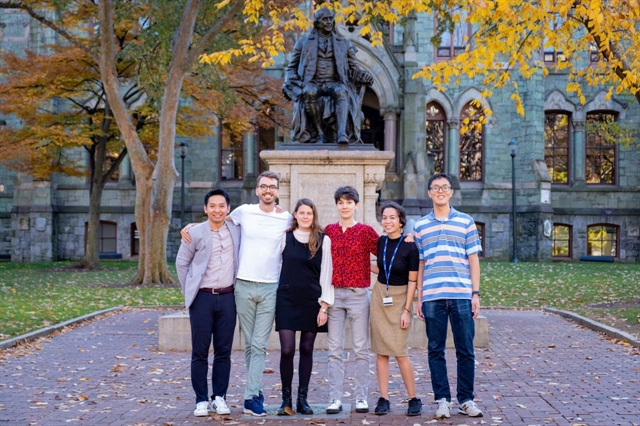 |
| Dr Văn Phụng Trường Sơn (first left), another newly recruited applied mathematician through the VNU350 Programme, alongside his colleagues in the US. — Photo courtesy of the scientist |
Bolstering the faculty at the VNU-HCM’s HCM City University of Technology is Sơn.
He did advanced research at Carnegie Mellon University and maintained close research collaborations with the University of Pennsylvania, both top-tier universities in the US.
His expertise is in partial differential equations, probability, and stochastic dynamical systems — the mathematical foundations underpinning big data, optimisation, and artificial intelligence.
At the HCMUT, he plans to pioneer research into "physical learning", a cutting-edge field exploring how physical systems such as mechanical and electrical networks can adapt organically to produce desired outputs.
He said the decision to return was heavily influenced by the calibre of local students.
"Vietnamese students possess highly sharp analytical minds. Many young individuals only need to be placed in a sufficiently rigorous and stimulating environment to excel. They are the 'rough diamonds' we have the privilege to accompany and polish."
However, the transition back to the domestic environment does not come without challenges.
He identified competitive remuneration and the establishment of a genuinely supportive, low-bureaucracy research culture as critical priorities.
"At the deepest level, researchers simply want the time and space to work and debate freely with good colleagues," he said, recalling how unstructured, passionate discussions over minor mathematical puzzles during his graduate years abroad served as a powerful catalyst for creativity.
Looking ahead, he sees the VNU350 Programme acting as a catalyst for establishing a world-class applied mathematics institute in southern Việt Nam, drawing inspiration from leading global centres such as the Courant Institute in the US.
While eager to connect local talent with his international network, his ultimate ambition is to foster intellectual self-reliance.
"My greater ambition is that, one day, Việt Nam will not just solve problems that the world has already set, but will formulate its own problems — those arising from the practical needs of our country and driven by an independent mindset."
By equipping the next generation of researchers with strong theoretical foundations and intellectual freedom, both scientists believe the country can successfully pivot from being a consumer of global technology to an originator of scientific breakthroughs. — VNS
Society
 Society
 Society
 Society
 Society
 Society
 Society
.jpg) Society
Society
 Society
 Society
 Society
 Society
 Society
 Society
 Society