 Society

Solcis launches open compliance layer for AI agents on NVIDIA OpenShell
1.
|
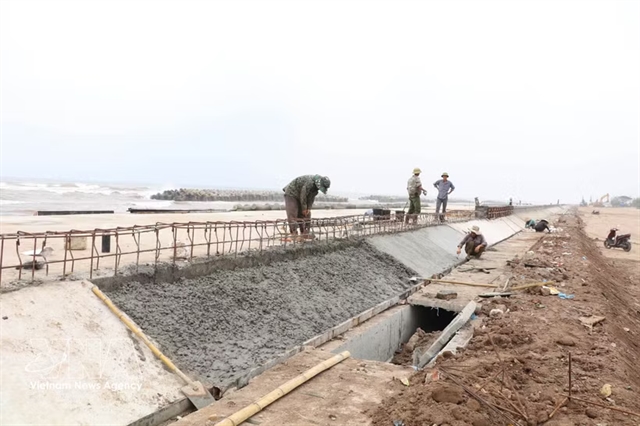
| Sea dike protection works to deal with the risk of erosion and rising sea levels in Hải Thịnh Commune, Ninh Bình Province. VNA/VNS Photo |
HÀ NỘI – Việt Nam needs to further improve its legal framework on natural disaster prevention and control to better respond to increasingly severe climate-related risks and minimise losses of human and property, according to Deputy Minister of Agriculture and Environment Nguyễn Hoàng Hiệp.
Hiệp said amendments to the Law on Natural Disaster Prevention and Control should be based on three key foundations: political requirements, legal consistency and practical realities.
Given its broad scope and links with planning, construction, water resources and socio-economic development, the law must be reviewed carefully to avoid overlaps and ensure consistency within the legal system, he said.
The Deputy Minister also proposed closer integration of disaster prevention into socio-economic development planning, population settlement strategies and the construction of multi-purpose public facilities that can serve as safe shelters during emergencies.
According to the Department of Dyke Management and Natural Disaster Prevention and Control under the Ministry of Agriculture and Environment, natural disasters during the 2020–2025 period caused increasingly serious damage nationwide. On average, natural disasters claimed more than 300 lives each year and caused economic losses exceeding VNĐ45 trillion (US$1.7 billion), up about 167% compared to the 2015–2019 period.
In 2024 alone, natural disasters left 519 people dead or missing, the highest figure recorded since 2007. Economic losses in 2025 were estimated at VNĐ104.7 trillion, the highest level on record.
The Law on Natural Disaster Prevention and Control 2013, which took effect on May 1, 2014 and was amended in 2020 and 2025, has provided an important legal foundation for disaster management. After 12 years of implementation, it has helped shift the country's approach from passive response to proactive prevention while improving state management and mobilising social resources for disaster risk reduction.
However, practical experience has revealed a number of shortcomings and emerging challenges that require further legal adjustments.
Director of the Department of Dyke Management and Natural Disaster Prevention and Control Phạm Đức Luận said coordination among agencies remains inconsistent, particularly in collecting disaster damage data and proposing support policies. The absence of a clearly designated lead agency can result in conflicting statistics and affect disaster response and recovery efforts.
He also stressed the need to strengthen disaster risk requirements in planning processes. Infrastructure projects, urban areas and development plans should be designed with disaster prevention in mind to avoid increasing flood risks and other hazards.
According to Luan, four major issues need urgent attention, including weaknesses in state management and inter-agency coordination, inconsistencies in determining authority for assessing disaster losses and relief needs, unclear regulations on receiving international emergency assistance, and shortcomings in integrating disaster prevention into development planning and flood management.
Meanwhile, challenges remain in improving the resilience of disaster prevention infrastructure and upgrading rescue equipment, especially in remote and mountainous areas. Although forecasting systems have improved significantly, predicting extreme weather events such as flash floods, landslides and localised heavy rain remains difficult.
With natural disasters becoming increasingly severe and unpredictable, the timely revision of the law is essential to strengthen state management, mobilise social resources, enhance disaster resilience and fulfil Vietnam’s international commitments. Ultimately, the goal is to better protect lives and property while supporting sustainable development in the face of climate change. VNS
Society
 Society
 Society
 Society
 Society
 Society
 Society
 Society
 Society
 Society
 Society
 Society
 Society
 Society
 Society