 Society
Việt Nam, EU sign Letter of Intent on Education and Training
1.
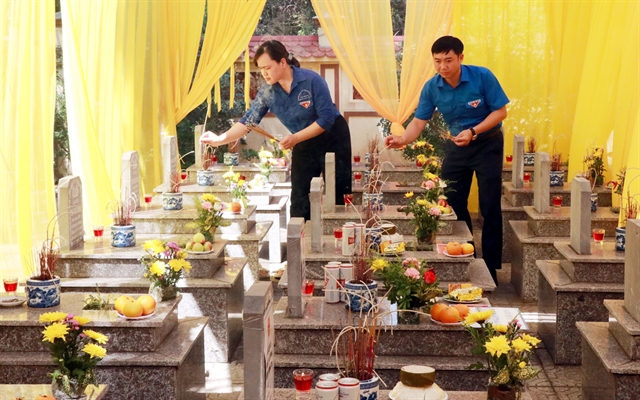 |
| Youth Union members light incense to pay tribute to the martyrs at the Yên Phương Martyrs' Cemetery, Phong Doanh Commune in Ninh Bình Province. — VNA/VNS Photo Nguyễn Lành |
NINH BÌNH — The northern province of Ninh Bình has around 7,900 graves of war martyrs with unidentified information in its military cemeteries. Years pass, yet families remain anxious, awaiting news of their loved ones.
The 500-day campaign to accelerate the search, recovery and identification of martyrs’ remains – an effort the provincial Party Committee, local authorities and specialised agencies are focusing on – aims not only to complete records of those who served the nation but also to meet the hopes and sentiments of martyrs’ relatives, reflecting the nation’s tradition and moral duty of Uống nước nhớ nguồn (Remembering the source of the waters we drink).
Early one morning at Yên Phương Military Cemetery in Phong Doanh Commune, thin incense smoke drifts up through golden sunlight, creating a solemn and sacred atmosphere.
Among the headstones bearing the names of heroes who fell for the country’s independence and freedom, there remain symbolic wind graves where names are inscribed but the remains have yet to be recovered.
As years pass, the anguish of families whose relatives lie on battlefields has not eased.
Command from the heart
Respectfully holding a stick of incense, Lã Văn Lực from Trung Yên Phương Hamlet gently wipes the grave marker bearing his elder brother’s name, martyr Lã Văn Thức.
His voice falters as he recounts that in 1978, Thức enlisted to defend the northern border, stationed in Hoàng Liên Sơn Province (now Lào Cai). A year later, the family received a death notification reporting that he had heroically fallen in the line of duty.
For many years after, the family repeatedly visited his former unit to seek information. Through comrades-in-arms, they learned that when the soldiers were killed, the unit buried them in a mass grave and placed wooden nameboards for each martyr.
Later, the remains were relocated to a local military cemetery. Over time, the wooden boards were ruined by sun and rain and decayed and during reburial, the identities of individual martyrs could not be established.
For many years, the family could only pay respects at the symbolic grave in their home cemetery on anniversaries and festivals. They still hope that one day the remains will be found so their lost relative can return to his homeland and rest in peace.
Đỗ Đức Huấn, nearly 60, from Trần Phú Hamlet, sat for a long while in quiet reflection beside the symbolic grave of his father, martyr Đỗ Đức Vị.
Staring into the distance, Huấn said his father enlisted in 1968 to join Special Commando Company 470, Military Region 5 and fought in the southern battlefields around Cam Ranh, Khánh Hòa.
When his father left, Huấn was only four months old. Decades later, the only information he has about his father remains a few lines in a death notice and a pre-enlistment photograph.
From accounts by his father’s former comrades, Huấn learned that in 1971, during a reconnaissance mission, a three-man team led by his father struck an enemy mine and was killed in that fierce engagement.
In 2015, the family received information that a martyr’s record matched his father’s details. However, identification of the grave could not be completed because the cemetery contained too many unidentified burials.
More than half a century has passed and the family still has not found his final resting place. That longing has quietly accompanied them for decades. Each time they light incense at the symbolic grave in their native village, they entrust their hope that one day they will bring their father home to the embrace of family and homeland.
Phong Doanh Commune has five military cemeteries with a total of 862 martyrs’ graves. Of these, only 278 graves have complete information and remains while 541 graves lack recovered remains; 21 graves contain remains but lack full or partial information and require samples for identity testing.
Vũ Hoàng Hiệp, chairman of the Phong Doanh People’s Committee, said that, chosen as the province’s first locality to take initial samples and hand over martyrs’ remains, Phong Doanh selected Yên Phương Cemetery, which has 165 martyrs’ graves, seven of which have no information and require DNA sampling.
The commune regards the search, sampling and identification of martyrs’ remains as a political duty that responds to the expectations of relatives.
Implementing the 500-day campaign to step up the search, recovery and identification of martyrs’ remains, launched by the national and provincial steering committees 515, the locality held meetings and assigned tasks on the principle of clear people, clear tasks, clear responsibilities and clear timelines.
Preparatory work has been carried out methodically, especially reviewing records and cemetery maps, conducting site inspections and cross-checking information repeatedly to avoid errors. The commune also convened meetings with martyrs’ families to explain the purpose and procedures and to listen to relatives’ views and wishes.
In Yên Mô Commune, which has the largest number of unidentified martyrs’ graves in the province, 846 burials, Party Secretary Bùi Thị Thu Hiền said that given the very large number, the commune considered this a particularly important task that must be implemented seriously, methodically and over the long term.
Because harsh, changeable weather can affect overall progress, the commune is working closely with provincial specialised agencies at every stage, from collecting, cross-checking and verifying records related to unidentified graves, to sampling, matching and validating information and martyrs’ files.
Meeting relatives’ hopes
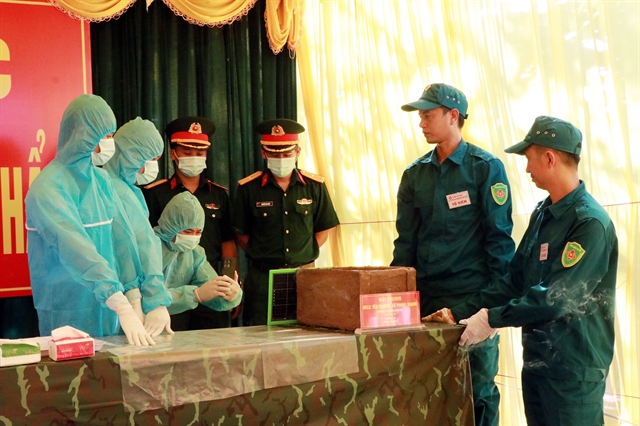 |
| Carrying out the digitisation of martyrs' remains information. — VNA/VNS Photo Nguyễn Lành |
Lieutenant Colonel Nguyễn Hải Đăng, head of the Military Medical Department of the provincial Military Command, said the process of sampling martyrs’ remains follows eight steps, ensuring rigour, scientific standards and compliance with regulations.
The most important step is selecting and collecting remains that still contain DNA for testing and comparison to establish identity. DNA sample quality determines the outcome of verification, so sampling must follow technical procedures precisely to ensure accuracy and avoid errors or mix-ups.
“Although the workload is large and implementation faces many difficulties due to weather conditions, the teams carrying out the tasks always demonstrate high responsibility, actively overcome obstacles and remain present in the field to complete their assignments as an act of gratitude to the heroes who bravely fought and sacrificed for the nation’s independence and freedom,” Đăng said.
According to the provincial Steering Committee 515, surveys of 365 military cemeteries across the province found more than 7,900 martyrs’ graves requiring DNA sampling for verification. Many cemeteries have large numbers of graves needing sampling, for example, Yên Mô Commune Cemetery with 846 graves and Gia Viễn Commune Cemetery with 622 graves.
Colonel Tô Văn Hà, deputy political commissar of the provincial Military Command and deputy head of Steering Committee 515, said that remains buried long ago have been affected by climate and soil conditions. Some graves have been relocated or reburied many times, making it difficult to determine historical burial locations. Grave inscriptions are incomplete and inconsistent and lack detail.
To carry out the 500-day campaign effectively, the provincial Steering Committee 515 requires localities and units to fully list all military cemeteries, accurately count graves with unknown information, make thorough preparations, coordinate closely, assign specific tasks and strictly follow the six clear principles: clear people, clear tasks, clear time, clear responsibility, clear products and clear authority.
Sampling of martyrs’ remains must be carried out according to correct procedures and techniques to ensure accuracy. The application of science and technology and digital transformation should be strengthened in management, storage and DNA testing. Data must be updated and synchronised with the national database on persons with meritorious service.
Ninh Bình aims to complete sampling of all martyrs’ graves with unidentified information by February 25 next year, ensuring all samples are taken according to technical procedures with full, accurate documentation.
At the same time, the province will digitise and fully update data into management software, ensuring connection, sharing and synchronisation with the national database on persons with meritorious service. — VNS
Society
 Society
 Society
 Society
 Society
 Society
 Society
 Society
 Society
 Society
 Society
 Society
 Society
 Society
 Society