 Society

Sang proves talent in virtual taekwondo
1.
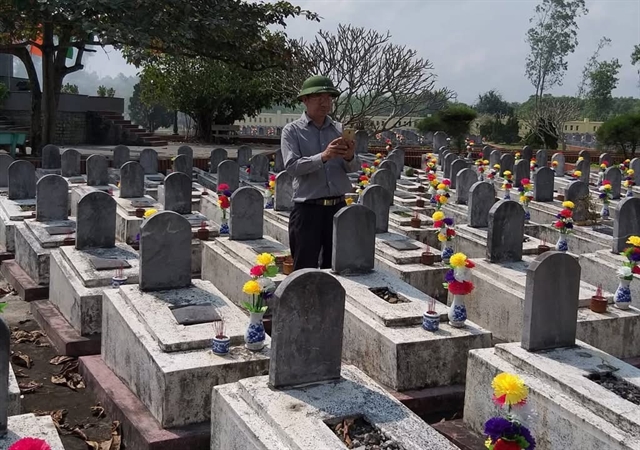 |
| Nguyễn Sỹ Hồ has taken about 800,000 photographs of martyrs' graves nationwide. — Photos courtesy of Hồ |
Khánh Dương
HÀ NỘI — Whether under the blazing sun or in pouring rain, 70-year-old Nguyễn Sỹ Hồ, a retired mathematics teacher from HCM City, has travelled thousands of kilometres across Việt Nam, visiting more than 1,000 martyrs' cemeteries to photograph the graves of fallen soldiers whose families are still searching for them.
After each trip, he spends hours sorting through the images and uploading them to his website, personal Facebook page and community groups, hoping to help families still searching for the resting places of their loved ones.
Each photograph is accompanied by detailed information about the fallen soldier and the cemetery where the grave is located.
The Vietnam Records Organisation has named him a national record holder for visiting the highest number of martyrs' cemeteries and photographing the greatest number of martyrs' gravestones in Việt Nam.
For nearly two decades, Hồ has devoted himself to the work without seeking recognition or financial reward, although he is sometimes called “a crazy man” by people around him.
His journey began in the mid-2000s while searching for the remains of his elder brother, who was killed during the war.
"While looking for my brother, I realised that many martyrs' graves bore full names and hometown details, yet their families had no idea where they were buried and had never been able to bring them home," Hồ said.
During his search, he discovered that many of his brother's comrades from the 271st Regiment were buried in cemeteries scattered across the country. He compiled information on 1,080 martyrs and sent it to Lao Động (the Labour) newspaper.
The publication of the records led 15 families to come forward, and the remains of seven martyrs were subsequently identified and reunited with their relatives.
"Those initial clues may seem small, but they are incredibly valuable in the search process and can help bring fallen soldiers home. That is why I became determined to devote myself to this work," he said.
The biggest obstacle, however, was neither the long journeys nor the lack of technology.
In the early years, many cemeteries did not allow him to enter and photograph graves.
Undeterred, Hồ continued travelling across the country, taking pictures wherever permission was granted.
A major turning point came in 2015, when the Department of Meritorious Services under the Ministry of Labour, Invalids and Social Affairs, now the Ministry of Home Affairs, officially authorised him to photograph graves at martyrs' cemeteries nationwide.
The approval significantly expanded his efforts to help families trace missing burial sites.
"I have visited more than 1,000 martyrs' cemeteries across the country," Hồ told Việt Nam News.
"Apart from some cemeteries in the Red River Delta, I have travelled to sites from the northern provinces of Quảng Ninh, Sơn La and Hòa Bình to the central provinces of Thanh Hóa and Nghệ An, and the southernmost province of Cà Mau.
"So far, I have taken about 800,000 photographs and uploaded them to my database at nguoiduado.com."
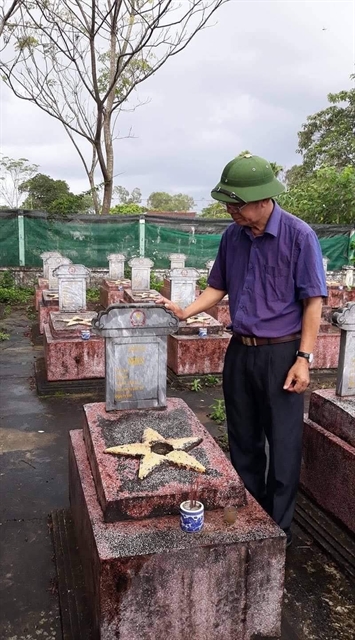 |
| Hồ has helped around 12,000 families locate the graves of their loved ones. |
He also wrote handwritten letters to families of fallen soldiers, sharing whatever information he had gathered.
In return, relatives sent him death notices, military records and other documents.
Armed with these leads, he would shoulder his backpack and set off again to verify the information on the ground.
For Hồ, any clue about a fallen soldier is reason enough to begin a new journey, regardless of distance or circumstance.
"I understand how families of martyrs have spent decades waiting for news of their loved ones. They are still waiting every day," he said.
When not on the road, Hồ spends much of his time at his computer organising records and updating the website, which he designed himself.
Structured to be simple and accessible, the platform allows users to search for information in just a few steps.
According to Hồ, information about some fallen soldiers may already exist on other websites but can be difficult for relatives to find.
His database, for example, allows users to search for names without entering Vietnamese diacritical marks, making the process easier for many families.
In numerous cases, relatives have found information through his website after unsuccessful searches elsewhere, motivating him to continue updating the archive every day.
Emotional reunions
As Việt Nam continues implementing a nationwide campaign to search for and identify missing martyrs' remains, the efforts of dedicated individuals such as Hồ have complemented those of government agencies and military teams.
He believes technology is playing an increasingly important role in the search process.
"When I first started, I communicated mainly through handwritten letters. Now most information is exchanged online," he said.
"Today, thanks to social media, sharing information has become much easier. On average, I reply to about 100 messages from martyrs' relatives every day."
To date, Hồ has collected more than 500,000 records of fallen soldiers and helped around 12,000 families locate the graves of their loved ones.
Over nearly 20 years of searching for martyrs' graves, Hồ has accumulated countless memories of emotional reunions between families and their fallen relatives.
"When families received letters from me through the post office informing them of a martyr's burial location, many were speechless and burst into tears. Some even questioned me at first, asking why a soldier who had died 50 years earlier had not been found sooner," he said.
"After I explained the information, they would apologise and thank me instead.”
As the nation continues efforts to locate and identify those who never returned from war, Hồ quietly carries on with his mission, believing that behind every name on a gravestone is a family still waiting for an answer. — VNS
Society
 Society
 Society
 Society
 Society
 Society
 Society
 Society
 Society
 Society
 Society
 Society
 Society
 Society
 Society