 Society
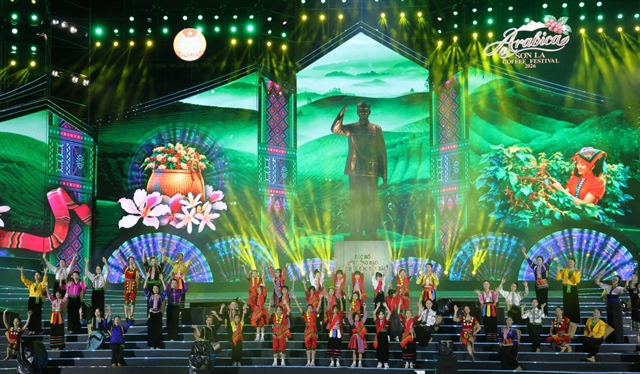
Sơn La holds second coffee festival, targeting stronger businesses in future
1.
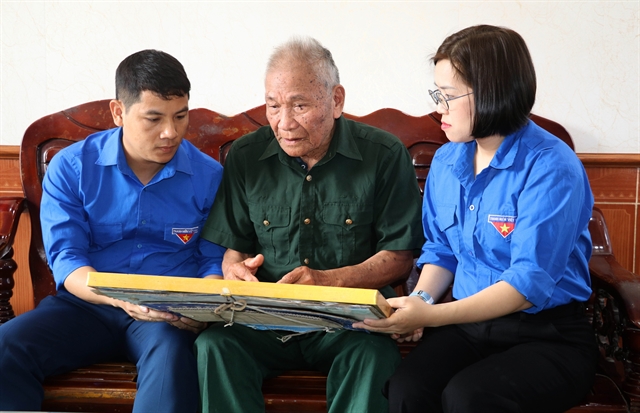 |
| Veteran Nguyễn Văn Lịch recalls the fiercest days associated with the battle at Hill A1 during the Điện Biên Phủ Campaign. — VNA/VNS Photo Thùy Dung |
NINH BÌNH — More than seven decades after the Điện Biên Phủ Victory, memories of those arduous days of tunnelling through mountains, sleeping in dugouts, enduring relentless rain and living on compressed rice remain etched in the minds of veterans in the northern province of Ninh Bình.
As young men in their twenties, they set off in service of the nation, helping to forge a victory that would become resounding across the five continents and shake the globe.
Now in his nineties, veteran Nguyễn Văn Lịch, 93, who lives in Nam Hồng Commune, still vividly recalls the gruelling years of the Điện Biên Phủ campaign.
For him, those memories are not only of youth, but also a stirring epic of patriotism, resilience and a readiness to sacrifice for national independence.
In 1950, at just 17, Lịch volunteered for military service, joining the main force of Inter-Region 3 within the 44th Regiment, 336th Brigade.
At the time, the resistance war against French colonial forces had entered a fierce phase, demanding the mobilisation of manpower and resources nationwide.
His early years in uniform were marked by long marches and combat under severe shortages of food, equipment and medicine.
In early 1954, following the strategic decision to launch a decisive campaign at Điện Biên Phủ, main force units were ordered to march to the north-west region.
Lịch and his comrades traversed treacherous mountain and forest paths, transporting food and ammunition, building fortifications and contributing to the creation of a solid encirclement strategy against the enemy.
At that time, the Điện Biên Phủ campaign was identified by the Politburo and President Hồ Chí Minh as a decisive battle of crucial importance to the outcome of the resistance war.
Lịch recalled that the fiercest fighting centred on Hill A1, a key stronghold within the French defensive complex.
Heavily fortified and bristling with firepower, it was regarded as the steel gate protecting the enemy’s command centre.
On May 1, 1954, his unit joined the attack on the stronghold, marking the beginning of the final general offensive of the campaign.
He and his comrades fought relentlessly despite hunger, exhaustion and incessant bombardment.
“There were days when we survived only on rice balls and stream water, yet none faltered,” he said.
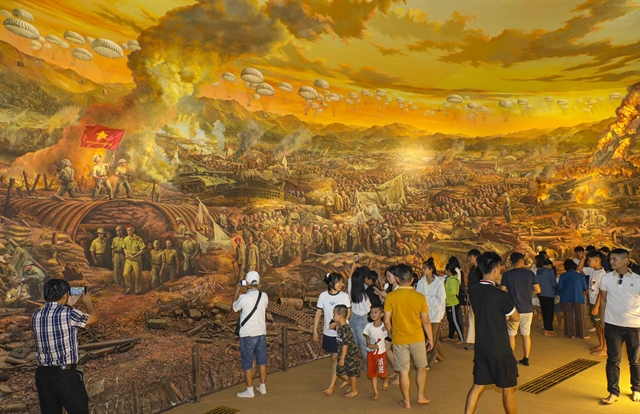
The campaign, fought from March 13 to May 7, 1954, lasted 56 days and nights and unfolded in three major offensives.
Battles at A1, C1 and D1 proved decisive.
After many days and nights of fierce fighting, troops gradually gained control of important strongholds, tightening the encirclement.
On the afternoon of May 7, 1954, a coordinated final attack overran the entire French stronghold.
General Christian de Castries and the French military command were captured alive.
The victory brought an end to the nine-year resistance war against French colonial rule (1945–54), paving the way for the signing of the Geneva Accords and the restoration of peace in Indochina.
Recalling that historic moment, Lịch said that when news of victory spread, soldiers embraced one another, overwhelmed with joy and tears.
“All the hardship and sacrifice had, at last, been vindicated, a memory that would never fade,” he said.
After the victory, he returned home, participating in production and building a new life in 1955.
Though he left the army, he continued to embody the qualities of Uncle Hồ’s soldiers.
In 2005, he was awarded the Resistance Medal against the French in recognition of his contributions to national liberation.
Nguyễn Văn Cương, Deputy Chairman of the communal Veterans’ Association, said such vivid and moving recollections are invaluable living documents, helping to educate younger generations about revolutionary traditions.
The epic of Điện Biên Phủ Victory continues to resonate, serving as a powerful source of spiritual inspiration and reminding present and future generations of the value of peace and independence, achievements won with the blood and sacrifices of forefathers.
A journey that made history
Veteran Nguyễn Văn Bào, 94, in Nam Trực Commune, also retains profound memories of the campaign, recalling his journey to becoming an artilleryman.
Born under French colonial rule, he joined a local guerrilla unit at the age of 15.
In 1953, he enlisted in the army and was assigned to Regiment 84, Division 351, the first main artillery force of the Việt Nam People’s Army, established in 1951 to meet increasingly demanding combat requirements.
Bào said that in early 1954, after a period of training, his unit received orders to march to Điện Biên Phủ.
The large-scale campaign required close coordination between infantry, artillery and engineering units, and the journey itself posed formidable challenges, with troops crossing rugged terrain under harsh weather conditions.
The campaign officially began on March 13, 1954, with the opening battle on Him Lam, launching a series of consecutive attacks by Vietnamese troops on the French colonialists’ fortified complex.
Over 56 days and nights, Vietnamese forces carried out three major offensives, gradually destroying key strongholds and tightening the siege.
As part of the artillery, Bào’s unit provided fire support, suppressing enemy positions and enabling infantry advances.
Crucially, the deployment and effective use of artillery significantly shifted the battlefield balance, forcing French forces onto the defensive.
Bào recalled the moment when news of victory spread through the ranks on the afternoon of May 7, 1954.
As French forces surrendered, he and his comrades were overcome with emotion.
Soldiers clasped hands, their faces alight with pride, joy and tears after days of relentless fighting.
“It was a sacred moment, marking the end of months of hardship and ushering in hope for peace and independence for the nation,” he said.
Tô Văn Quang, Secretary of the Nam Trực Commune’s Youth Union, said that beyond being historical witnesses, these veterans are “living flames” inspiring today’s younger generation.
Youth organisations regularly arrange meetings and exchanges between young people and veterans, helping the younger generation gain a deeper understanding of history, fostering patriotism and a sense of responsibility towards the nation.
“These stories are not merely memories,” he said.
“They are invaluable lessons in determination, resilience and dedication, a foundation for today’s youth to carry forward the task of building and defending the country in a new era.” — VNS
Society
 Society
 Society
 Society
 Society
 Society
 Society
 Society
.JPG) Society
Society
 Society
 Society
 Society
 Society
 Society
 Society