 Society

Cambodian PM Hun Manet chairs welcome ceremony for Vietnamese counterpart Lê Minh Hưng in Phnom Penh
1.
|
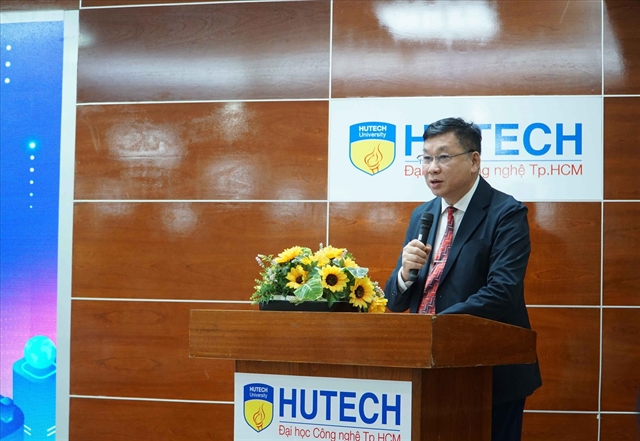
| Trần Lê Hồng, deputy director-general of the Intellectual Property Office of Việt Nam, speaks at a workshop held in HCM City on April 24. — VNA/VNS Photos Thu Hoài |
HCM CITY — Intellectual Property (IP) is no longer just a protective shield for creativity but has become a driving force for innovation, the commercialisation of research, and the growth of endogenous technology, experts said at a recent workshop in HCM City.
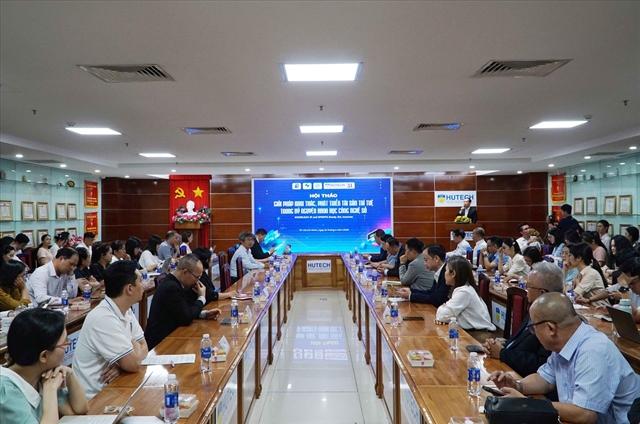
The workshop, called "Solutions for Exploiting and Developing Intellectual Property in the Era of Digital Science and Technology," was held on April 24.
The event was co-organised by the Intellectual Property Office of Việt Nam (IP Việt Nam) under the Ministry of Science and Technology, the municipal Department of Science and Technology, the City’s Intellectual Property Association, and the HCM City University of Technology (HUTECH).
Speaking at the event, Trần Lê Hồng, deputy director general of IP Việt Nam, emphasised that IP serves as the "engine" of innovation.
By establishing a fair ‘playing field’, it allows inventors and businesses to recover their Research and Development (R&D) investments and continue producing breakthrough initiatives.
"In business, trademarks and industrial designs are vital tools to protect identity, prestige, and economic value while preventing counterfeit goods," he said.
IP facilitates the commercialisation of research results, particularly within universities. It acts as a bridge to transform scientific findings into tangible assets and foster the creation of spin-off companies, he added.
Despite a relatively complete legal framework, the sector faces significant hurdles amid rapid digital transformation.
Nguyễn Trung Hiếu, an expert from the Center for Research, Training, and Support-Consultancy (IP Việt Nam), noted that the field is under pressure from a shortage of skilled human resources and overloaded, non-synchronous data infrastructure.
"Digital transformation in IP is not merely about digitising documents; it is about redesigning the entire operational architecture to enhance national competitive advantage," he said.
He proposed restructuring processes to be faster and more automated to shorten the time for establishing IP rights.
From an academic perspective, Associate Professor Phạm Văn Việt, director of the CIRTech Institute of Technology at HUTECH, said forming spin-off enterprises is an inevitable trend for modern universities.
“However, local reality shows that commercialisation rates remain modest due to weak links between academia and industry, as well as a lack of synchronous financial mechanisms,” he said.
To foster the growth of these enterprises, he proposed the development of a three-pillar ecosystem:
Strengthening the institutional framework: This involves establishing transparent IP policies that robustly protect the legal rights and interests of scientists.
Enhancing infrastructure and incubation: The focus should be on providing dedicated co-working spaces, advanced laboratories, and professional mentorship networks to nurture startups.
Expanding access to capital and markets: It is essential to create strong bridges between researchers, venture capital funds, and major corporations to ensure financial backing and market reach.
|
| An overview of the workshop on exploiting and developing intellectual property in the digital era, held in HCM City on April 24. |
Việt also outlined a five-step roadmap for bringing scientific ideas to market, starting from screening and protection to technology incubation, valuation, enterprise establishment, and finally, reinvestment into new research.
According to experts, legal corridors for the spin-off model are improving, specifically citing Resolution No 57-NQ/TW of the Politburo as an institutional breakthrough for science, technology, and innovation.
To turn IP into a true developmental resource, speakers called for increased investment in applied research and stronger public-private partnerships, ensuring a cohesive synergy between the State, universities, and the business sector. — VNS
Society
 Society
 Society
 Society
 Society
 Society
 Society
 Society
 Society
 Society
 Society
 Society
 Society
 Society
 Society