 Society

LANDMARK Launches ‘Destination CENTRAL’: A District-Wide Invitation to Explore the Dynamism, Luxury, and Soul of Central
1.
|
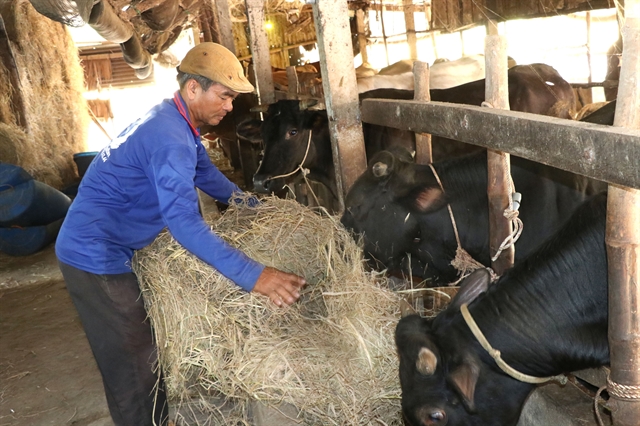
| A farmer feeds cattle at a household livestock facility in Vĩnh Long Province, supported by preferential loans from the Vietnam Bank for Social Policies to expand production and improve income. — VNA/VNS Photo |
VĨNH LONG — Efforts to expand funding for social policy credit are being stepped up in the Mekong Delta province of Vĩnh Long, as local authorities seek to better support livelihoods and socio economic development.
Social policy credit programmes have continued to deliver tangible results, helping generate employment and support production and business activities, while also contributing to improved living standards and sustainable social security across the province.
Through these programmes, more than 39,000 borrowing households have received loans totalling VNĐ2.08 trillion (US$83.3 million) to develop production and business activities. The funding has helped increase incomes, improve living conditions, invest in production tools and accumulate capital.
According to the provincial branch of the Việt Nam Bank for Social Policies (VBSP), total disbursement in the first quarter increased by over VNĐ1 trillion (US$40 million) compared to the beginning of the year, representing a growth rate of 7 per cent and fulfilling 73.7 per cent of the assigned capital plan.
Credit quality has remained at a good level, with nearly 6,500 savings and loan groups rated as good, accounting for 84.3 per cent, while the ratio of overdue and frozen debt has been kept low at just 0.45 per cent.
However, challenges remain. There is still a shortage of capital for job creation programmes as well as rural clean water and sanitation. The province also has more than 2,300 borrowers who have left their place of residence, with outstanding loans totalling VNĐ69.5 billion (US$2.8 million), while over 200 savings and loan groups are classified as average.
At a meeting held on April 14, the provincial Board of Representatives of the Management Council of the Việt Nam Bank for Social Policies reviewed its first quarter performance and outlined key tasks for the second quarter of 2026.
The hybrid meeting connected directly and online to 124 communes and wards across the province, and also launched a campaign to mobilise savings deposits from organisations and individuals to supplement lending capital.
Nguyễn Thị Bé Mười, vice chairwoman of the provincial People’s Committee and head of the board, said the effective implementation of preferential credit programmes not only helps secure livelihoods but also addresses a range of social issues, thereby contributing to local socio economic development.
Board members were urged to improve the efficiency of policy credit while ensuring safety in the implementation of preferential lending programmes.
Close coordination among different levels of government will be required, with provincial authorities responsible for issuing appropriate mechanisms and policies, while commune and ward authorities directly organise implementation in line with practical conditions.
The board also called for stronger inspection, supervision and evaluation of loan use to ensure funds reach the right beneficiaries.
At the same time, agencies were asked to review and strengthen organisational structures, while implementing Government regulations on social policy credit in line with plans set by the provincial Party Committee and People’s Committee.
Local authorities at the commune level were encouraged to play a more active role in directing, implementing and monitoring policy credit programmes, particularly by enhancing the role of hamlet heads, socio political organisations and savings and loan groups in supervising borrower selection and fund usage.
For its part, the provincial VBSP branch will continue reviewing and refining support policies, while tightening control over overdue and bad debts and handling difficult to recover loans.
The bank will also strengthen coordination with relevant agencies in implementing joint programmes and step up efforts to encourage voluntary savings deposits from organisations, businesses and residents to mobilise additional resources.
Lê Hoàng Phi, director of the provincial branch, said the bank would focus on improving credit quality, reducing overdue debt and strengthening the performance of savings and loan groups, while raising borrowers’ awareness and responsibility in using and repaying loans.
At the same time, it will continue advising on reallocating entrusted public investment capital to expand funding sources, while integrating policy credit with local socio economic development programmes and projects. — VNS
Society
 Society
 Society
 Society
 Society
 Society
 Society
 Society
 Society
 Society
 Society
 Society
 Society
 Society
 Society