 Society

LANDMARK Launches ‘Destination CENTRAL’: A District-Wide Invitation to Explore the Dynamism, Luxury, and Soul of Central
1.
|
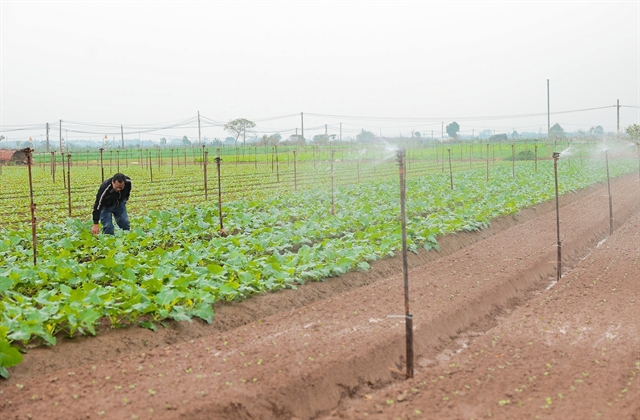
| The Đông Cao General Services Cooperative in Hà Nội's Mê Linh Commune has applied PEP irrigation technology across its riverside farming area, helping reduce labour demands while improving productivity and product quality. — VNA/VNS Photo Lê Đông |
HÀ NỘI — As rapid urbanisation shrinks agricultural land while demand for high-quality produce rises steadily, Việt Nam’s agricultural sector is under growing pressure to increase value per unit of land.
In response, digital and green transformation is emerging as a fundamental solution to cut costs, raise productivity and build more sustainable growth models.
Nguyễn Văn Tùng, director of the Đông Anh Safe Vegetable Cooperative, one of Hà Nội’s largest certified safe vegetable-growing areas, said technology has significantly improved production efficiency.
“With just a smartphone, I can adjust nutrient levels in the water, switch cooling systems on and off, monitor pests and check the condition of the vegetables,” he said.
“Thanks to technology, productivity has increased by nearly 30 per cent, while water and fertiliser use has fallen by more than 40 per cent compared to traditional farming methods.”
Each batch of vegetables is labelled with a QR code, allowing buyers to trace information such as sowing dates, cultivation conditions and quality standards. The model currently supplies dozens of tonnes of certified-safe vegetables each month to schools and supermarkets across Hà Nội.
In HCM City, under traditional production methods, costs at the GAP Clean Vegetable Production, Trade and Service Cooperative in Đông Thạnh Commune ranged from VNĐ50–70 million (approximately US$1,900–2,660) per hectare. By adopting high-tech and circular production models, these costs have been reduced to just VNĐ20–30 million (around $760–1,140).
Cooperative Director Mai Văn Khánh said the shift towards greener, high-tech and circular production has helped enhance production autonomy.
“The cooperative has also invested heavily in seedlings and production tools to support its members to reduce risks linked to fluctuations in input materials, while working with retail suppliers to stabilise both prices and output in line with our expansion plans,” he said.
These are just two examples out of many businesses and cooperatives in Việt Nam’s major cities that have effectively adopted digital and green transformation models.
Against a backdrop of rapid technological change and mounting sustainable development demands, digital and green transformation have become an inevitable trend and a key driver for businesses, particularly those operating in the agricultural sector, to foster growth in a new era.
According to agricultural experts, digital transformation has become an unavoidable pathway as abnormal weather patterns, global warming and increasingly unpredictable natural disasters continue to affect production.
Integrating digital transformation into agricultural production can help make the sector safer and more sustainable.
Prof. Dr. Mạc Quốc Anh, vice chairman and secretary general of the Hà Nội Association of Small and Medium Enterprises and director of the Institute for Business Development, cited a report from the Ministry of Planning and Investment (now the Ministry of Finance) showing that around 60 per cent of businesses have begun applying digital technology at a basic level, while about 20 per cent have developed clear digital transformation strategies.
However, only around 5 per cent have achieved comprehensive digital transformation.
As for the green transformation, a survey by the Việt Nam Chamber of Commerce and Industry found that approximately 40 per cent of businesses have started paying attention to Environmental, Social and Governance (ESG) standards, but only about 10 per cent have implemented large-scale green production models.
This indicates that the transformation process among Vietnamese enterprises remains at an early stage, with significant room for further development.
Shifting towards digital and green models still faces multiple challenges, including relatively high initial investment costs, particularly for green technologies in production.
Other issues include shortages of skilled workers and limited technological and governance capacity among many small- and medium-sized enterprises (SMEs).
To accelerate this process, further improvements to institutions supporting the digital and green economy are needed. Focus should also be placed on developing a robust green finance ecosystem and expanding support programmes for SMEs through consulting, training and technology transfer.
Greater investment is also needed to train workers in digital technology, ESG governance and green technology, alongside stronger development of national digital infrastructure to underpin the digital economy.
Deputy Minister of Agriculture and Environment Võ Văn Hưng said that digital transformation is an essential task to improve governance efficiency, better serve people and build a smart agricultural sector.
In the next few years, the sector will focus on three key priorities: shifting from manual, experience-based management to data-driven management; completing shared sectoral databases that are accurate, complete, clean and up-to-date; and applying digital technology in monitoring, forecasting and decision-making, he said. — VNS
Society
 Society
 Society
 Society
 Society
 Society
 Society
 Society
 Society
 Society
 Society
 Society
 Society
 Society
 Society