 Society
Vietnamese students place confidence in Việt Nam-China cooperation
1.
|
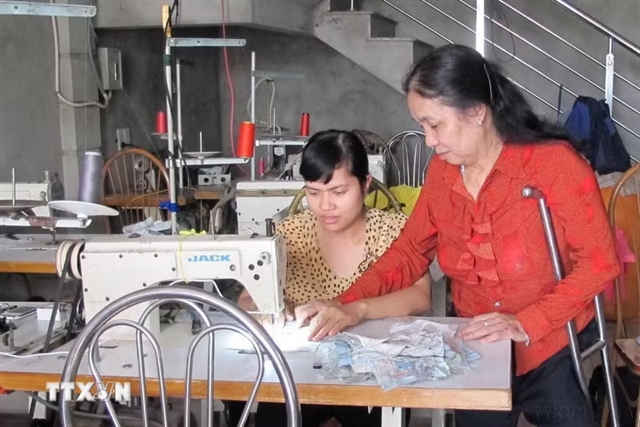
| Nguyễn Thị Hòa, owner of a garment workshop in Ninh Bình Province, is a person with disabilities. Over several decades of operation, her workshop has trained thousands of workers, including around 500 people with disabilities. — VNA/VNS Photos |
HÀ NỘI — Facing barriers to employment access, many vocational training models tailored to the needs of people with disabilities are being implemented, helping create sustainable livelihoods and promote social inclusion.
Lương Thu Hòa, Principal of the Xã Đàn primary and secondary school in Hà Nội – which offers education suitable to both mainstream and hearing-impaired students, said vocational skills equipped at an early stage is a crucial foundation for hearing-impaired students to become more independent.
In the past academic year, the school introduced diverse vocational training activities for the group, including facial skincare, handmade flower crafting, beverage preparation, information technology, and even the establishment of a robotics team. In the coming time, it plans to expand its training scale and develop a high school level to provide better learning opportunities for the disabled learners.
Although job opportunities for people with disabilities have improved, challenges remain, with many still limited to traditional manual jobs with low income. This reality highlights the need to expand new training models aligned with both individual capabilities and market demand.
Addressing this need, a project teaching therapeutic hair washing for the visually impaired, implemented by the Hanoi Blind Association from October 2025 to March 2026 with funding from Finland's Abilis Foundation, has provided specialised training for 20 learners. In addition to vocational skills, participants were trained in communication, customer care, and the application of AI in marketing and service promotion. After completing the programme, all trainees graduated, with many confidently starting their own businesses, marking a shift from basic support to economic empowerment.
Đinh Việt Anh, Vice President of the Vietnam Blind Association, noted that the project not only provides new skills but also helps change mindsets. Many trainees have overcome self-doubt and gained confidence in delivering technically demanding services. The model is expected to be replicated more widely, enabling visually impaired individuals to pursue entrepreneurship or work in professional spa environments.
Experts observed that improving employment outcomes for the disabled requires diversifying career options and gradually shifting toward high-demand sectors such as IT, psychological counselling, and customer service. Standardising workforce skills through professional soft-skills training, applying AI to reduce barriers, and building formal job-matching platforms are also key solutions.
In 2025, the Association in Support of the Vietnamese Handicapped and Orphans organised vocational training for 645 people with disabilities, with total funding exceeding VNĐ3.6 billion (US$136,700). About 70 per cent of trainees secured jobs and stable incomes after training.
Notably, six online sales training courses were conducted for over 300 participants nationwide, with 162 graduates continuing to receive support in sourcing goods for business, thus creating jobs suited to their health conditions and generating stable income.
The association also provided financial support totalling over VNĐ9.7 billion for 755 people with disabilities and their families, along with livestock and plant support for targeted households, helping improve livelihoods and living standards.
In the context of digital transformation, pathways to inclusion for people with disabilities are becoming more practical and sustainable. With continued community support and appropriate policies, they can confidently participate in the workforce, achieve self-reliance, and affirm their value in society. — VNA/VNS
Society
 Society
 Society
 Society
 Society
 Society
 Society
 Society
 Society
 Society
 Society
 Society
 Society
 Society
 Society