 Society
European higher education week opens new opportunities
1.
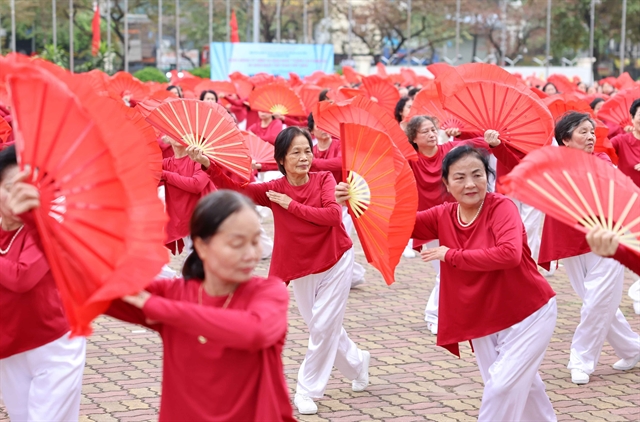 |
| Old persons join a wellness fan dance in Hà Nội. — VNA/VNS Photo |
HÀ NỘI — In Việt Nam, self-help clubs among older people are helping members live happily and healthily while continuing to contribute to the community. The Intergenerational Self-Help Club (ISHC) model is a typical initiative of the Việt Nam Association of the Elderly, supported technically and financially by HelpAge International (HAI) in Việt Nam.
The model is considered well-suited to the country’s socio-economic conditions, creating mutual support networks among members and integrating activities such as culture, sports, microfinance and home-based care. The project has received numerous prestigious domestic and international awards, including the Healthy Ageing Asia Innovation Award in 2020 and recognition by The Wall Street Journal in 2022. Most recently, it won the top prize at the Human Act Prize 2025.
Each ISHC is a voluntary social organisation with 50 to 70 members, working together to improve health, increase income, care for vulnerable groups, strengthen community solidarity and promote the role of older persons. Membership is intergenerational, with about 60 to 70 per cent older persons and 30 to 40 per cent younger members. All clubs establish income-generating and operational funds to sustain and enhance effectiveness.
According to Nguyễn Thị Tư, member of the standing committee of the Việt Nam Association of the Elderly, the country now has more than 9,000 ISHCs across 34 provinces and cities, with nearly 500,000 members. These clubs are managed by older persons themselves and operate under principles of self-governance, transparency and accountability. Their distinctive feature is intergenerational linkage: older persons act as the core connectors, passing on experience and supporting younger generations in economic development and cultural life, while younger members bring vitality and innovation, she said.
“This two-way interaction creates a sustainable and inclusive living environment,” she said.
Over the past 20 years, the ISHC model has achieved significant results, contributing to the implementation of social security policies at grassroots level, particularly in protecting, caring for and promoting the role of older persons amid population aging. The then Prime Minister has approved three national schemes to expand and maintain the quality of this model.
The association will continue to work with ministries, sectors and localities to strengthen existing clubs and establish at least 12,000 new ones, aiming to cover at least 20 per cent of residential areas. By 2030, all communes and wards are expected to have at least three standard clubs. About 70 to 80 per cent of clubs will maintain all eight core activities with monthly meetings, and 85 per cent of management boards will be trained in operational skills.
Dr Trịnh Thu Nga from the Institute of State Organisational and Labour Sciences under the Ministry of Home Affairs said Việt Nam has gradually developed diverse and socialised service models for older persons. In addition to ISHCs, services such as home care, community support, public and private social protection facilities, day care, semi-residential care and integrated care models are emerging, she said.
However, to meet the growing demands of an aging population, it is necessary to build a friendly, multi-tiered, integrated and sustainable service ecosystem, placing the community as the foundation, technology as a supporting tool and older persons at the centre of all policies, she said. Club activities should also be innovated to include digital transformation, green transition, digital skills training, online fraud prevention and environmental protection.
She also recommended scaling up the integrated care model for older persons, following new guidelines from the World Health Organization. This model includes four steps, from initial community-based assessment to personalised care planning and monitoring, emphasising the roles of communities and caregivers. A one-stop service network connecting health care, social protection, families and communities should also be established, she said.
Experts stress the need to develop home-based care services, professionalise the workforce and train community nurses, social workers and volunteers according to geriatric standards, focusing on rehabilitation, mental health care and family support.
Dr Nga also proposed piloting a “multi-tier integrated community care model” for the 2026–35 period, which consists of three levels: ISHCs as the core at the grassroots level; intermediate day-care service centres and specialised health care and rehabilitation systems at provincial and regional levels. It operates on principles of people-centred care, integration of health, social and family services, application of digital technologies and big data, environmental friendliness, financial sustainability and caregiver training, she said. — VNS
Society
Society
 Society
 Society
 Society
 Society
 Society
 Society
 Society
 Society
 Society
 Society
 Society
 Society
 Society