 Society
European higher education week opens new opportunities
1.
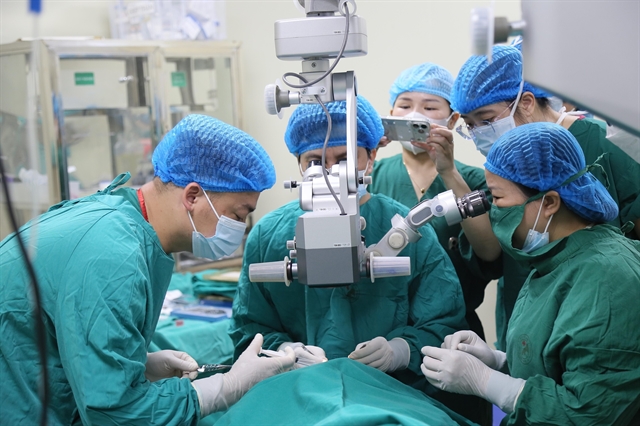 |
| Doctors at Đức Giang General Hospital performing a corneal transplant. — Photo suckhoedoisong.vn |
HÀ NỘI — A new frontier in treating blindness is opening as scientists, clinicians and industry push to make bioengineered corneas a clinical reality.
Biomaterial alternative to donated human corneas promises to ease chronic shortages of donor tissue, widen options for complex cases and restore sight to thousands who currently face long waits or no viable treatment.
Dr Vương Ánh Dương, deputy director of the Department of Medical Services Administration, the Ministry of Health, said corneal disease was one of the leading causes of blindness, but treatable. Corneal transplantation could restore patients’ vision, he said.
It is estimated Việt Nam has over 300,000 people blind from corneal disease who need grafts, according to Dương, who also cited global figures that place more than 12 million people on waiting lists for corneal transplants.
The gap between demand and supply is stark. Donation rates remain low and tissue banks cannot meet rising needs.
“Many patients face long waits and may lose the opportunity for timely treatment,” Dr. Vương warned. He also noted that severe cases such as ocular burns, complex surface injuries or multiple graft failures were often poorly served by conventional transplantation, making alternative solutions a clinical priority.
Bioengineered corneas, made from advanced biomaterials and tissue‑engineering methods, replicate the clarity and structure of human corneas and offer a scalable, on‑demand alternative that could fill supply gaps and serve patients unsuited to donor grafts.
“Bioengineered corneas are a new invention and an advanced biomaterial that significantly expand substitute options for corneal disease treatment,” said Professor Tôn Thị Kim Thanh, head of the Vietnam Ophthalmological Society.
“Developing and applying this material will help us gradually reduce dependence on donor corneas in clinical practice,” she added, underscoring the potential to change treatment pathways for many patients.
At the recent international conference on bioengineered corneas, a representative from Gen and Stem Cell Vietnam Company (VGCT), part of CT Group, said it had invested more than a decade in research and in building an integrated ecosystem spanning R&D, production and commercialisation.
“We have consistently invested in research for more than a decade, building an ecosystem from R&D to commercialisation,” said Đặng Thị Tươi, deputy general director of VGCT.
She said bioengineered corneas are a field with deep scientific and humanitarian value and national strategic importance, and stressed the “'three‑party' cooperation model of government, academia and industry under Resolution 57 as the way to scale the technology nationwide.
The Ministry of Health has received a dossier seeking market authorisation for a bioengineered cornea in Việt Nam. That filing signals that regulators, clinicians and industry are testing pathways to bring the product from lab to clinic.
Success depends not only on the technology itself but on the capacity to organise system‑wide implementation, according to Professor Thanh.
She called for close coordination among eye hospitals, corneal specialists and research units to shorten the gap from research to clinical use while ensuring patient safety and efficacy. Training, standardised protocols and robust post‑market surveillance will be essential components of any rollout.
“We must ensure that any new material meets the highest standards before widespread use,” Thanh warned, calling for phased clinical trials and collaborative oversight.
For patients and families, restoring sight transforms daily life, independence and economic prospects.
“For a blind person to see again is not only a medical achievement but a full restoration of life capacity and work ability, reducing the caregiver burden on families,” Tươi said.
At societal scale, restored vision can improve quality of life, increase workforce participation and generate economic as well as humanitarian value. — VNS
Society
Society
 Society
 Society
 Society
 Society
 Society
 Society
 Society
 Society
 Society
 Society
 Society
 Society
 Society