 Politics & Law
Vietnamese Prime Minister meets Cambodian National Assembly President
1.
|
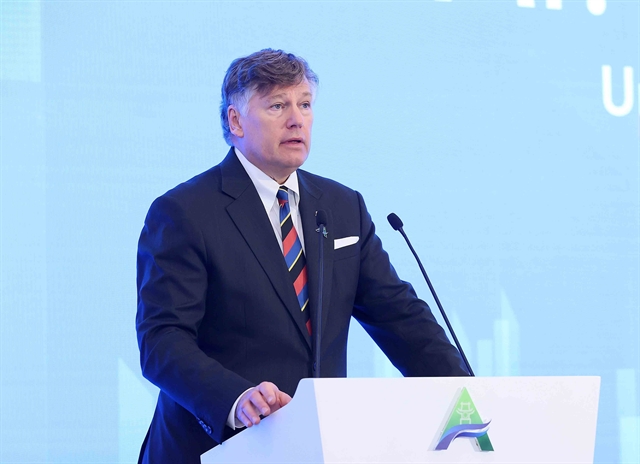
| US Deputy Secretary of State Christopher Landau addressed the 3rd ASEAN Future Forum in Hà Nội, in a dedicated panel 'The United States and ASEAN: A strong and resilient partnership for the future' on June 10. — VNA/VNS Photo |
HÀ NỘI — United States Deputy Secretary of State Christopher Landau has used his first visit to Việt Nam to reaffirm Washington’s commitment to deepening ties and engagements with the country as well as ASEAN as a whole, describing Southeast Asia as one of the world’s most dynamic regions and highlighting economic cooperation, energy security, digital transformation and maritime stability as key pillars of future collaboration.
Addressing the 3rd ASEAN Future Forum in Hà Nội, Landau said the evolution of US–Việt Nam relations from wartime adversaries to Comprehensive Strategic Partners stood as a powerful example of reconciliation and cooperation.
“This is my first time in Việt Nam,” he said, noting that he had been moved by the warmth of the Vietnamese people and the transformation of bilateral ties.
The deputy secretary said the United States supports “a strong, independent and prosperous Việt Nam", describing that objective as the guiding principle behind bilateral cooperation. He pointed to expanding collaboration across diplomacy, defence, security, law enforcement, trade and people-to-people exchanges.
Landau also praised Việt Nam's growing international role, citing its participation in peacekeeping efforts and broader contributions to international security.
“Việt Nam isn’t just a regional player, it’s truly a global partner,” he said, praising the country's participation in the US-led Board of Peace meant to address the Gaza situation.
Landau said he's pleased to be the highest-ranking American official to attend the ASEAN Future Forum, adding that his participation reflected the importance that President Donald Trump’s administration places on Southeast Asia.
“The United States is a strong supporter of ASEAN,” he said, arguing that the region’s strategic importance stems from both its rapid economic growth and its role in maintaining regional stability.
He said more than 6,000 US companies are operating across ASEAN, while trade and investment links with Southeast Asia support hundreds of thousands of jobs in the United States. He stressed that economic ties between the US and ASEAN have become deeply integrated and mutually beneficial.
“The United States is ready, willing, and able to be an active partner with ASEAN,” he said, while acknowledging the diversity of political systems, cultures and development levels among member states.
Landau devoted significant attention to energy security, portraying it as the foundation of economic development across the region.
He said recent global energy disruptions had underscored the need for countries to diversify energy sources and supply chains. Washington, he noted, is seeking closer cooperation with ASEAN countries in areas ranging from liquefied petroleum gas (LPG) and liquefied natural gas (LNG) to broader energy resilience initiatives.
The deputy secretary highlighted ongoing US efforts to increase energy exports and support partners facing supply challenges, citing shipments of crude oil and LPG to the Philippines. He also voiced support for expanding the ASEAN Power Grid as a means of improving regional energy connectivity and reliability.
On critical minerals, Landau said the United States is exploring opportunities to share expertise, identify supply-chain gaps and encourage investment aimed at creating more resilient and diversified supply networks, and in this field, there is considerable potential for deeper US-ASEAN cooperation in both conventional and emerging energy sectors.
The US also seeks to cooperate further with ASEAN in terms of digital technology.
The American diplomat expressed support for the development of a high-standard ASEAN Digital Economy Framework Agreement and stated that artificial intelligence is a transformative technology capable of driving economic growth, improving public services, expanding access to education and strengthening healthcare systems.
Landau said Washington wants to identify opportunities for closer cooperation on AI development following the inaugural US-ASEAN AI ministerial meeting held two weeks earlier. He advocated policies that encourage innovation and technological development rather than unnecessarily restricting it.
The deputy secretary also underscored the importance of trusted digital infrastructure, including 5G networks, undersea cables, data centres and energy systems.
“The choices you all make today about infrastructure partners will shape your security and prosperity for decades to come,” he said.
Landau described Southeast Asia as one of the world’s most digitally connected regions and argued that ASEAN countries should have access to advanced technologies as AI becomes increasingly integrated into economies and daily life.
Landau reaffirmed longstanding US positions in the East Sea (known internationally as the South China Sea), saying Washington seeks to preserve peace and stability, uphold freedom of navigation and overflight, maintain the free flow of commerce and oppose coercion in resolving maritime disputes.
He noted that the issue affects not only regional countries but also global trade flows worth trillions of dollars annually.
The deputy secretary voiced support for ASEAN’s efforts to negotiate a Code of Conduct for the South China Sea that is consistent with international law and protects the interests of all nations. He said the United States would continue working with Việt Nam and other ASEAN partners to ensure the waterway remains “free and open”.
Beyond traditional security concerns, Landau identified online scam centres as a growing regional threat requiring coordinated action.
He said scam operations were harming citizens, businesses and economies throughout Southeast Asia while also exploiting victims of human trafficking. The issue, he argued, extends beyond law enforcement and has become both an economic and humanitarian challenge.
The United States, he said, shares an interest with ASEAN governments in dismantling criminal networks, protecting victims, and bringing high-level perpetrators to justice.
During the Q&A session, President of the Diplomatic Academy of Việt Nam Nguyễn Hùng Sơn voiced concerns that changes in US administrations can create uncertainty about long-term American engagement in the region.
Landau acknowledged that the US political system can produce shifts in priorities as administrations change. However, he argued that engagement with ASEAN has increasingly become a bipartisan area of consensus.
He pointed to the elevation of US-ASEAN ties to a Comprehensive Strategic Partnership under the previous administration and said the current administration supports continued strengthening of those relations.
While acknowledging that US policy had not always followed a 'straight line', he said: "The trend has always been towards increasing engagement, and I don’t see that changing in future.”
He added that long-term resilience in US-ASEAN relations should depend less on individual political leaders and more on institutional, economic and technological links built over time.
Energy agreements, digital cooperation and expanding investment ties, he said, can create enduring foundations that remain intact regardless of political changes in Washington or elsewhere.
Landau concluded by expressing optimism about the future of US engagement with both Việt Nam and ASEAN, saying the region’s economic dynamism and growing strategic importance provide a strong basis for deeper cooperation in the years ahead. — VNS
Politics & Law
 Politics & Law
 Politics & Law
 Politics & Law
 Politics & Law
 Politics & Law
 Politics & Law
 Politics & Law
 Politics & Law
 Politics & Law
 Politics & Law
 Politics & Law
 Politics & Law
 Politics & Law
 Politics & Law