 Society

Lotte, Phát Đạt combine strengths in Thu Thiem project
1.
|
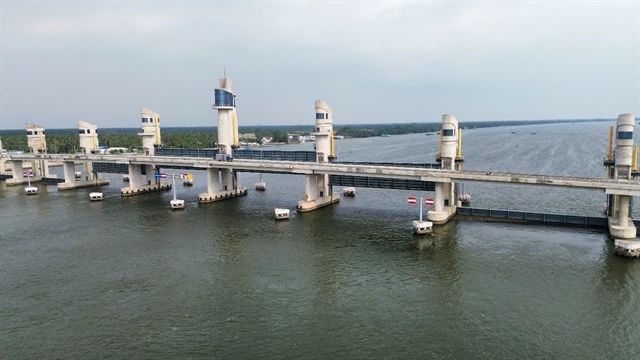
| The Cái Lớn sluice on the Cái Lớn River in the Mekong Delta province of An Giang regulates salt, freshwater and brackish water, serving agriculture and daily household use. — VNA/VNS Photo |
HCM CITY — As the dry season intensifies, saltwater intrusion is pushing deeper into river systems in the Cửu Long (Mekong) Delta and also threatening irrigation in the central region, the Department of Water Resources Management under the Ministry of Agriculture and Environment.
In the delta, the intrusion this month is expected to intensify during high tides, with salinity of four grammes per litre penetrating up to 60km into river mouths.
Most plants can tolerate only one gramme.
In the delta’s Vàm Cỏ river system, including the Vàm Cỏ Đông and Vàm Cỏ Tây rivers, salinity is forecast to reach four grammes per litre and extend 55–60 kilometres inland, five to seven kilometres less than last year.
Local authorities have been urged to proactively operate irrigation works and store freshwater to ensure adequate supply for agriculture and household use during the peak dry season.
During high tides, salinity may affect water intake at irrigation works located 45–55 kilometres from the sea.
The Cái Lớn – Cái Bé sluice system, the largest in the delta, has effectively controlled saltwater intrusion.
Authorities across the delta are drawing up response plans and rolling out both structural and non-structural measures to cope with salinity.
They are also advising locals to adjust farming schedules to limit losses.
The provinces and Cần Thơ in the delta are storing fresh water when salinity levels are low, dredging canals and repairing degraded irrigation works.
|
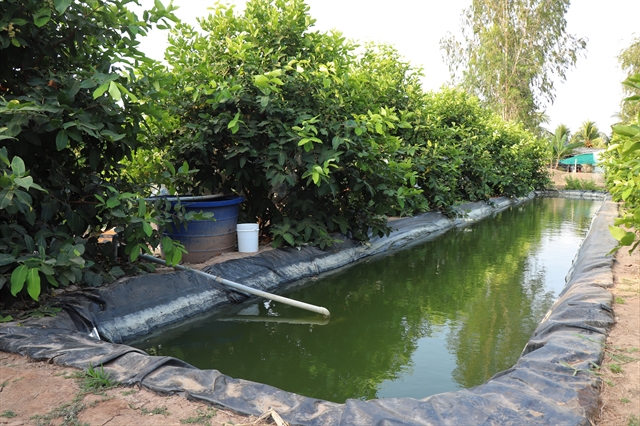
| To cope with saltwater intrusion, residents in Cù Lao Dung Commune in the Cửu Long (Mekong) Delta city of Cần Thơ dig ponds to store water for irrigation. — VNA/VNS Photo |
Drought risks
Elsewhere, in the southeastern region, localities are entering the peak dry season.
Reservoir storage is forecast to fall to 61 per cent of capacity by the end of this month, according to the Department of Water Resources Management.
With current water levels and expected rainfall, there is likely to be enough water to meet demand for the 2025–26 winter–spring crop, it said.
But widespread heatwaves forecast from March and intensifying in April could increase the risk of water shortages at minor irrigation works and in areas beyond irrigation coverage.
In the South-Central Coastal–Central Highlands region, south-central coastal localities have planted 354,600ha of annual crops for the winter–spring crop, including 229,600ha of rice and 125,000ha of other annual crops, along with 51,000ha of perennial trees.
Central Highlands localities have planted around 224,400ha of annual crops, including 96,100ha of rice and 128,300ha of other crops, and more than 884,000ha of perennial trees.
Saltwater intrusion in the Vĩnh Điện River in the Vu Gia – Thu Bồn basin caused salinity to jump to 5.8 grammes per litre at the Tứ Câu pumping station at times, higher than the permitted threshold for five grammes.
The department warned that without timely anti-salinity measures, continued increases this month could force Tứ Câu and other stations on the Vĩnh Điện River to suspend operations.
This will directly affect more than 2,000ha of farmlands and water supply to the Hội An Water Plant.
Other areas are largely expected to have sufficient water. — VNS
Society
 Society
 Society
 Society
 Society
 Society
 Society
 Society
 Society
 Society
 Society
.jpg) Society
Society
 Society
 Society
 Society