 Society
Việt Nam fosters comprehensive cooperation with Uruguay
1.
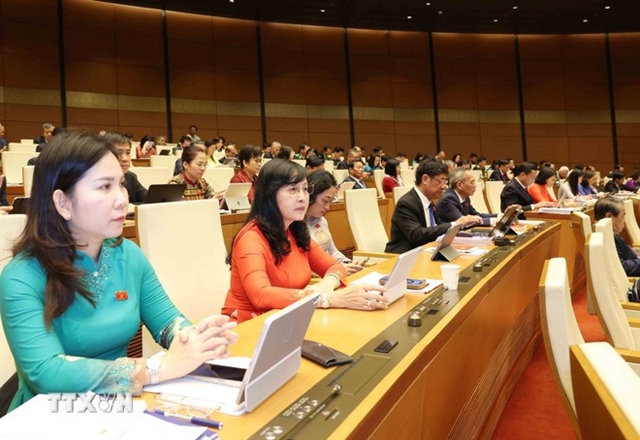 |
| Female deputies at the 15th National Assembly. — VNA/VNS Photo |
Khánh Dương
HÀ NỘI — Vietnamese women are increasingly affirming their leadership roles in the National Assembly (NA) and people’s councils at all levels, with the proportion of female candidates in the upcoming general elections rising to over 40 per cent nationwide.
According to the National Election Council, a total of 864 candidates have been officially announced to run for 500 seats in the 16th NA across 182 constituencies nationwide.
Of these, 392 are women, accounting for 45.37 per cent.
Women represent 42 per cent of candidates for Hà Nội People’s Council, while the proportion at commune and ward level in the city has reached 44.8 per cent.
Experts say the growing presence of female candidates at both national and grassroots levels reflects a significant shift in perception, as women are no longer seen merely as symbolic representatives but as substantive contributors to public decision-making and governance.
Lỗ Thị Yến Ngọc, 35, an official of the Việt Nam Fatherland Front Committee of Quốc Oai Commune in Hà Nội and a candidate for the communal People’s Council for the 2026–31 term, said the more than 40 per cent share of female candidates demonstrates not only improved gender balance but also the recognition of women’s practical contributions.
“In the past, when young people or women were nominated to run for seats on people’s councils, it was often for representational purposes or to meet gender targets,” she told Việt Nam News.
“But this year, I see a clear difference. The proportion of women running exceeds 40 per cent. That’s significant.
“It shows that their participation is no longer merely symbolic or about meeting a quota. Women are being recognised as a substantive and practical force.”
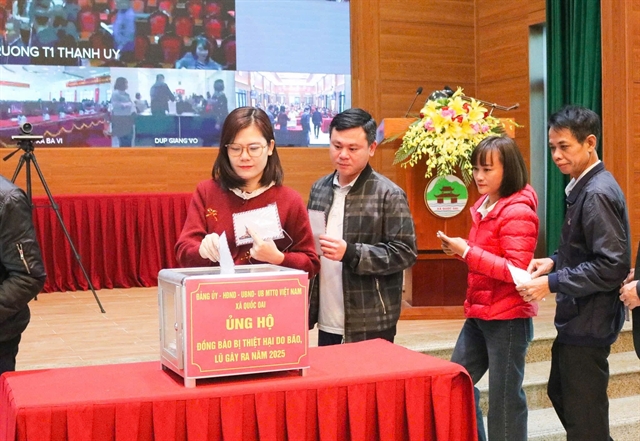 |
| Lỗ Thị Yến Ngọc (first in line) attends the donation campaign of Quốc Oai Commune's authorities for victims of typhoons and flooding in 2025. — Photo courtesy of Ngọc |
In Quốc Oai Commune, 32 out of 56 candidates for the communal People’s Council are women, accounting for 57 per cent.
Ngọc, who has worked in local administrative offices with many female leaders, said women in leadership positions often create a more open and empathetic working environment.
“When we have women in leadership positions, it often feels easier to open up, share concerns and feel truly understood," she said.
"As wives and mothers themselves, they tend to empathise deeply with the challenges others face.
“For women in particular, working and interacting under the guidance of a female leader can bring many advantages.
“That is why I have always hoped that the proportion of women in leadership roles within the political system will be on par with men or even higher.”
Lâm Nữ Dạ Thảo, 39, deputy secretary of the Party Committee of Hà Thượng Hamlet, Gio Linh Commune, central Quảng Trị Province, is running for a seat on the communal People’s Council for the second time.
She said the role of women in local governance is increasingly recognised and effectively promoted, with broader opportunities for women to serve as officials, Party members, civil servants and public employees, as well as to hold key positions in Party committees, people’s councils, people’s committees, Fatherland Front bodies and socio-political organisations.
Gio Linh Commune has 35 People’s Council candidates for the 2026-31 term, including 16 women, accounting for 45.71 per cent.
In Gio Linh Commune, the role of female leaders is reflected across all sectors, with almost no limitations on how they can contribute, from economic development, socio-cultural affairs to new-style rural development.
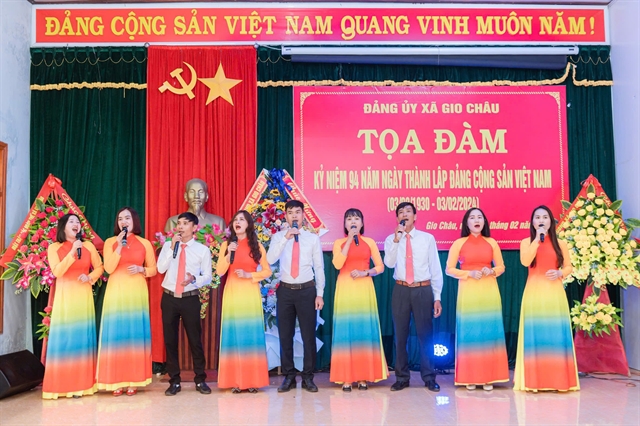 |
| Lâm Nữ Dạ Thảo (fourth from right) in an art performance at an event of local administration in 2024. — Photo courtesy of Thảo |
Thảo said social welfare, education, family affairs and mass mobilisations are areas where local female leaders often demonstrate particular strengths.
As the primary caretakers, they bring deep experience in nurturing and supporting their families and raising children while actively promoting gender equality and preventing domestic violence, she said.
“Decisions made by female leaders are shaped not only by economic efficiency, but also by considerations of humanity, equity and long-term social sustainability,” she said.
Women can do everything men can
At the age of 59, Vũ Thị Ninh Giang, head of the Women’s Union Branch in Residential Area No. 35 in Vĩnh Tuy Ward, Hà Nội, is running for a seat on the ward People’s Council for the first time.
After 12 years working as a grassroots official and Women’s Union member, she said women are present and making active contributions across nearly all activities of the local political system.
“In the era of the Fourth Industrial Revolution, women are no longer confined to traditional roles. They can lead businesses as well as government agencies,” she said.
“Women are not limited to the kitchen. They are fully capable of performing the same tasks as men and doing them well.”
Under her leadership, the grassroots Women’s Union has established savings and loan groups to help women access capital to create jobs or start small businesses, offering practical support for trade and entrepreneurship.
Confessing that she is the elderly generation among candidates, Giang said she is making daily efforts to improve her technological skills to better serve community work.
“If we learn, we can do it,” she said.
Remaining barriers
Giang said mobilising women’s participation at grassroots level remains difficult, particularly among younger women who have recently moved into neighbourhoods after marriage.
Greater efforts are needed to attract younger women and ensure balanced representation in terms of both numbers and age structure, she said.
Meanwhile, Thảo acknowledged that women still hold relatively few key and leading positions within local government, especially at village level – the tier closest to the people – where female village heads or Party cell secretaries remain rare.
This situation partly stems from limited training opportunities in management and leadership skills, as well as lingering perceptions that women may be less assertive or decisive than men, she said.
Action plans
If elected, Thảo pledged to prioritise listening to local residents and faithfully conveying their views to the People’s Council.
Giang said she would continue focusing on women’s issues in her residential area while encouraging older women to apply technology in their daily work.
As an official of the Việt Nam Fatherland Front, Ngọc said female candidates running for seats on local-level people’s councils need to equip themselves with strong public speaking skills, the ability to read and interpret legal documents and adequate technological competence. — VNS
Society
 Society
 Society
 Society
 Society
 Society
 Society
 Society
 Society
 Society
 Society
 Society
 Society
 Society
 Society