 Society
Textile exports face dual challenges of sustaining orders and boosting efficiency amid growing competition
1.
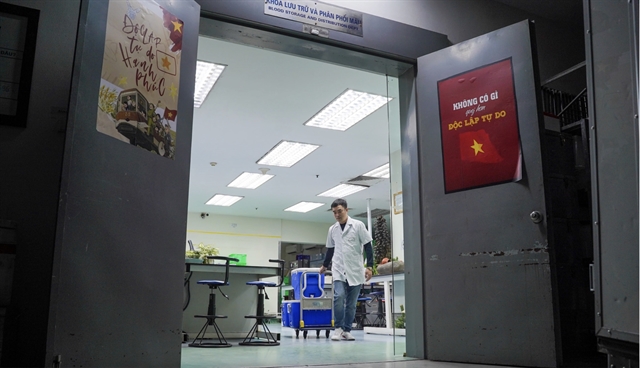 |
| Pharmacist Nguyễn Hoàng Minh is preparing containers of blood and blood products in the early morning in the Blood Storage and Distribution Department of the National Blood Centre. Photo dantri.com.vn |
HÀ NỘI — Before the city is fully awake, at 5am, while Hà Nội’s streets are still wrapped in cold mist, the Blood Storage and Distribution Department of the National Blood Centre is already in full swing.
Sitting beside the storage containers, pharmacist Nguyễn Hoàng Minh carried out a final check of each bag of blood before loading it onto the truck.
More than 500 units of blood and blood products were set to be transported that day to provincial hospitals, where many patients were waiting for transfusions to sustain their lives.
At the depot, the storage containers were arranged neatly inside the trucks.
Minh said each type of blood product would be kept at a different temperature.
“Red blood cell concentrates are stored at a temperature between 2 and 6 degrees Celsius, and during transport, the temperature must be maintained between 1 and 10 degrees Celsius. Containers holding this type of product always have a layer of ice placed on top to dissipate heat downwards, maintaining a stable temperature,” Minh told dantri.com.vn.
“Meanwhile, plasma products must be stored at minus 18 degrees Celsius or lower. The plasma containers are loaded with more ice and arranged separately from other products.
“Even a slight temperature change can cause the blood to spoil and become unusable. Therefore, proper preservation during transportation is crucial.”
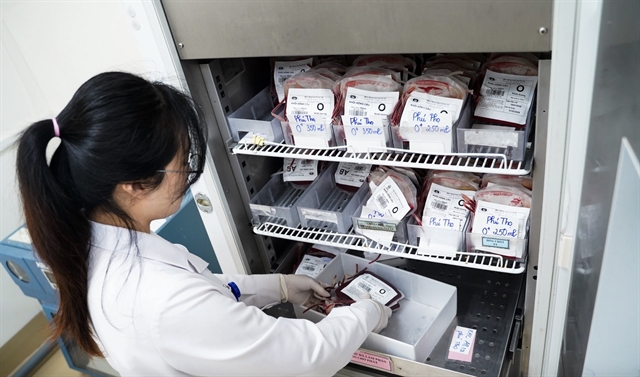 |
| A health worker is checking bags of blood. Photo dantri.com.vn |
That morning, the blood was transported to four hospitals: Phúc Yên General Hospital, Vĩnh Phúc Children’s Hospital, Vĩnh Phúc General Hospital and Lào Cai General Hospital, the final destination.
At 5.30am, the specialised vehicle driven by Nguyễn Tấn Giang, who is experienced in long-distance blood transport, left the National Blood Centre.
After one hour, the truck arrived at Phúc Yên General Hospital.
There, the transport team handed over 52 bags of red blood cell concentrates in 350ml and 250ml packs, including 25 bags of O blood group, along with one bag of frozen plasma.
Hospital staff quickly checked the shipment and placed the blood products in storage. These blood bags could be used the same day for emergencies, surgery or treatment.
Leaving Phúc Yên, the truck continued to Vĩnh Phúc Children’s Hospital.
In the cab, Giang occasionally checked the temperature control panel for the cargo compartment at the back.
The temperature inside the storage compartments must remain stable to ensure the quality of the blood.
"There is a temperature control panel for the blood storage compartment at the back. I check it to make sure the temperature does not fluctuate, which could affect the quality of the blood. Otherwise, these blood bags would spoil easily, leading to waste," the driver said.
The next stop was Vĩnh Phúc General Hospital. There, a total of 88 units of blood and blood products were delivered, including fresh frozen plasma, red blood cell concentrates, apheresis platelet concentrates and cryoprecipitate-rich plasma.
After several hours on the road, the team arrived at Lào Cai General Hospital, the final destination and the largest recipient, which received 250 units of red blood cells and 60 bags of plasma.
“Every unit of blood that arrives at the right time can help patients overcome critical situations. Therefore, transportation must be timely and under the correct storage conditions,” Minh said.
In the days leading up to Tết, demand for blood would increase and the trucks would run quietly every day, carrying opportunities of survival to patients awaiting transfusions at provincial hospitals.
On journeys that cross several provinces, each stop is a vital task that cannot be delayed, because behind those blood containers are the lives of patients waiting for transfusions.
"Just arriving on time and completing the handover makes me feel relieved. Patients are waiting for blood, so I cannot afford to be late," the pharmacist said about his work.
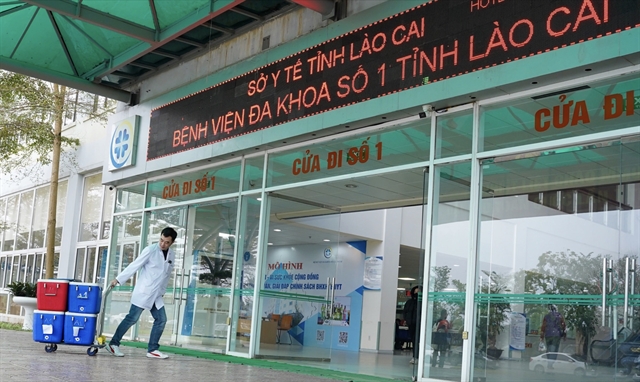 |
| Delivering blood to Lào Cai General Hospital. Photo dantri.com.vn |
More donation needed
Each type of blood product serves different patients, including those with severe anaemia, cancer patients who need platelets and people with blood clotting disorders.
Postpartum haemorrhage is one of the leading causes of maternal death. Many women can lose blood very quickly during or after childbirth. Timely transfusions and the availability of blood products are crucial to saving both mother and child.
Reliable distribution allows hospitals to treat patients promptly without waiting for supplies from higher-level facilities.
Blood is a special biological product. At present, it cannot be manufactured or artificially produced in laboratories.
Most blood used in medical treatment comes from volunteer donors. Donated blood is then screened and separated into different products for clinical use.
As the Lunar New Year, or Tết, approached, demand for blood increased while the number of donors tended to fall.
According to the National Institute of Haematology and Blood Transfusion, in February alone the blood supply for 180 hospitals in the North and some localities in the South reached about 40,000 units, with each unit equal to 250ml.
The institute called on the community to donate an additional 10,000 units, including 5,000 units of O blood group.
Meanwhile, emergency cases, surgeries and treatments for chronic diseases continue without pause.
For that reason, blood reserves at provincial hospitals need to be replenished regularly. — VNS
Society
 Society
 Society
 Society
 Society
 Society
 Society
 Society
 Society
 Society
 Society
 Society
 Society
 Society
 Society