 Society

SBV to curb property price inflation, enforce lending rate rules
1.
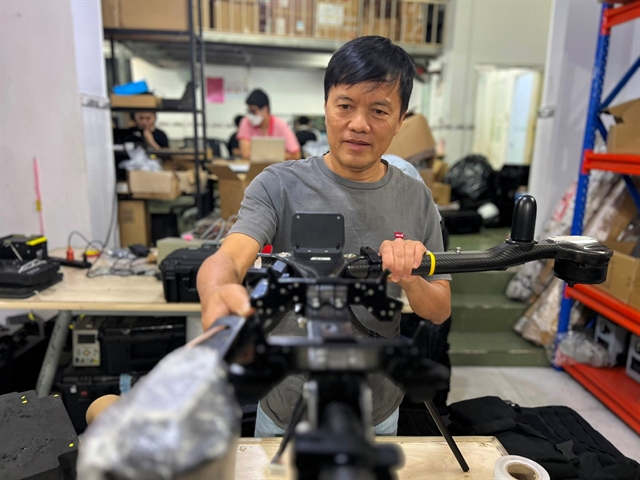 |
| Lương Việt Quốc with a Hera drone. — Photo tienphong.vn |
HÀ NỘI — When floodwaters swept across central Việt Nam last November, whole communities vanished from view. Roads disappeared, power failed and mobile networks went dark, turning the search for loved ones into a frightening wait for any sign of life.
For families trying to reach relatives in the hardest-hit areas, the silence was often the most terrifying part.
Hundreds of kilometres away, Lương Việt Quốc was fielding a phone call he did not expect and could not ignore.
A friend told him that his relatives in Khánh Hòa Province had been out of contact for days. With mobile networks down and no way to confirm whether anyone was alive, the question was simple and desperate: could a drone be sent to look?
Quốc, chief executive of Real-time Robotics (RtR), paused to weigh the risks. He and his team ran through the variables: distance, weather, terrain, flight time and the danger of flying in heavy rain.
“If we went straight away, there was at least a chance. If we didn’t, then there was no chance at all,” he said later.
And they went.
Within hours, RtR engineers and drone pilots assembled three aircraft, loaded them with batteries, phones, life jackets and food and began the long drive from HCM City to Khánh Hòa.
The drones, known as Hera, had previously been developed for high-end industrial and overseas clients. This time, their task was harder: find people.
As news of the mission spread, more messages arrived, about elderly residents trapped in flooded homes, children marooned in schools and families searching for parents, siblings and neighbours.
“We couldn’t respond to everything, but every message was someone’s life. That’s what made it so heavy,” Quốc said.
From the air, the flood zone looked endless: rooftops barely visible above fast-moving water, fields turned into lakes. In places where boats and trucks could not reach, the drones scanned wide areas for signs of movement or improvised distress signals.
On November 22, a drone located a kindergarten surrounded by floodwater. Inside were seven children, ten adults and an elderly woman.
Supplies were dropped to help them hold out until ground teams could reach the site.
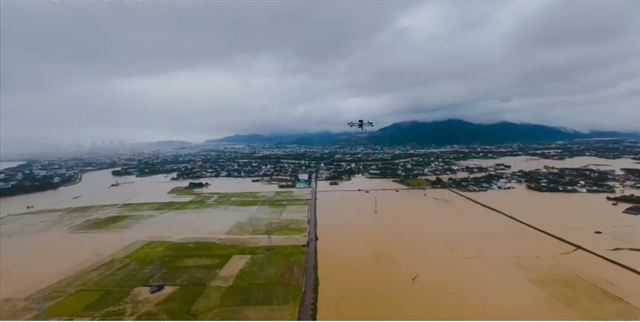 |
| A drone searches for survivors in the flood-hit Khánh Hòa Province. — Photo tienphong.vn |
For Quốc, the moment laid bare both the limits and the value of technology.
“The supplies buy time,” he said. “But the real job is finding people. If you don’t know where they are, nothing else can happen.”
That lesson has reshaped how RtR thinks about disaster response. Bigger drones carrying heavier loads are not always the answer, Quốc argues. What matters more is speed, coverage and flexibility, with many small aircraft reaching many locations at once.
The company is now refining artificial intelligence systems that allow drones to do more than spot people. The aim is to identify who is most at risk, children, the elderly and those showing signs of medical distress, and flag those cases for priority rescue.
“It’s not just about seeing,” Quốc said. “It’s about understanding what you’re seeing.”
Quốc believes rescue drones should be positioned in flood-prone regions before disaster strikes, rather than dispatched from distant cities after the fact. He compares them to fire hydrants, infrastructure that only works if it is already in place.
With extreme weather becoming more frequent, he hopes to help build a nationwide network of rapid-response drones ready to be deployed at short notice.
“Technology that doesn’t help people when it matters is just hardware,” he said.
What he takes most pride in, he added, is not international sales but the team behind the machines, a group of Vietnamese engineers in their twenties and thirties working on complex problems in robotics and artificial intelligence.
As RtR continues to develop new systems, including dual-camera platforms designed to expand search coverage, Quốc says the purpose remains unchanged.
“When something you built helps keep people alive,” he said, “that stays with you longer than any contract ever will.” — VNS
Society
 Society
 Society
 Society
 Society
 Society
 Society
 Society
 Society
 Society
 Society
 Society
 Society
 Society
 Society