 Society

Results of the ixCrypto Index Series Quarterly Review (2026 Q3)
1.
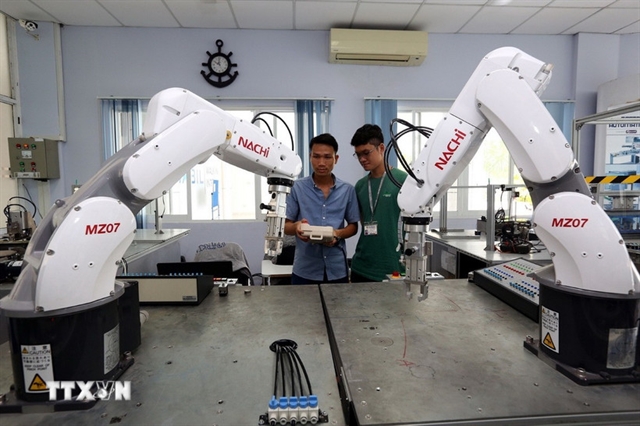 |
| Trainees practice programming and operating robots at the Training Centre in HCM City's High-Tech Park. The center collaborates with high-tech companies and universities to offer training courses for engineers on advanced technology topics. — VNA/VNS Photo |
HÀ NỘI — Resolution 57/NQ-TW by the Politburo in 2024 shows that science and technology development, innovation and digital transformation is a breakthrough and motivation for the country’s rapid and sustainable development.
Many localities across the country have gradually shaped their strategies for developing research centres with various outstanding solutions and support mechanisms to promote research and innovation, and enhance technological self-reliance, competitiveness and position in the global value chain.
Innovation eco-system
HCM City has always identified innovation and creative entrepreneurship as key drivers for sustainable growth.
The city's innovation ecosystem is strengthened with a system of public and private centres and incubators that act as bridges, connecting creative start-ups with investment funds, expanding markets and promoting the refinement of products and business models.
Realising the resolution, the city launched a project to develop an international-level innovation centre network with four major pillars.
These are the international renovation centre at the HCM City National University - a core institution for research, development of advanced technologies and training of high-quality human resources; the HCM City High-Tech Park International Innovation Centre serving as a hub for research and development, testing, sandboxing and commercialisation of high-tech technologies; the HCM City Innovation and Start-up Hub (SIHUB) coordinating the ecosystem, connecting national and international stakeholders; and other international innovation centres invested in by businesses under public-private partnerships or enterprises to promote the rapid commercialisation of strategic technologies.
The city has been carrying out a project to build a mechanism to promote the formation and development of internationally accredited research centres.
A superior mechanism will be offered to participant units such as wages and salary up to VNĐ120 million (US$4,600) per person, per month for managers and experts while remuneration for performing scientific and technological tasks has been significantly increased and in-depth investment has been made in infrastructure and laboratories.
So far, there are five organisations eligible to participate in projects in the fields of materials, IoT chips, sensor and bio-technology.
In 2025, three applications from two units were approved with a total budget of over VNĐ200 billion ($7.6 million), including the Institute of Advanced Materials Technology of the Việt Nam National University, HCM City and the Research and Development Centre of the HCM City High-Tech Park.
Adhering closely to Resolution No. 57-NQ/TW, the entire political apparatus of Cần Thơ City is determined to get involved, diversifying operational models and effectively mobilising scientific and technological resources.
Vice chairman of the Cần Thơ People’s Committee, Nguyễn Văn Khởi, said that the city was ready to order universities, institutes and scientists to study making products that bring practical effectiveness for the city and the whole Cửu Long Delta region.
The committee has established the Start-up and Innovation centre and introduced a project to build an innovation centre of Cửu Long Delta region.
Currently, the project of the Cần Thơ Technology Transaction Platform has completed the acceptance procedures that is expected to create a space for technological product display and promote commercialisation of scientific research results.
Meanwhile, Hải Phòng is striving to become a leading city in implementing green marine economy, in which sciences and technology play a vital role, in accordance with the Strategy for Sustainable Development of the Marine Economy to 2030, with a Vision to 2045.
Late last year, the municipal People’s Committee approved the Hải Phòng Marine Science and Technology Programme until 2030.
The programme sets a target of developing and applying science, technology to improve abilities of study, management and sustainable exploitation of marine resources.
The programme also focuses on building open marine data, applying artificial intelligence (AI) in forecasting marine resources and the environment; deploying the Internet of Things (IoT) in aquaculture; developing digital maps for marine tourism; and accelerating the digitalisation of maritime and logistics operations.
Digital transformation
The Intelligent Operations Centre (IOC) of the Civil Judgment Enforcement Department of HCM City has been developed following a large-scale integrated data centre model.
It synchronously connects multiple systems and specialised software applications on a unified platform, enabling comprehensive, real-time monitoring and supervision of civil judgment enforcement across the city, instead of relying on manual aggregated reports as in the past.
The IOC focuses on supervising and managing the entire specialised operational process of the civil judgment enforcement system, closely linked to the responsibilities of each unit and each enforcement officer.
The implementation of the IOC is a concrete step in realising the spirit of Resolution No. 57 which emphasises the need to strongly promote the application of science and technology, digital transformation and innovation in public administration methods, with citizens and businesses placed at the centre of service delivery.
In the field of civil judgment enforcement, which is directly linked to the lawful rights and interests of organisations and individuals, the requirements for openness, transparency and timeliness are of particularly critical importance. VNS
Society
 Society
 Society
 Society
 Society
 Society
 Society
 Society
 Society
 Society
 Society
 Society
 Society
 Society
 Society