 Society

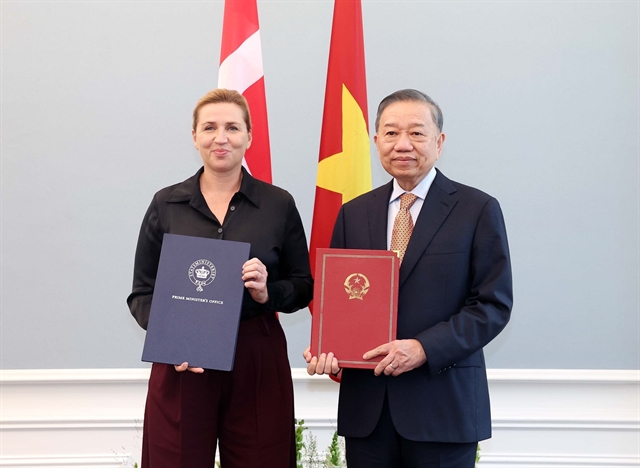
Việt Nam, Denmark issue joint statement on establishment of Comprehensive Strategic Partnership
1.

|
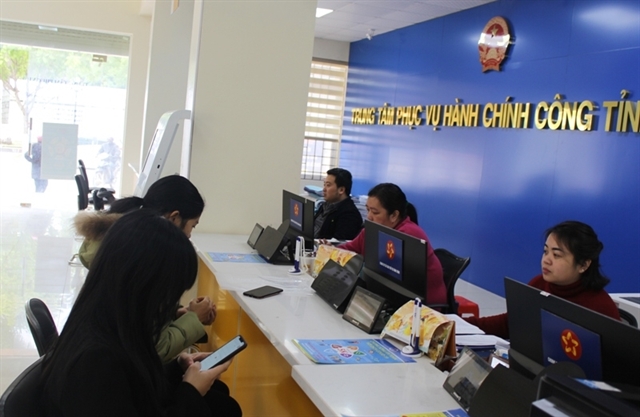
| The Hoa Lư City Land Registration Office in Ninh Bình Province utilises specialised software systems in its operations to serve the processing of administrative procedure dossiers. — VNA/VNS Photo Thùy Dung |
HÀ NỘI — The Ministry of Agriculture and Environment (MAE) has set ambitious targets for this year, aiming to halve administrative procedure processing times and compliance costs while completing land databases at local level and accelerating digital transformation in resource and environmental management.
These goals are among the key tasks outlined in the ministry’s action programme announced on Tuesday to implement Government Resolution No 01/NQ-CP and Resolution No 02/NQ-CP on socio-economic development, improving the business environment and enhancing national competitiveness this year.
Under the programme, the MAE is targeting sector-wide GDP growth of about 3.7–4 per cent, with total export turnover of agricultural, forestry and aquatic products reaching US$73–74 billion.
Alongside growth objectives, the sector will continue to prioritise resource and environmental protection and sustainable development.
Specifically, the rate of urban domestic solid waste collection and treatment is targeted at 95 per cent, forest cover is to be maintained at 42.02 per cent and 100 per cent of large operating hydroelectric reservoirs will be controlled and monitored online to ensure works safety and water security.
To improve the investment and business environment, the MAE has identified deep cuts to administrative procedures as a major breakthrough.
Accordingly, it plans to reduce and simplify 100 per cent of unnecessary investment and business conditions and abolish all business conditions for industries and trades not listed under the Investment Law’s schedule of conditional investment and business sectors.
At the same time, administrative procedure processing times and compliance costs are to be cut by 50 per cent compared with 2024.
Digital transformation is seen as the key solution to achieving administrative reform goals. The action programme highlights accelerating digitisation in land, resource and environmental management, completing land databases at local levels and integrating them into the national land database.
On that basis, the MAE will develop an online land information sharing platform to provide transparent and timely access for people and businesses, reduce transaction costs and improve the efficiency of state management.
In agriculture, the ministry will focus on developing ecological, green and sustainable agriculture while promoting large-scale commodity production of agricultural, forestry and aquatic products through high technology and innovation.
Reorganising production linked to planting area codes and traceability will continue to be strengthened to meet increasingly strict domestic and export market requirements.
A key priority is to address the European Commission’s recommendations aimed at lifting the yellow card on illegal, unreported, and unregulated (IUU) fishing, creating conditions for the sustainable expansion of Việt Nam’s seafood export markets.
The action programme also sets targets for rural development and environmental protection. The proportion of communes meeting new-style rural standards under the 2026–30 criteria is expected to reach about 15 per cent, while the share of rural households using clean water to standards is targeted at 62 per cent.
In the environmental sector, in addition to the 95 per cent urban solid waste collection and treatment goal, the ministry aims for 100 per cent of large reservoirs to be operated and monitored online. It also plans to identify and announce minimum post-dam flows for 84 hydroelectric and irrigation reservoirs across about 700 works to ensure a balance between water resource exploitation and protection.
Solutions
To achieve these objectives, the action programme sets out 11 key groups of solutions to be implemented in a coordinated and resolute manner from the start of the year.
A central focus is continuing to review and refine institutions, policies and laws to promptly address practical difficulties and bottlenecks. The development and issuance of legal documents must create favourable conditions for businesses, cooperatives and people while being closely linked to administrative reform on a digital foundation.
At the same time, the MAE will continue streamlining its organisational structure to improve the effectiveness and efficiency of state management.
Units with similar functions and tasks will be reviewed and merged to enhance specialisation and reduce overlaps.
Recent mergers of research institutes in the livestock, veterinary and aquaculture fields have already helped improve research efficiency and technology transfer.
Another major pillar is achieving breakthroughs in science, technology and innovation. The MAE has stressed that science and technology must not only serve production but become a genuine driver of development. Scientific tasks will be prioritised on a strategic and large-scale basis, linked to growth model transformation, ecological agriculture, the circular economy and greenhouse gas emission reduction.
In addition, the sector will continue restructuring agriculture towards higher added value and sustainable development, closely tied to food safety and traceability.
Market development and the promotion of agricultural product consumption are identified as overarching solutions, with a focus on trade promotion, expanding export markets and supporting businesses and cooperatives to participate more deeply in global value chains. — VNS
Society
 Society
 Society
 Society
 Society
 Society
 Society
 Society
 Society
 Society
 Society
 Society
 Society
 Society
 Society