 Society
Top Vietnamese leader highlights new horizon for Việt Nam–Denmark cooperation
1.
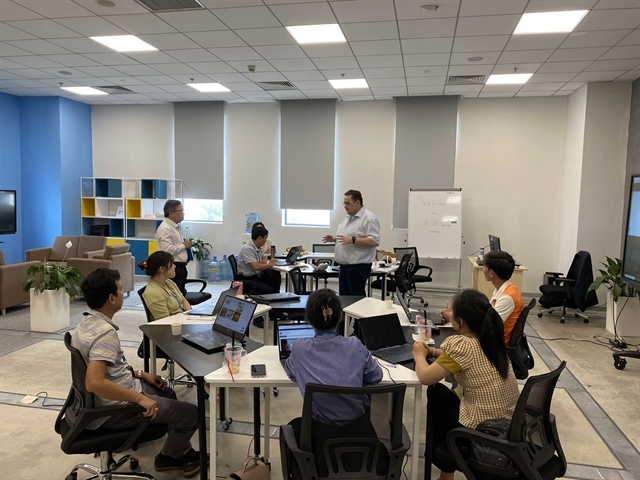 |
| The “Digital Classroom” model is introduced at Vietnamese-German University in HCM City. — VNA/VNS Photo Huyền Trang |
HCM CITY — Twelve vocational education institutions in HCM City have received digital education equipment worth more than VNĐ800 billion (US$30,400) to pilot the “Digital Classroom” model, a joint initiative aimed at accelerating digital transformation in vocational training.
The handover ceremony was held on January 22 by Vietnamese-German University (VGU) in collaboration with the German World University Service (WUS) and the Hesse State Institute for Continuous Professional Development (HLFT).
The activity is part of the Digital Change Expert (DCE) project, launched in 2023 under a cooperation framework between the German state of Hesse and Việt Nam.
The project seeks to modernise the vocational education system by strengthening digital capacity at training institutions and developing high-quality human resources for the digital economy.
According to the organisers, the equipment package will support the implementation of the “Digital Classroom” model at intermediate- and college-level vocational schools, helping bridge theory and practice while aligning training with digital transformation requirements in governance, teaching and learning.
Speaking at the event, Dr Kambiz Ghawami, President of WUS, noted that Việt Nam is among the leading countries in Southeast Asia in building a legal framework for artificial intelligence, with a dedicated law expected to take effect in March 2026.
Alongside rapid digital transformation, the vocational education sector is undergoing positive changes, in which the Digital Transformation Expert training programme plays an important role, he said.
The “Digital Classroom” model is built on five pillars aligned with German standards, including digitalised school management, lecturer capacity building, development of interactive digital learning resources, application of modern teaching infrastructure, and stronger linkages between vocational institutions and businesses.
The model will be adapted to local vocational education conditions in HCM City.
Representatives of Vietnamese and German partners reaffirmed their commitment to supporting Việt Nam’s education digital transformation.
They expressed their hope that trained experts will form a core force to sustain and spread digital transformation practices across the vocational education system.
Sponsors expect the 12 beneficiary institutions to gradually develop into “model practice centres” for digital transformation, continue refining digital manuals and apply a “train-the-trainers” approach.
This is expected to facilitate the wider rollout of the “Digital Classroom” model nationwide.
Following the completion of Phase 1, which trained nearly 30 leaders and managers, the DCE project has entered Phase 2, focusing on practical application and technology transfer for 34 officials from 12 vocational education institutions in HCM City. — VNS
Society
 Society
 Society
 Society
 Society
 Society
 Society
 Society
 Society
 Society
 Society
 Society
 Society
 Society
 Society