 Society
.jpg)
Điện Biên Province eyes trade, investment links with China, Laos
1.
 |
| Workers and employers attend a job fair at HCM City Centre for Employment Service. — VNA/VNS Photo Thanh Vũ |
HCM CITY — HCM City’s labour market is set to continue experiencing a shortfall of suitably qualified workers in 2026, Nguyễn Văn Hạnh Thục, director of the city’s Centre for Employment Service, has said.
The imbalance is driven by three key factors: the ongoing disbursement and expansion of foreign direct investment (FDI); the city’s strengthening position as a regional centre for services, finance, trade and logistics; and socio-economic development strategies for the 2025–2030 period, all of which are sustaining strong demand for manpower.
Labour demand next year is forecast to exceed 313,000 positions, including around 136,340 in the former HCM City area, 105,080 in the former Bình Dương Province, and 72,261 in the former Bà Rịa–Vũng Tàu area.
Demand is expected to reflect the economic profile of each area, signalling continued recovery and expansion in production and services.
In the former HCM City area, recruitment will remain concentrated in office-based jobs, finance, information technology (IT), e-commerce, retail, food and beverage, tourism and customer service, highlighting the role of post-Tết domestic consumption recovery as a key growth driver.
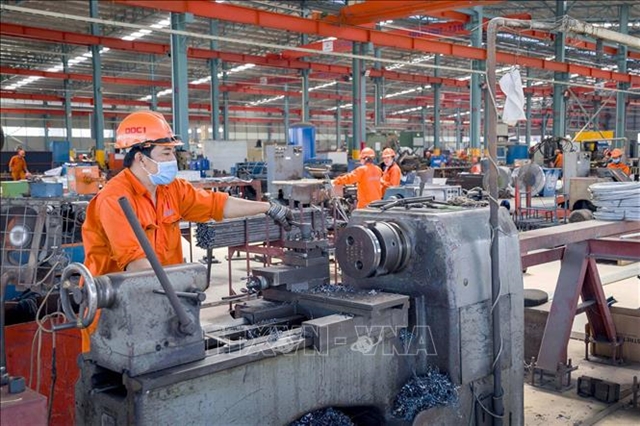
The former Bình Dương area, meanwhile, is set to remain a major magnet for unskilled labour and production line workers, as factories and industrial parks are expected to accelerate order fulfilment from early 2026, boosting demand for production, technical and maintenance staff.
In the former Bà Rịa–Vũng Tàu area, 2026 is forecast to be a peak period for seaport, logistics, transport and port-related services. Rising activity at the Cái Mép–Thị Vải port complex, along with expanding logistics projects and international shipping routes, is expected to drive demand for skilled and highly qualified workers in warehousing, port logistics, maritime engineering and coastal tourism.
By occupation, unskilled labour is expected to account for the largest share at 39.82 per cent, followed by processing and technical jobs at 23.23 per cent and trade, services and logistics at 8.99 per cent.
Highly skilled segments include finance, accounting and real estate (6.34 per cent); administration, law and management (4.83 per cent); IT and communications (1.89 per cent); education and social services (2.64 per cent); and healthcare (0.31 per cent).
High-quality services, logistics, e-commerce, finance and accounting, IT, and tourism–hospitality have maintained strong growth momentum since 2025 and are poised for further expansion in 2026.
On the supply side, only about 8.20 per cent of workers have short-term vocational training, while those aged over 45 make up 20.41 per cent of the workforce and often struggle to adapt to new skill requirements.
A gender mismatch also persists, with labour supply skewed towards women while demand favours men. These factors continue to hinder improvements in the supply–demand balance, particularly in sectors requiring hands-on skills, industrial discipline and shift work.
Online recruitment remains the dominant trend, especially for office, service and technology-related positions.
In 2026, the city is also expected to face fiercer competition in attracting and retaining workers, particularly in the former Bình Dương area, where post-Tết labour turnover remains high.
At the same time, highly skilled workers in IT, data, advanced logistics and finance are becoming increasingly scarce and tend to gravitate towards areas offering more favourable working and living conditions. — VNA/VNS
Society
 Society
 Society
 Society
 Society
 Society
 Society
 Society
 Society
 Society
 Society
 Society
 Society
 Society
 Society