 Society
Amendments to bidding law aim to boost project owners’ autonomy and ensure transparency
1.
|
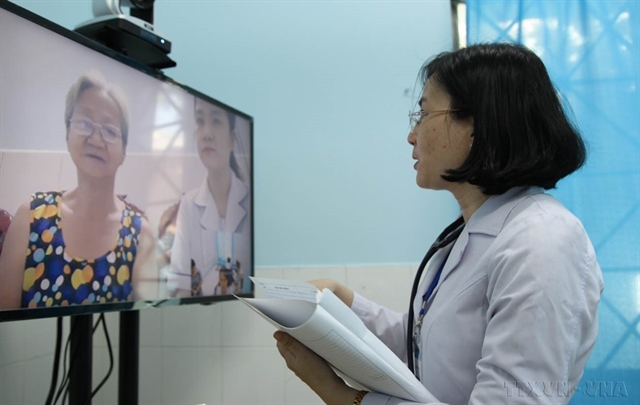
| A doctor in HCM City gives remote health check for a patient. — VNA/VNS Photo Đinh Hằng |
HÀ NỘI — From battling a once-in-a-century pandemic to reshaping how care is delivered nationwide, the 2020–2025 period proved extraordinary for Việt Nam’s health care sector as it maintained routine services while pressing ahead with structural reform, professional management and digital transformation.
Deputy Minister Trần Văn Thuấn highlighted the scale of that effort at a conference reviewing professional and technical guidance, Project 1816 and remote health care initiatives for 2020–2025, hosted by the Ministry of Health in Hà Nội on Monday.
"This is a conference of special significance, not only reviewing the programmes and three projects, but systematically reflecting on strengthening the entire health care network amid unprecedented disruptions," he said.
Thuấn said professional guidance, Project 1816 and remote health care had shown strategic value not as temporary solutions but as lasting pillars of a modern health system.
Together, the initiatives have helped redistribute expertise across the system. Health care capacity, once heavily centralised, has gradually been transferred, supported and strengthened at grassroots level in a more substantive and sustainable way.
“Many techniques previously confined to central hospitals have been standardised, transferred and safely implemented locally, enabling timely treatment near patients' homes, easing referral burdens, cutting societal costs and boosting public satisfaction," the Deputy Minister said.
Project 1816, he added, reflects a people-centred approach. Rotating specialist staff goes beyond technical support to include hands-on training, on-site skill building, clinical experience sharing and the development of local teams.
Technique packages have also allowed local facilities to master entire care chains, from diagnosis and treatment to monitoring and long-term management.
Alongside this, remote health care has opened new avenues of support. Technology has evolved from a supplementary tool into a knowledge infrastructure, delivering advanced expertise to grassroots facilities in real time. Remote consultations, training and supervision have narrowed geographical gaps and blurred hierarchical lines, a shift that has been especially important for remote, mountainous and island areas.
"This vividly demonstrates a knowledge- and connectivity-driven health system, not one bound by administrative locations," Thuấn said.
He noted that governance lessons from the period showed how investment in training, skills transfer and digital infrastructure can drive growth. When resources are directed at priorities and coordination mechanisms are aligned, each budgetary pound can generate wide spillover benefits. These efforts have also fostered a new management mindset that is capacity-based, standards-driven and data-led, moving beyond rigid administrative tiers.
Challenges remain. In some localities, transferred skills do not match available facilities, equipment or staffing. The pace of digital transformation still lags between policy design and practical implementation, while financial mechanisms and policies have yet to keep up with deployment needs.
“Thus, key questions remain: How to standardise lower-tier capacities by specialty? How to make remote health care routine, integrated with workflows and payments? How to link health data for system governance, turning policies into enablers rather than barriers?” the Deputy Minister asked.
Strengthening lower-tier health care
Deputy Director of the Department of Medical Service Administration Dương Huy Lương said the 2020–2025 drive in professional guidance, Project 1816 and remote health care had laid essential foundations for strengthening lower-tier capacities, easing pressure on higher-level hospitals and advancing more equitable access.
Data showed sustained and well-organised activity focused on substantive empowerment. Over six years, 1,372 line-guidance classes were held, averaging about 230 a year, alongside 8,522 activity days, or more than 1,400 annually. These reflected continuous, practice-oriented training and direct on-site transfers rather than short-term courses.
The reach of Project 1816 was also evident, with 69,395 staff taking part across 10,650 units nationwide, covering provincial, district and grassroots facilities and helping deliver more uniform gains across the system.
Remote support played a key role, with 1,108 online consultations, peaking at 360 in 2021 during the height of the COVID-19 pandemic. These supported complex cases, reduced unnecessary referrals and improved outcomes at local level.
In addition, 598 online communication sessions helped raise public awareness of grassroots health care capabilities, easing overcrowding at higher-tier hospitals.
Monitoring efforts, including 820 evaluation teams and 788 workshops, identified obstacles related to staffing, equipment, finance and insurance reimbursements, helping ensure that transferred techniques could be retained sustainably.
Despite progress, challenges persist. These include disparities between tiers, difficult terrain in remote, border and island areas, uneven equipment distribution, staff turnover and delays in insurance approval for new techniques, which can discourage wider adoption.
Thống Nhất Hospital, a national leader in geriatrics, was cited as an example of effective implementation. The hospital delivered training, workshops and both direct and remote support, transferring elderly-care techniques to provincial and district units. This helped build local expertise, improve treatment quality and reduce avoidable referrals.
However, limitations remain, including a shortage of geriatrics specialists below upper tiers, mismatches between facilities and transferred techniques and the dependence of sustainability on local unit resources.
Drawing on experiences from the field, the department proposed refining nationwide professional guidance systems, allocating strategic budgets on a long-term basis and accelerating digital health development while improving insurance mechanisms for remote care.
It also called for stronger investment in infrastructure, equipment and staffing policies, particularly for hard-to-reach areas, to ensure the effectiveness and durability of future phases. — VNS
Society
 Society
 Society
 Society
 Society
 Society
 Society
 Society
 Society
 Society
 Society
 Society
 Society
 Society
 Society