 Society

Ministry eyes data architecture as quality becomes key to deeper digital transformation
1.
|
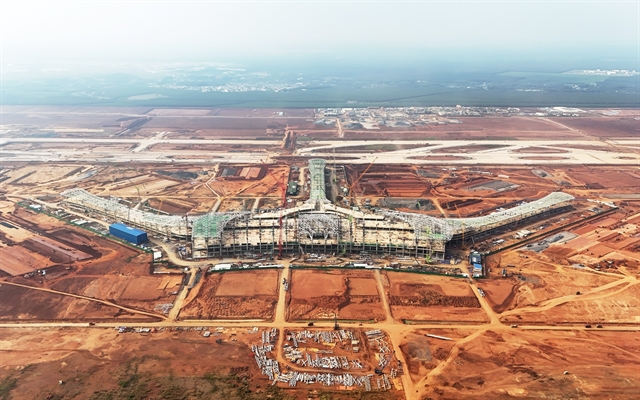
| Long Thành International Airport is set to anchor innovation hubs and a modern logistics ecosystem in Đồng Nai Province. — VNA/VNS Photo |
ĐỒNG NAI — Đồng Nai Province is positioning itself for a major economic transformation, with comprehensive development based on three strategic economic pillars supported by one unified digital foundation.
Digital transformation is identified not just as a supportive tool but a core driving engine to shape a new growth model powered by technology, innovation and data connectivity across all sectors.
According to the province’s plan for digital economy and digital society development in 2026-30, the three pillars include high–tech and smart manufacturing industries, high-tech agriculture integrated with rural digital economy and logistics services coupled with digital border-gate economy.
In parallel, digital infrastructure, digital data and digital human resources are defined as the essential backbone enabling the full potential of each pillar to be realised.
The province emphasises that people and businesses must remain at the centre of all development efforts.
In its view, all digital transformation programmes must ultimately ensure higher living standards, improved access to public services, transparent governance, and lower operational costs for businesses.
Provincial authorities strongly encourage digital technology enterprises, especially foreign–owned firms and domestic innovators, to take the lead in research, new technology adoption and commercialisation of digital solutions.
To turn this vision into reality, Đồng Nai expects infrastructure to remain ahead of demand and institutions to create favourable conditions for growth.
Digital infrastructure is described as “the foundation of foundations”, requiring investment that is modern, highly resilient and secure enough to support the future surge of the digital economy and digital society.
Alongside this, the province plans to actively pilot regulatory sandbox mechanisms to unlock flexible policy space for new digital business models, future-oriented technologies and emerging industry practices where it has a competitive advantage.
Sustainable development goals remain strongly embedded in its agenda.
It intends to incorporate circular economy and green economic practices, especially in ecological industrial parks where digital technology can optimise resource efficiency and reduce emissions.
It has identified six major development targets for the digital economy by 2030.
The digital economy is expected to account for at least 30 per cent of the province’s economy and a minimum of 20 per cent in each sector.
Digital labour is projected to account for at least 20 per cent of the workforce.
The total value of cashless payments is targeted to reach 30 times GDP.
Đồng Nai also plans to operate at least one data exchange platform and nurture a minimum of 10 newly-established digital technology enterprises capable of exporting services and platforms to the international market.
A key priority is to strengthen the digital foundations and digital society capabilities across every sector.
This includes fulfilling central–level legal frameworks, implementing provincial-level digital strategies and accelerating the digitalisation and intelligent management of essential infrastructure.
All administrative operations, business governance, commercial activities, and service delivery are expected to migrate to digital platforms.
Data is treated as a vital asset, requiring clear institutional arrangements for sharing between State agencies, enterprises and the public citizens.
Each department and industry is tasked with identifying specific challenges that can be solved using artificial intelligence.
Đồng Nai intends to issue policies that support enterprises in adopting AI into production management and commercial activities, while continuing to develop a digitally skilled workforce and fostering the evolution of digital citizens, digital culture and digital enterprises.
In logistics, one of its strongest sectors, the province seeks to develop a seamless end-to-end digital chain linking seaports, border-gates, warehouses, and distribution networks through to consumers, reducing logistics costs and improving competitiveness for import-export activities.
In commerce, Đồng Nai will expand its digital market footprint through e-commerce platforms, enabling businesses to transition fully on to the online marketplace and access global buyers.
Tourism, culture, education, and healthcare will also undergo comprehensive digital transformation to enhance service quality and user experiences.
The share of digital economy value added has grown steadily in recent years.
The figure increased from 5.69 per cent in 2020 to 6 7.42 per cent in 2024.
Đồng Nai has also maintained a top 10 ranking in the country in e–commerce readiness for nine consecutive years, reflecting an increasingly dynamic and digitally oriented business environment.
Currently major technology and innovation projects are being implemented across the province, including the Long Thành Digital Technology Park, expected to commence construction on 119 hectares, innovation hubs associated with Long Thành International Airport and planning for a Free Trade Zone covering more than 8,000ha.
These developments are designed to create a vibrant ecosystem for advanced logistics, smart manufacturing, cross-border digital trade, and start–up acceleration anchored in the heart of the southern key economic region.
With clear strategic direction, strong institutional determination and the confidence to pioneer new economic models, Đồng Nai is charting an ambitious path to become a leading hub of digital transformation and high–tech growth, contributing significantly to Việt Nam’s national objectives for a prosperous digital future. — VNS
Society
 Society
 Society
 Society
 Society
 Society
 Society
 Society
 Society
 Society
 Society
 Society
 Society
 Society
 Society