 Society
Việt Nam fosters comprehensive cooperation with Uruguay
1.
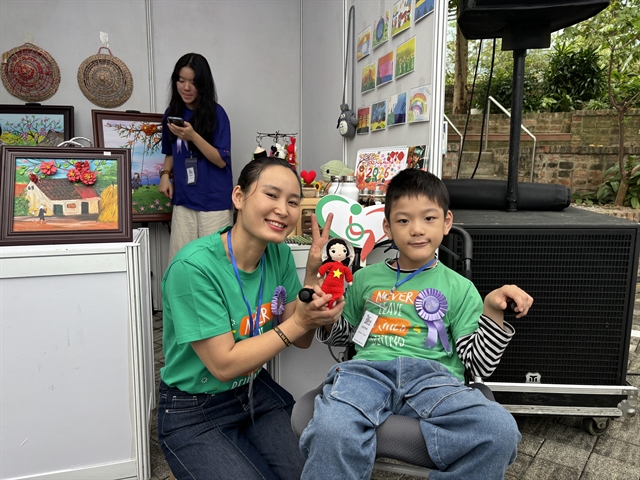 |
| A mother and her son who has cerebral palsy create a handmade woollen doll at the 'Touching the Green' social enterprise. — VNS Photos Khánh Dương |
Khánh Dương
HÀ NỘI — While searching for job opportunities, many persons with disabilities (PWDs) in Việt Nam want employers to evaluate them based on their abilities, not the limitations in their bodies.
Vũ Thị Hải Anh, a 25-year-old visually impaired student majoring in Public Relations at the University of Social Sciences and Humanities, said the biggest challenge facing PWDs is the prejudice held by employers and colleges around them.
She said employment opportunities and supportive mechanisms for PWDs in Việt Nam remain limited, making it difficult for them to secure jobs. Many are judged by employers solely through the lens of their disabilities rather than their actual skills or potential.
As a result, many lack social insurance and stable employment, leaving them dependent on freelance or informal work and living with an unstable income, she said.
Dreaming of becoming a social activist for the PWD community, Hải Anh said: “We have needs, capabilities and the desire to work like anyone else.”
PWDs do not seek preferential treatment or pity, she added. Instead, they want to be recognised as equal members of society – being able to contribute, collaborate and thrive.
Bình, a 25-year-old deaf paint sprayer in Hà Nội, shared a similar reality.
“If I couldn’t read, write or use sign language, I wouldn’t be able to find a job," he said.
"I would be completely isolated from society."
“I can do all the tasks assigned at work. I desire integration and for everyone to recognise our abilities.”
André Gama, International Labour Organization's Social Protection Regional Specialist, said most persons with disabilities in Việt Nam still work in the informal sector. Many are self-employed or create their own micro-businesses.
“The challenge but also the opportunity is how to help them participate more in formal employment,” he said.
To support PWDs’ integration into the labour market, he recommended raising awareness among businesses about the productivity and potential of workers with disabilities, as well as providing training on disability inclusion.
“Another important factor is ensuring that the voices of persons with disabilities are heard in social dialogue when workers, employers and the government discuss employment and labour issues,” André told Việt Nam News.
With Việt Nam’s population ageing, he added, the country needs more young people in productive jobs.
“If we have between six to 10 per cent of persons in the country with disabilities, we can take advantage of that to help continue fast economic growth that Việt Nam has been experiencing,” he said.
Overcoming barriers
In reality, many PWDs have overcome prejudice to start their own businesses and create jobs for others.
Lê Tuấn An, director general of the Institute of Science, Technology and Environment under the Việt Nam Cooperative Alliance, said many cooperatives in Việt Nam are now established and run primarily by persons with disabilities.
These cooperatives not only demonstrate their skills and ability to preserve cultural identity but also reflect their determination, talent and aspiration to rise and contribute to the country.
At 60, Hoàng Thị Khương, who has lived with paralysis of one leg since she was three months old, has managed her embroidery business for 12 years.
She founded her social enterprise in 2013 after overcoming many hardships, aiming to create jobs for herself and for other persons with disabilities.
Today, her enterprise provides work for around 30 people with disabilities from inside and outside her local community.
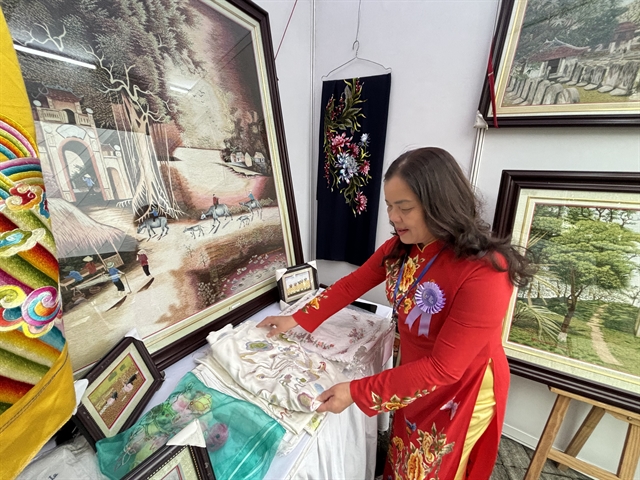 |
| Hoàng Thị Khương and her embroidered scarves. |
Khương said challenges remain in recruiting and retaining employees with disabilities, but she has received valuable support from the Việt Nam Federation on Disability in networking and experience sharing.
Nguyễn Thùy Chi, 35, founded the social enterprise Chạm Vào Xanh (Touching the Green), which sells handmade souvenirs, paintings and art cards created mostly by adults with cerebral palsy or mothers of children with cerebral palsy.
Her enterprise, which sells products at a shop on Thành Thái Street and via Facebook and Instagram, creates jobs for people with cerebral palsy and fosters exchange opportunities among different disability groups.
About 51 per cent of profits from handmade products go back to supporting the cerebral palsy community.
Looking ahead, Chi hopes to bring the products onto e-commerce platforms to reach more customers.
“We understand our community best. We know what our community needs and what it hopes for,” she said.
“I hope persons with disabilities are not seen only as beneficiaries. We can create value. We can achieve much more if given the opportunity,” she said. — VNS
Society
 Society
 Society
 Society
 Society
 Society
 Society
 Society
 Society
 Society
 Society
 Society
 Society
 Society
 Society