 Politics & Law

Digital transformation opens new prospects for sports medicine in HCM City
1.
|
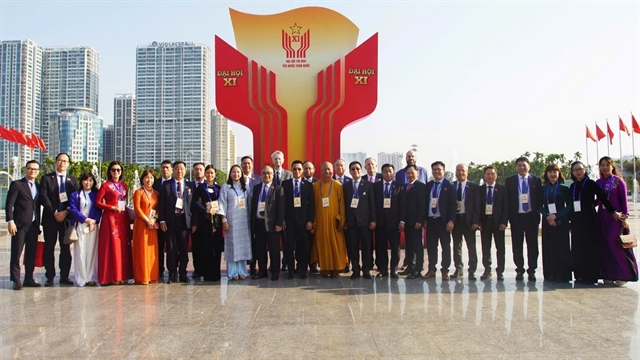
| Delegation of overseas Vietnamese attending the 11th National Emulation Congress in Hà Nội on December 27, 2025. — VNA/VNS Photo Diệp Trương |
PRAGUE — The Party's and the State's proactive efforts to collect feedback from overseas Vietnamese on draft documents of the 14th National Party Congress, constitutional amendments, and the formulation of major resolutions and laws represent the country’s “important step forward that demonstrates strategic vision and proactive governance,” reflecting renewed thinking in people-to-people diplomacy and the policy of great national unity.
The assessment was made by Phan Kiên Cường, an economic arbitrator in the Czech Republic, Slovakia, and Vienna, and Deputy Director of the Vietnam Consultant Centre for Development of Economy and Trade (VICENDETI), in an interview with the Vietnam News Agency's correspondent in Prague.
According to Cường, these activities reaffirm the consistent position of the Party and the State that overseas Vietnamese are “an inseparable part of the Vietnamese nation and an important resource for national development.”
He stressed that inviting and listening to feedback from overseas Vietnamese is not symbolic, but embedded in formal, institutionalised policy frameworks.
Alongside in-person conferences, forums for overseas Vietnamese and high-level meetings, Việt Nam has diversified consultation channels through overseas representative offices, the State Committee for Overseas Vietnamese, online platforms, and community associations.
This approach, he said, enables overseas Vietnamese across different regions, professions, and circumstances to contribute “more conveniently, promptly, and effectively.”
Notably, dialogues have expanded beyond external affairs and community-related issues to encompass strategic and foundational areas such as national development orientation, Party building, institutional reform, science and technology, education, and culture.
This demonstrates that the Party and the State do not view overseas Vietnamese merely as a group to mobilise, but as stakeholders in policymaking and policy review, with advantages in expertise, international experience, and diverse perspectives.
Cường emphasised that these forums also send a clear message that the Party and the State value, respect, and create conditions for, overseas Vietnamese to remain closely connected with the homeland and contribute to national development.
This approach helps consolidate trust, enhance social consensus, gradually narrow psychological and historical gaps, and foster a sense of responsibility and national pride within the overseas Vietnamese community, he commented.
He described the creation of dialogue platforms for overseas Vietnamese as a vivid manifestation of the great national unity policy in a new context.
While acknowledging room for improvement in feedback and response mechanisms to ensure greater transparency and clarity, he noted that the overall trend is “increasingly open, substantive and in-depth,” helping make overseas Vietnamese policies more effective and sustainable.
Regarding community responses, Cường said overseas Vietnamese have generally reacted positively and become more proactive and substantive in engaging with Party and State initiatives, reflecting a strong desire to accompany Vietnam’s development.
In recent consultation rounds, many overseas Vietnamese, particularly intellectuals, entrepreneurs, and experts, have carefully studied draft documents, submitted written feedback, and participated in specialised seminars and discussions.
This, he said, shows that overseas Vietnamese are no longer focused solely on community interests, but increasingly concerned with the country’s long-term strategic issues.
Their priorities for contribution include knowledge transfer, management experience, science and technology, and innovation, especially in areas where Việt Nam has strong demand such as digital transformation, green growth, healthcare, education, and hi-tech industries.
They also aspire to invest, connect markets, and expand international cooperation networks to help Vietnamese products and businesses integrate more deeply into global value chains, Cường said.
Many contributions, he noted, are constructive, candid, and heartfelt, reflecting aspirations for sustainable development, effective governance, a stable legal system, and a transparent investment environment.
This underscores that overseas Vietnamese, despite living and working abroad, remain closely engaged with domestic developments and seek to make long-term, meaningful contributions.
At the same time, overseas Vietnamese expect continued improvements in mechanisms for receiving and responding to feedback, a more enabling legal environment for returning to work, invest, and conduct research, and stronger coordination hubs to better harness the community’s intellectual resources.
Cường concluded by affirming that overseas Vietnamese are increasingly demonstrating a commitment to contribute in a substantive, sustained, and responsible manner.
This represents “a particularly important resource” which, if effectively mobilised, can make a significant contribution to Việt Nam’s development in the new phase, he stated. — VNA/VNS
Politics & Law
 Politics & Law
 Politics & Law
 Politics & Law
 Politics & Law
 Politics & Law
 Politics & Law
 Politics & Law
 Politics & Law
 Politics & Law
 Politics & Law
 Politics & Law
 Politics & Law
 Politics & Law
 Politics & Law