 Society

Vincom Retail Partners with South Korean Premium Buffet Giant QooQoo
1.
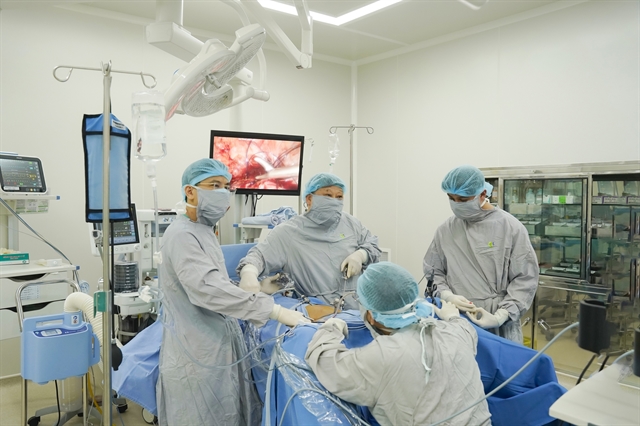 |
| Nguyễn Viết Tiến and his team use the new device to operate on patients with caesarean scar fluid retention. Photo: baochinhphu.vn |
HÀ NỘI — Shedding light on a longstanding surgical challenge, a uterine elevator, a specialised device used in laparoscopic surgery to treat caesarean scar defects (isthmocele), has been granted an exclusive patent for use in caesarean scar defect surgery in Việt Nam.
The patent was issued by the Intellectual Property Office under the Ministry of Science and Technology to Professor Dr Nguyễn Viết Tiến, Vice Chairman of the National Medical Council and President of the Việt Nam Association of Obstetrics and Gynaecology.
Caesarean scar defects are common and can lead to secondary infertility or repeated embryo transfer failure. As caesarean delivery rates continue to rise, the prevalence of caesarean scar defects has increased accordingly. An estimated 12.7–48 per cent of women develop such defects after a C-section, with the risk growing with each additional surgery.
This condition can cause a range of health issues, including prolonged menstrual bleeding, abnormal uterine bleeding, chronic pelvic pain, dyspareunia, urinary disorders or pelvic pressure, secondary infertility and repeated failed IVF cycles.
Current treatments remain limited. When a caesarean scar defect becomes inflamed, leading to IVF or embryo transfer failure, doctors often prescribe hormonal contraception, which offers only temporary and modest results. Laparoscopic surgery is more effective, but surgeons still face key challenges: difficulty pinpointing the exact location of the defect and the risk of uterine perforation or damage to healthy tissue if it is misidentified.
Accurate localisation depends heavily on the surgeon’s experience, as visual and tactile cues alone cannot guarantee precision.
Before the creation of this new device, once the uterus was opened, surgeons struggled to clearly identify the scar from the outside. Some attempted to illuminate the uterine cavity from within, but visibility remained limited, increasing the risk of complications such as uterine tears or bleeding and making it harder to completely remove pathological scar tissue.
The patented technique aims to enhance the accuracy, speed and safety of identifying the defect site during laparoscopic repair.
The innovation uses a semi-opaque white Teflon guiding tip placed inside the uterine cavity. Coated with oil to prevent adhesion, the tip transmits light through the uterine wall, allowing surgeons to see the defect clearly from the outside.
This method improves scar localisation, enhances surgical safety and shortens operating time.
Its key advantage lies in significantly improving visibility: the light emitted from the guiding device, combined with the laparoscopic camera, makes the defect stand out clearly. This reduces reliance on a surgeon’s subjective experience, improving objectivity and reliability during surgery.
The invention also facilitates more thorough scar removal and reduces the risk of surgical complications. When the defect is precisely located, surgeons can excise the scar tissue safely and accurately.
This precision also helps prevent accidental injury to the bladder, a dangerous and relatively common complication, especially when the defect sits close to the bladder.
Tiến and his team have applied the device in nearly 500 laparoscopic procedures, achieving high success rates with no surgical complications or long-term health consequences.
After surgery, many patients have regained a normal quality of life, with numerous cases resulting in natural conception or successful embryo transfer.
With nearly 40 years dedicated to obstetrics and gynaecology and a long record of pioneering achievements, including introducing IVF and the non-invasive US HIFU tumor ablation technique to Việt Nam, Tiến continues to innovate despite being well past retirement age. His ongoing research aims to give Vietnamese women more opportunities to conceive and overcome reproductive health challenges.
His dedication not only helps ease the burden on Việt Nam’s obstetrics and gynaecology sector but also inspires others through his compassion and unwavering commitment to safeguarding the happiness of millions of Vietnamese families. — VNS
Society
 Society
 Society
 Society
 Society
 Society
 Society
 Society
 Society
 Society
 Society
 Society
 Society
 Society
 Society