 Society

AIMCONNECT 2026 Held in Singapore, Bringing Global Automotive Leaders Together to Explore the Future of AI, Trust and Connected Mobility
1.
|
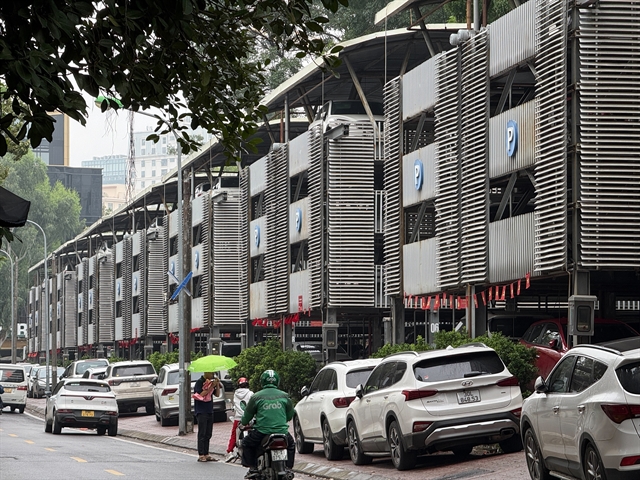
| A parking lot on Hà Nội's Nguyễn Công Hoan Street built using South Korean technology, featuring 17 four-storey blocks with security monitoring and fire safety systems. — VNA/VNS Photos |
HÀ NỘI — Thousands of parking locations have been planned across Hà Nội, yet only a few dozen have materialised. The gap between goals and reality is widening, leaving the capital struggling under rising traffic pressure and a chronic shortage of parking spaces.
According to the Hà Nội Department of Construction, by 2030 the city will need nearly 1,700 parking facilities covering about 1,800 hectares for vehicles.
Currently, only around 72 official car parks are in operation, less than 10 per cent of the planned number. Land reserved for parking accounts for under 1 per cent of the city’s area, far below the international standard of 3-4 per cent.
The consequences are clear. Pavements and roadways are routinely occupied by parked vehicles, reducing urban aesthetics, constricting traffic flow and creating safety risks. In many central areas, where vehicle ownership continues to rise, almost no land remains to build new facilities.
Investment challenges
The slow development of parking stems from both limited land and complex investment mechanisms. Many planned sites lie within densely populated neighbourhoods, State offices or public premises, making land clearance difficult.
Underground and multi-storey parking structures require substantial capital, yet offer slow returns and low profit margins, discouraging private investors. Existing incentive policies are weak, and detailed planning often remains theoretical, reduced to coloured marks on maps without clear implementation pathways.
Dr Đào Ngọc Nghiêm, an architect and vice chairman of the Việt Nam Association for Urban Planning and Development, said underground and multi-level parking is an inevitable trend for major cities worldwide and suits Hà Nội’s needs.
But he stressed that adequate funding is essential, and with State budgets under strain, private capital through socialised investment is crucial. For such schemes to succeed, the city must provide preferential policies for investors while balancing the interests of businesses, the State and residents.
Director of the Hà Nội Department of Finance Nguyễn Xuân Lưu said that above-ground parking is relatively cheap, while underground facilities are costly, and parking fees remain capped.
He pointed to a 1.7-hectare site near Thanh Xuân Park where a two-level underground car park could serve 700 vehicles daily, yet at the regulated cap of VNĐ1.15 million (US$43.70) per vehicle per month, revenue would reach only about VNĐ1 billion – far below the VNĐ680 billion investment required.
To make underground parking viable, the department has proposed targeted incentives, including interest rate support, and suggested the city could use public funds to develop underground facilities in parks and other areas where surface space is underutilised but demand is high, Lưu said.
Dr Nghiêm said that careful planning, transparent investment mechanisms and prioritising safety are vital if Hà Nội is to modernise its infrastructure and overcome its parking shortage.
While Hà Nội seeks long-term solutions, HCM City has adopted temporary measures, converting public land near parks, cultural centres and administrative offices into provisional parking areas. Though not permanent, these measures have eased immediate pressure.
Thailand's capital, Bangkok, offers another model. A smart shared parking platform lets residents locate, reserve and pay for spaces via a mobile app, optimising existing capacity without expanding physical infrastructure.
|
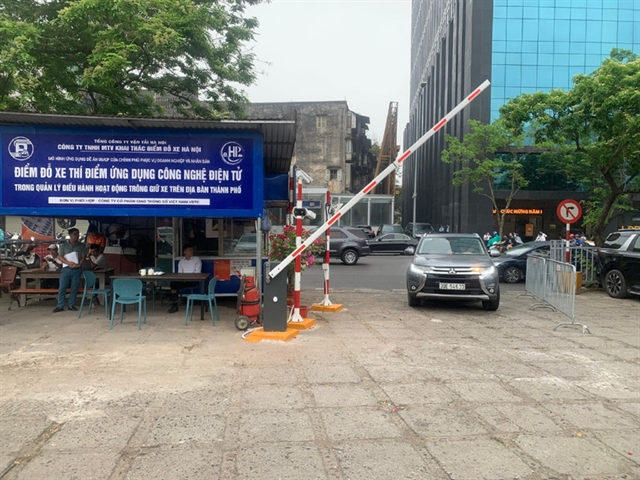
| A Hà Nội parking lot equipped with an electronic payment system. |
A push for a new model
Experts recommend a comprehensive strategy that integrates planning, policy and technology. Public-private partnerships, with the State clearing land and private firms investing in construction and operation, could attract investors if coupled with competitive incentives on taxes, land rental and credit access.
Smart technology is key. A centralised system linking public and private lots and commercial centres would allow drivers to check availability and pay electronically, improving efficiency and transparency. Future facilities could integrate electric vehicle charging stations to support green transport.
In the short term, temporary options, such as spaces beneath flyovers or vacant public land, can provide relief as long as safety standards are met. Long-term planning must focus on modern, automated underground facilities like those in Tokyo, Seoul or Singapore.
Deputy Director of the Hà Nội Department of Finance Lê Trung Hiếu warned that if parking infrastructure lags, planning will remain impressive only on paper, while streets and pavements remain overcrowded. He said parking must be treated as core urban infrastructure, on par with metro lines, BRT routes and ring roads.
A research group including Dr Đặng Minh Tân of the University of Transport and Communications and MSc Lê Văn Chè of Hà Nội University of Architecture said current parking facilities meet only 8-10 per cent of demand, with the rest accommodated informally through school grounds, apartment courtyards and vacant plots. Illegal parking remains widespread despite enforcement efforts.
They recommend concentrating multi-storey or underground parking near metro stations, commercial centres, offices and residential buildings; expanding shared parking models that allow private landowners to rent spaces during off-hours; and using on-street parking strategically, supported by smart sensors and real-time data. Flexible pricing could further influence driver behaviour, encouraging public transport use and reducing unnecessary car trips.
Addressing parking is part of a broader effort to create a greener, more liveable city. Organised parking reduces emissions, saves energy and improves urban aesthetics while shaping travel behaviour. Linking parking development with public transport expansion is essential.
If implemented consistently, these measures could relieve pressure on Hà Nội’s streets and move the city closer to becoming smart, civilised and sustainable.
|
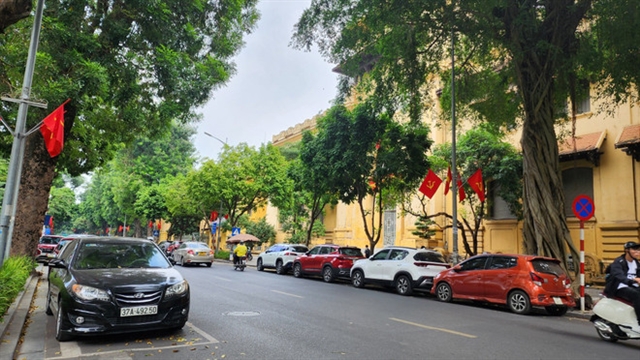
| Authorised on-street parking in Hà Nội. |
In response to growing demand, the Hà Nội People’s Committee is seeking public feedback on a draft resolution regulating urban roads and railways. Article 7 proposes allowing temporary parking on roads and pavements while planned facilities are built.
Architect Trần Huy Ánh from the Hà Nội Association of Architects explained that under the Law on Roads, pavements and road surfaces are classified strictly as traffic space, where non-traffic activities such as unauthorised parking and commercial use are prohibited.
However, he acknowledged that Hà Nội’s proposal could serve as a temporary measure to ease the current shortage of parking spaces. Any implementation must be accompanied by clear conditions, placing safety as the foremost priority and ensuring that the measure is both appropriate and effective, he said.
A further question raised by the public concerns how revenue generated from this temporary use will be managed, and whether it will be channelled into the State budget rather than absorbed by vested interests.
Ánh said that technology will be crucial in ensuring transparency and accountability in managing such a scheme. — VNS
Society
 Society
 Society
 Society
 Society
 Society
 Society
 Society
 Society
 Society
 Society
 Society
 Society
 Society
 Society