 Society
Capital market development critical to unlock investment resources
1.
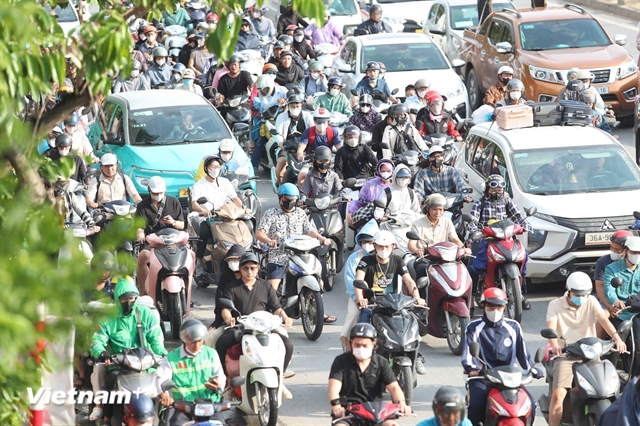 |
| Petrol-powered motorbikes will be banned from travelling within the Ring Road 1 from July 2026. — VNA/VNS Photo |
HÀ NỘI — Hà Nội will ban petrol-powered motorbikes during certain hours or within designated areas of Ring Road No,1 from July 2026, when the city's first low-emission zone is implemented.
The Hà Nội People’s Council deputies on November 26 voted to replace Resolution No. 47/2024 on low-emission criteria, establishing the basis for implementing low-emission zones (LEZs) across the capital.
Accordingly, a low-emission zone is an area where polluting motor vehicles must be restricted to improve air quality.
In low-emission zones, gasoline-powered motorbikes and scooters will be banned on the roads depending on time frames or areas – the details of this scheme have not yet been available; vehicles operating on application platforms will also not be allowed to operate.
Cars that do not meet level 4 emission standards will be restricted and eventually banned from entering these areas according to specific times or routes.
The city has issued a roadmap for green conversion for commercial vehicles using fossil fuels.
Motorcycles must complete conversion before 2030, and taxis from July 1, 2026 can only be newly invested or replaced with electric or green energy vehicles.
From January 1, 2035, the city People's Committee will decide the scope and time of restricting the circulation of road vehicles depending on actual conditions.
In addition to banning gasoline-powered motorbikes, the low-emission zone also applies many additional measures such as not investing in or registering new fossil-fuel vehicles when scrapping old vehicles, especially for vehicles owned by organisations; and banning gasoline-powered trucks over 3.5 tonnes from entering the area.
Under the roadmap, from July 1, 2026, Hà Nội will pilot a low-emission zone in several wards within Ring Road No. 1, including the wards that make up most of the capital city's urban core – Hai Bà Trưng, Cửa Nam, Hoàn Kiếm, Ô Chợ Dừa, Văn Miếu – Quốc Tử Giám, Ba Đình, Giảng Võ, Ngọc Hà, and Tây Hồ.
Starting 2028, the zone will expand to the whole of the Ring Road No. 1 and part of Ring Road No. 2, comprising more populous areas like Láng, Đống Đa, Kim Liên, Bạch Mai and Vĩnh Tuy. From January 1, 2030, the low-emission zone will be implemented within Ring Road 3, covering 36 wards and communes across all three ring roads.
The city's Department of Agriculture and Environment has been tasked with drafting a low-emission-zone proposal for areas within Ring Road No. 3. For areas outside this boundary, commune-level People’s committees will prepare proposals and submit them to the city’s People’s Council for consideration before implementation.
Earlier, a resolution on low-emission zones had been approved at the end of 2024, with plans to pilot the model in two former districts of Hoàn Kiếm and Ba Đình, during the 2025–2030, but no area has yet been officially designated.
The city is also developing a resolution on financial support for residents switching to green vehicles, but this item was withdrawn from the agenda of the current meeting of the People’s Council. Under this tentative plan, Hà Nội is proposing financial support of up to VNĐ20 million (US$760) for low-income households and VNĐ15 million ($570) for near-poor households to help them replace petrol motorbikes with electric models.
According to the Hà Nội People’s Committee, shifting to time-based vehicle restrictions instead of full-time bans reflects feedback from departments and grassroots authorities, indicating that the transition needs to be phased to match infrastructure capacity, social welfare conditions, and residents’ travel habits.
Hà Nội considers low-emission zones one of the key solutions for tackling air pollution, an issue that has plagued the city for many years and become one of the residents' top concerns.
The city currently has more than eight million vehicles, including 1.1 million cars and 6.9 million motorbikes, along with around 1.2 million vehicles from other provinces circulating daily. — VNS
Society
 Society
 Society
 Society
 Society
 Society
 Society
 Society
 Society
 Society
 Society
 Society
.jpg) Society
Society
 Society
 Society