 Society

Digital transformation opens new prospects for sports medicine in HCM City
1.
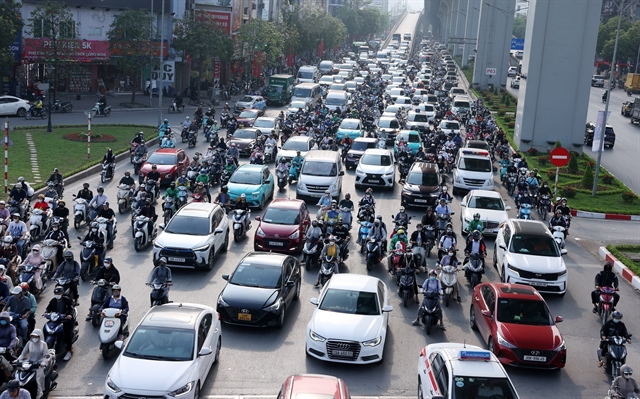 |
| Dense traffic on Trường Chinh Road, Hà Nội. — VNA/VNS Photo |
HÀ NỘI — The capital city will not impose a complete ban on gasoline-powered motorbikes within Ring Road No. 1 starting as soon as in 2026.
Instead, it will implement time- or area-specific restrictions – which is currently sparse on details – in a bid to minimise impacts on residents’ daily lives and ensure an appropriate transition roadmap.
This is stated in a draft resolution on regulations for low-emission zones that the Hà Nội People’s Committee has just submitted to the municipal People’s Council.
Under the draft resolution, low-emission zones are defined in accordance with the 2024 Law on the Capital and apply to areas with strict environmental protection status, frequent traffic congestion, or consistently below-average air quality measurements based on national and city monitoring data.
The plan begins with a pilot zone covering nine urban central wards inside Ring Road No. 1 in 2026, before expanding to 14 wards within Rings 1 and 2 from Jan. 1, 2028.
By Jan. 1, 2030, restrictions would apply across a much wider area within Ring Road 3, encompassing 36 wards and communes including Cầu Giấy, Thanh Xuân, Hoàng Mai, Long Biên, Đông Anh, and Nội Bài.
From 2031 onward, any area meeting the qualifying criteria would be required to implement low-emission controls.
Within these zones, gasoline motorbikes would be banned during designated hours or in specific areas, and app-based motorbike transport services would also be restricted.
Cars that do not meet Euro 4 emission standards would face phased limitations as well.
The city is also setting a green-transition timeline for commercial vehicles, including requiring all newly purchased or replacement taxis to use clean energy from July 1, 2026, and fossil-fuel motorbikes used for transport services to shift to greener alternatives before 2030.
Further measures include prohibiting new registrations of fossil-fuel vehicles when outdated ones are scrapped, particularly for vehicles owned by organizations, and banning fossil-fuel trucks over 3.5 tonnes from circulating in low-emission zones.
The draft differs from the stricter roadmap outlined in a directive earlier this year, which called for a full ban on fossil-fuel motorbikes within Ring Road 1 by July 1, 2026, and expanded restrictions within Rings 1 and 2 by 2028.
The move comes as Hà Nội continues to struggle with hazardous air quality. The National Environmental Report for 2016–2020 found average PM2.5 concentrations nearly double national limits, while PM10 levels exceeded standards by 1.3 to 1.6 times. The city attributes 58–74 per cent of emissions to road traffic, especially motorbikes, alongside dust from road surfaces.
Hà Nội currently has more than 8 million registered vehicles, including 6.9 million motorbikes and 1.1 million cars, with an additional 1.2 million vehicles entering from other provinces on a regular basis.
Gradual transition
To ensure that the transition process takes place sustainably and without causing major disruptions, the draft proposes a range of support policies for citizens and businesses. Specifically, Hà Nội will introduce incentive policies to encourage the shift to environmentally friendly vehicles, while also providing support for residents living and working in low-emission zones as well as businesses required to convert their production and business vehicles to clean energy or zero-emission alternatives.
Explaining the proposal to restrict gasoline-powered motorcycles and scooters by time frames or specific areas instead of a full-time ban, the city’s People’s Committee added that during the process of gathering broad feedback from departments, agencies, local authorities, and when publishing the draft on the electronic information portal, the Department of Agriculture and Rural Development – the unit in charge of drafting – received many suggestions recommending a more gradual implementation roadmap.
The feedback stressed taking into consideration the city's transport infrastructure conditions, the capacity of the city's public transit system, social welfare guarantees, and alignment with citizens’ travel habits.
With this draft resolution, Hà Nội demonstrates its determination to promote green transportation while at the same time carefully calculating to ensure feasibility and social consensus. — VNA/VNS
Society
 Society
 Society
 Society
 Society
 Society
 Society
 Society
 Society
 Society
 Society
 Society
 Society
 Society
 Society