 Society

Results of the ixCrypto Index Series Quarterly Review (2026 Q3)
1.
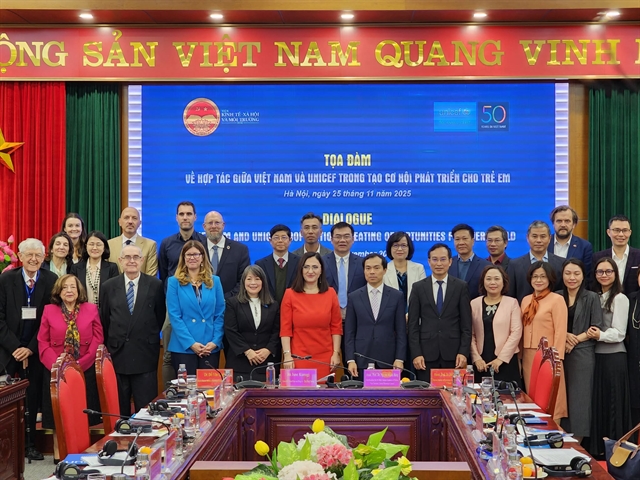 |
| The dialogue on Tuesday. — VNS Photo Lê Việt Dũng |
HÀ NỘI — Việt Nam’s senior officials and international child-rights experts have hailed 50 years of progress for the country’s children while warning that climate change, deep-rooted inequality and an ageing population are creating new risks that government policy can no longer ignore.
At a dialogue in Hà Nội on Tuesday titled Dialogue on Việt Nam and UNICEF cooperation: creating opportunities for every child, officials marked five decades of partnership between UNICEF and the Government, and 35 years since Việt Nam ratified the UN Convention on the Rights of the Child, becoming the first country in Asia to do so.
"For many years, Việt Nam has always identified children as the centre of the country’s development strategy," said Nguyễn Mạnh Hùng, Deputy Director of the Hồ Chí Minh National Academy of Politics and Vice Chairman of the Central Theoretical Council.
"The Communist Party and the State had made many important accomplishments in caring for, protecting and promoting children’s rights."
He added that UNICEF had been a reliable partner for five decades, helping to drive reforms that raised living standards and expanded opportunities for every child, particularly the most vulnerable, from policy design and law-making to practical programmes on the ground.
June Kunugi, UNICEF’s Regional Director for East Asia and the Pacific, set the tone by recalling the state of the country when UNICEF first arrived.
"Fifty years ago, UNICEF became the first United Nations agency to support the newly reunified Việt Nam and its children," she said.
"I tried to imagine what life was like for children in 1975 – a country ravaged by war; children facing widespread hunger and poverty; struggling to access basic services such as water, health and education."
Since then, the gains have been stark. Under-five mortality has fallen from around 91 deaths per 1,000 live births in 1980 to 16.9 today, and stunting among under-fives has dropped from nearly 60 per cent in the early 1990s to about 19 per cent in recent years.
Universal primary and lower-secondary education were achieved in 2000 and 2010 respectively, while nationwide immunisation has eliminated polio and neonatal tetanus.
"These achievements would not have been possible without the visionary leadership of the Party and the Government of Việt Nam," Kunugi said, adding that children’s rights had been placed "at the heart of national policy."
Health officials credited UNICEF with playing a central role in those gains.
Nguyễn Khánh Phương, Director of the Health Strategy and Policy Institute under the Ministry of Health, called UNICEF a very important and reliable partner over the past half-century, not only as a source of funding but also of technical expertise and international standards on child health.
She highlighted UNICEF’s role in helping establish the Expanded Programme on Immunisation in the early 1980s and in sustaining it through crises, including supply disruptions during and after the COVID-19 pandemic.
"When difficulties in vaccine supply occurred, UNICEF accompanied the Ministry of Health, even organising international procurement to supply vaccines to Việt Nam at very preferential and timely prices to maintain immunisation," she said.
UNICEF’s work, she added, had been "very diverse": improving maternal and child health in ethnic minority and disadvantaged areas, strengthening care at district hospitals and commune health stations, and supporting efforts to cut malnutrition, including obesity, to build "a healthy generation" for a high-skill workforce.
Việt Nam had met the nutrition targets laid out in Resolution 20 of the Party, she said, with UNICEF-supported programmes making a very important contribution.
Despite these milestones, officials were clear about the unfinished agenda.
"As of 2022, 8.6 per cent of children – equivalent to 2.1 million – are multidimensionally poor," Kunugi said, deprived in multiple essential areas including education, health, housing and access to information.
"The unfinished agenda is clear: we must redouble our efforts to ensure that every child, regardless of background or circumstance, can survive, develop, be protected and participate fully in society."
Those national gaps sit within a grim global picture. Sophie Kiladze, Chair of the UN Committee on the Rights of the Child, told the dialogue that 1.4 billion children worldwide were living on just US$8.30 a day, and that 417 million were in multidimensional poverty – a form of deprivation that was much more difficult to break.
"1.6 billion children live without social protection coverage," she said. "It means they have no access to different services… are exposed to all kinds of violence… living without education, no chances for them to have a happy life."
Digital divides and climate risks compound those problems, with four in five children globally being exposed to at least one extreme climate event every year, and many still having no access to the internet or basic digital tools, according to Kiladze.
Speakers warned that the forces reshaping childhood in Việt Nam were intensifying.
"Climate change, digital transformation, migration and demographic shifts are reshaping childhood in ways we could not have imagined a generation ago," Kunugi said.
She pointed to multiple devastating typhoons this year and creeping drought in the Mekong Delta as threats to the safety and well-being of millions of children.
Digital technology, meanwhile, had opened new avenues for learning but also exposed children to cyberbullying and online exploitation. Migration and rapid urbanisation were creating new barriers to schooling, health care and protection, especially for children "left behind or on the move."
At the same time, Việt Nam’s population is ageing and the share of children is shrinking, raising hard questions about whether the youngest generation will continue to receive the investment they need.
Vũ Thái Hạnh, from the Institute for Social, Economic and Environmental Research, said Việt Nam was in a golden population period but ageing fast, with risks of reduced investment for children.
Climate change, digitalisation, migration and urbanisation, he said, were bringing both major opportunities and challenges for child rights.
Much of the discussion focused on how to embed children’s rights in long-term planning as Việt Nam pursues its ambition of becoming a high-income country by 2045.
Kunugi called this a "pivotal crossroads," arguing that the aspiration was within reach – but only if bold and strategic investment would be made in children today.
She urged a Children’s Agenda for 2026–2030 with a long-term vision to 2045, centred on development that is child-focused, rights-based, inclusive, sustainable and climate-resilient.
Hạnh went further, calling for the Politburo to issue a National Strategy on Children to 2045.
Among his recommendations were completing the legal framework on children in line with international standards, prioritising high-quality early-years education, and building child-centred health systems focused on prevention and early intervention.
Social welfare and public-finance policies, he argued, needed to narrow inequality between population groups, while a comprehensive national strategy would be required to tackle the "double burden" of undernutrition and obesity.
"Today’s dialogue is not merely a celebration – it is a call to action. Let us all commit to leaving no child behind… Together, we can build a Việt Nam where every child’s rights are realised and every child’s dreams come within reach," said Kunugi.— VNS
Society
 Society
 Society
 Society
 Society
 Society
 Society
 Society
 Society
 Society
 Society
 Society
 Society
 Society
 Society